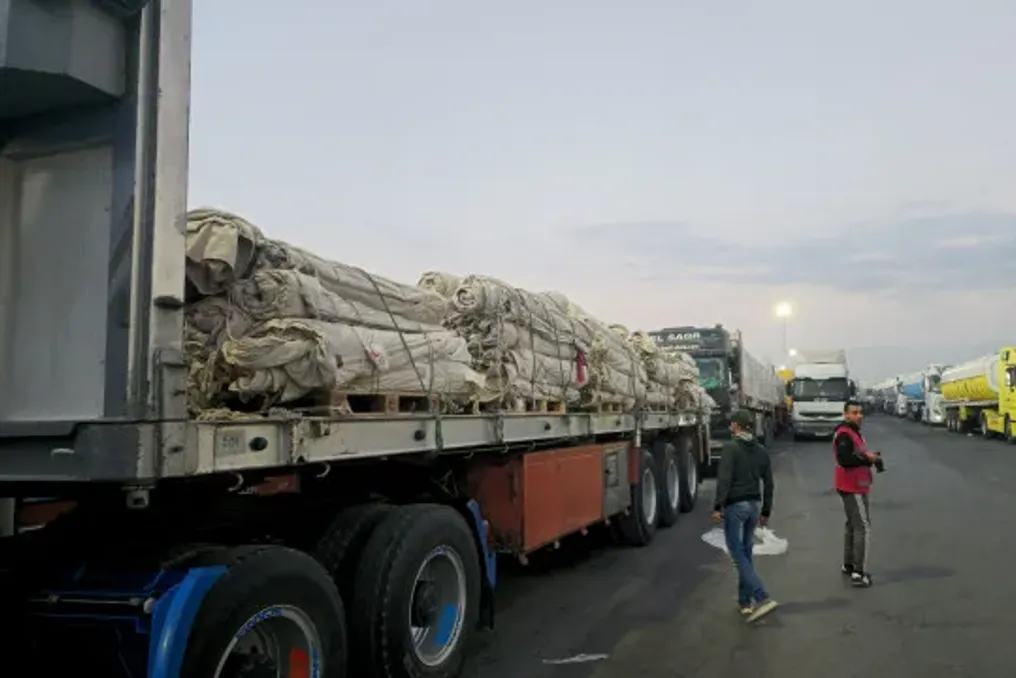
The Israeli government announced the gradual resumption of goods entry into the Gaza Strip, following a four-day suspension. This suspension occurred because Israel accused the Palestinian Islamic movement Hamas of extorting merchants.
The Coordination of Government Activities in the Territories (COGAT), the Israeli body responsible for activities in the occupied Palestinian territories, reported that Hamas had ceased its fiscal mechanisms and threats. This refers to the collection of 10,000 shekels, approximately 2,800 euros, demanded by the Palestinian Islamic movement for every truck entering the territory.
On the previous Thursday, when COGAT raised the accusation of extortion against Hamas, the Palestinian group justified the amount as part of a 'voluntary community initiative.' According to them, this initiative involved entrepreneurs contributing to a national fund entirely dedicated to supporting the most vulnerable groups, in addition to financing housing, sanitation, and humanitarian assistance projects.
Subsequently, after confirmation that Hamas stopped collecting this fee, merchants began resubmitting their requests to reestablish coordination with Israel regarding the entry of goods into Gaza.
COGAT assured that the resumption of coordination is aligned with Israel's commitment to the humanitarian guidelines established in the ceasefire agreement. Meanwhile, Palestinian media outlets, such as the Sanad agency, reported that trucks would begin entering Gaza as early as Tuesday.
However, COGAT remained cautious, emphasizing that the merchants' claims alone do not constitute definitive verification. For this reason, the body, which depends on the Israeli Ministry of Defense, stressed the 'gradual' nature of this reopening.
Furthermore, Israel warned that any merchant who had made payments to Hamas would have their operating permit under the Gaza Strip goods entry mechanism revoked.
This decision was announced on the same day that the World Food Programme (WFP) disclosed the need to reduce its humanitarian operations in the Gaza Strip due to resource scarcity, which would leave 500,000 Palestinians without monthly aid.
The organization also issued a statement urging the global community not to ignore the war-devastated enclave. Shaun Hughes, WFP director in the Palestinian territories, told the French news agency AFP that 'families... live in extremely difficult humanitarian conditions,' even after one year of ceasefire.
The Israeli offensive in the Palestinian enclave began after the attack by the Palestinian Islamic group Hamas on Israel, which occurred on October 7, 2023. Hughes informed that about 1.4 million people, out of a total population of 2.1 million, 'still face acute food insecurity and require humanitarian aid to survive,' speaking from the UN agency offices in Beit Hanina, a neighborhood in East Jerusalem.