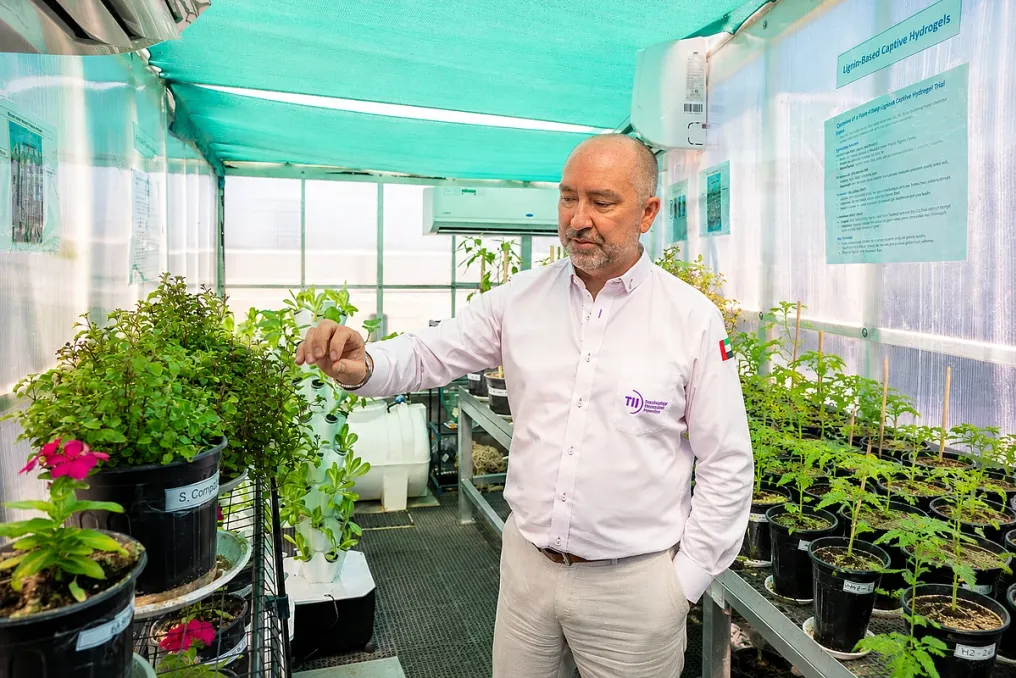
Researchers from the United Arab Emirates (UAE) have created a new soil additive—a gel made from plant waste—that helps agricultural crops grow with less water, which is particularly relevant for the harsh climate of the UAE.
Testing of this gel, named agrigel, was conducted at the Institute of Technological Innovation's (TII) greenhouse. In a comparison, plants treated with this material showed noticeably better growth compared to those grown without it. For instance, spinach grown using the gel was about twice as large as the control group, and corn was also twice as tall.
Although these observations are preliminary, the greenhouse trials showed an average reduction in water consumption of approximately 30 percent. Professor Phil Hart, lead researcher and head of TII's Center for Renewable and Sustainable Energy Research, noted the project's goal: 'More harvest, less water.'
The main objective is to increase food production in a country where agriculture is constrained by harsh climate and lack of suitable land, without increasing the burden on water and energy resources. Hart emphasized that using more water would necessitate a significantly greater amount of energy.
Agrigel is made from natural waste, including date palm waste and other plant residues. Researchers process this material, transform it into a porous substance, and mix it with other components before applying it to the soil. Hart described each particle of the material as 'its own small reservoir,' which quickly absorbs water and holds it near the roots, slowing down moisture release according to the plant's needs.
Furthermore, the material decomposes during the growing season, gradually releasing nutrients, which potentially reduces the need for farmers to apply separate fertilizers. It also differs from powdery traditional materials in that it remains in the soil, ensuring slow release of water and nutrients.
A similar material is also being developed to collect moisture from atmospheric humidity. Unlike the soil agrigel, this material has a form that facilitates the absorption of atmospheric moisture and retains it until needed. Hart compared this to 'moisture harvesting,' explaining that when humidity is sufficient, the material acts like a sponge. The water can then be extracted through heating or compression, representing a potential method for collecting small volumes of water from the air. However, Hart clarified that this is not a replacement for traditional water sources but a useful tool for situations with limited water.
The team is preparing for field trials to test the reproducibility of the results outside controlled greenhouse conditions. Trials are scheduled to begin next week at three farms: one in Al Ain, one north of Yas Island, and a third in Al Barsha. Two plots will be used for closed and open trials, and the third for full-scale outdoor testing.
Researchers tested the material on various crops, including lettuce, corn, sunflower, chili, and leaf lettuce. During a tour of the greenhouse, it was noted that sunflowers treated with the gel bloomed about two weeks earlier than those grown without it.
Commercialization of the technology is planned for 2027, provided the field trials are successfully completed. For the researchers, success is defined by the practical benefit the technology brings outside the laboratory.
As part of a separate project, TII researchers are using artificial intelligence to identify molecules capable of protecting solar panels from ultraviolet (UV) radiation. The concept is similar to sunscreen: the molecules are designed to absorb UV light before it degrades the panel materials and then re-emit this energy as visible light, which the solar cells can use to generate electricity.
Hart reported that testing showed that modern solar panels can degrade by up to 20 percent within the first two years of operation. Such a loss can have a significant impact when scaled up to a large solar farm. The goal is to develop molecules that block UV radiation while making some of that energy useful.
Traditionally, the process of developing molecules is long and labor-intensive. The use of AI has accelerated the early stages of this process. The team used AI to analyze about 40,000 combinations of elements and narrowed the pool of candidates down to 10 molecules that showed potential for absorbing UV light and converting energy into visible photons. The primary goal is panel protection, with additional electricity generation being a secondary benefit.