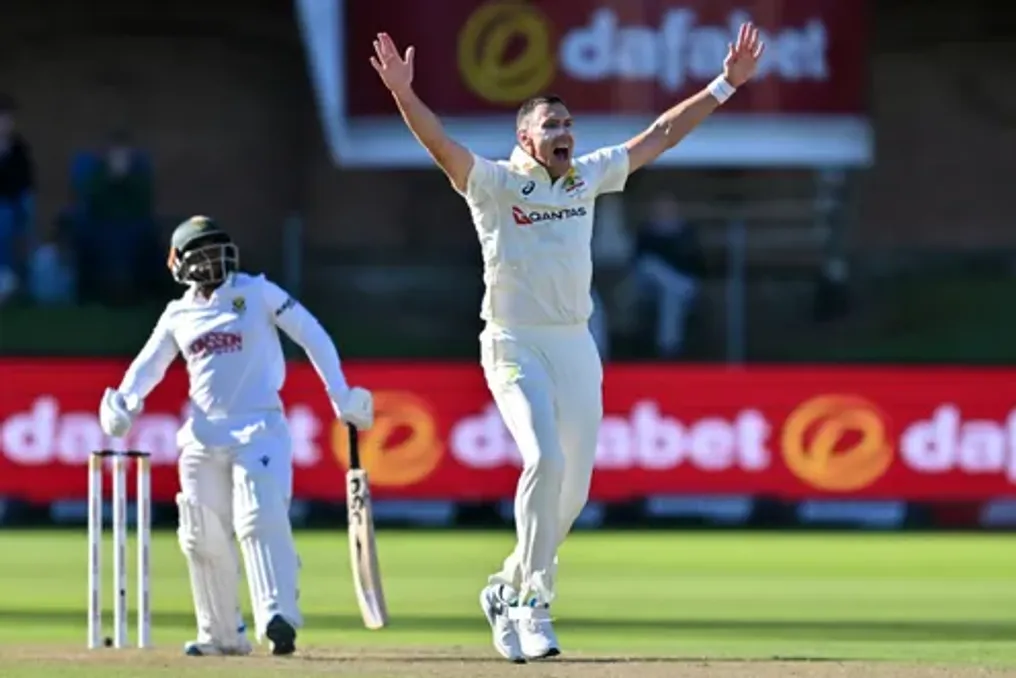
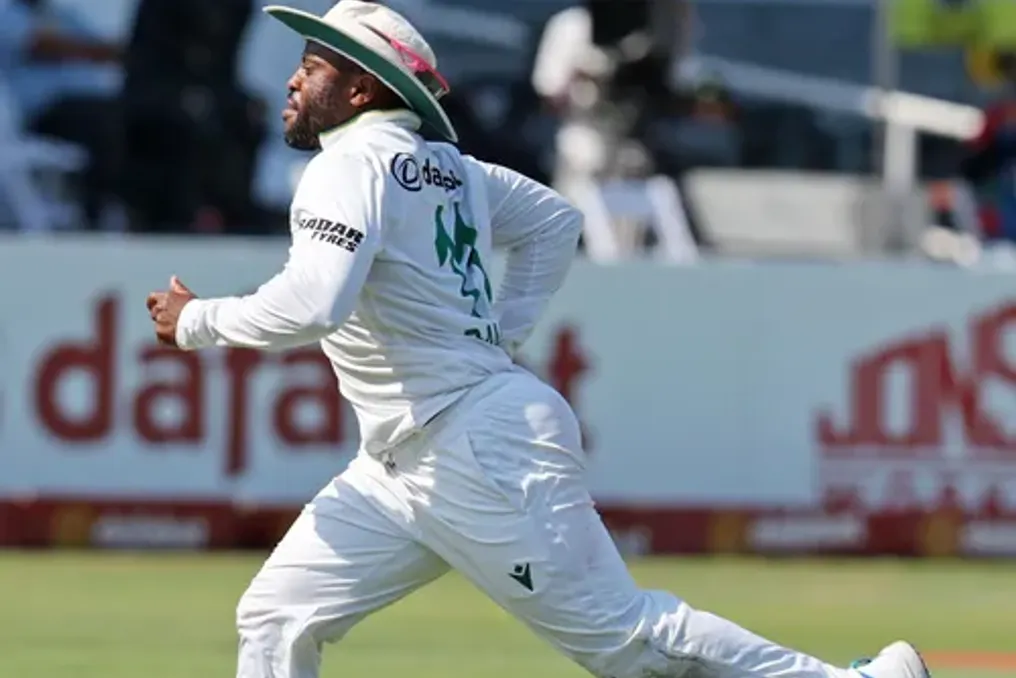
Temba Bavuma's resistance gives Proteas hope amid Scott Boland's onslaught
Read more
IOL
iol.co.za

Temba Bavuma's resistance gives Proteas hope amid Scott Boland's onslaught

Hope for the Proteas team in the conclusion of this match at St George's Park and for the entire series rests on the shoulders of their captain, Temba Bavuma. Despite Australia managing only 43 overs over two days of the second Test after two more sessions were lost due to bad weather and wet pitch, the home side faced a number of setbacks.

The world champions of Test matches found themselves trailing by four wickets with only 40 runs scored after the game finally started at 3:45 PM.

Scott Boland, a fast bowler with the best statistical average since World War II, demonstrated strong determination. Bowling from Park Drive End, Boland used the Kookaburra red ball, skillfully moving it off the edge in both directions.

The Victorian had already dismissed Test debutant Marcus Ackermann, adding to his previous catches of Aiden Markram and David Bedingham, and looked ready for further success.

Someone had to stop this onslaught, and that was done by Temba Bavuma and Ryan Rickelton, who came out as the sixth batsman for the first time since taking charge of the team from Kyle Verreyn.

They did not take risks; their play was tenacious, disciplined, and watchful, allowing every ball to pass by the bat. This sharply contrasted with Matthew Britzke's earlier play, who looked unprepared for red ball cricket when he tried to attack Mitchell Starc's wide delivery outside the crease.

Every run scored by Bavuma seemed earned from the depths of his soul. The Proteas captain, fully aware of the hopes resting on him, approached every delivery with immense caution and concentration. His discipline was unwavering; he masterfully left the ball outside the off stump and, when forced to play, did so softly and right under his eyes.

This forced Australia to change its plans and switch to a short-ball strategy, incorporating a light slip and deep square leg. However, Bavuma also stood firm in this situation, sending down his equivalent of Pat Cummins for six runs through fine leg.

However, the plan almost worked on the other end. Rickelton (31 off 51 balls, 5 fours) played just as cautiously alongside his captain, but Cummins forced the left-hander to hit a rising ball into the waiting hands of Marnus Labuschagne. Nevertheless, Labuschagne missed the chance, and Rickelton got a respite.

But just when it seemed the pair would safely see the team through the day, Boland was called again. Switching to Duck Pond End, he bowled another tempting ball that caught the outer edge of Rickelton and led to an impressive one-handed catch by Matthew Renshaw at first slip. The partnership of 52 runs, built over 109 balls, was broken, and the door for the South African middle order remained slightly ajar.

Vian Mulder managed to get through the last few overs with Bavuma, but Australia knows that the Proteas captain stands between them and the possibility of making a big step towards securing the series here in Gqeberha.
Similar stories

Temba Bavuma supports Proteas in the fight against Australia in Gqeberha
Read more
iol.co.za

Temba Bavuma supports Proteas in the fight against Australia in Gqeberha

In Gqeberha, at the St George's Park stadium, the Proteas team is preparing for a match where they trail Australia by 0-1 after a tough loss in the first Test in Durban. The team returns to the historic arena, hoping that the energy of the fans and tactical discipline will help them change the course of the series in their favor.

The local flavor in Gqeberha is palpable: the famous St George's Park brass band plays in the stands, and the local fan base, which has experience winning in SA20 with Sunrisers Eastern Cape, creates a strong culture of victory and support for the home team.

However, the weather may affect the start of the match. Forecasts include unpredictable coastal winds and possible rain delays, which, according to Temba Bavuma and Pat Cummins, will play a central role in determining the pace of sessions and squad selection strategy.

Despite ongoing questions regarding the exact composition of the batting line-up, the Proteas relies on its proven temperament in crucial matches. This team previously defeated India on home soil and also beat Australia in the WTC final at Lord's last year, demonstrating an ability to fight even when at a disadvantage.

A critical factor is the return of Rabada to lead the fast bowling attack, immediately bringing authority and power into the dressing room. Beyond individual skill, Bavuma's players understand that the key to initiating a counter-attack lies in restoring their psychological state and extending the duration of their batting innings.

Reflecting on the team's mentality, Bavuma explained how they plan to approach this task. He stated: 'We would like to put in much more effort, just be more ruthless in execution, and more importantly, when the opportunity arises, do something big for the team.' He added that the team uses positive moments in batting, drawing confidence from Aiden [Markram]'s game, but the main task is precisely to extend their playing intervals.

Squad selection may depend on morning weather conditions. Kagiso Rabada is fit and ready to return to lead the fast bowling attack. One option is to retain both spinners, Keshav Maharaj and Simon Harmer, or include an extra fast bowler or batsman. Matthew Britzke is ready to come out of the dugout, and Marcus Ackermann is also being considered as a candidate for his Test debut.

Bavuma emphasized that mental resilience will determine the team's reaction. He noted: 'Defending against these mental lapses is key. When you are playing against a team that is ahead, you have to match that fight... I think we have the luxury of choosing any path, and we trust that whatever path we take, we can assemble a very, very competitive eleven.'

Proteas Player Ratings: Markram Showed Outstanding Play, While Rickelton and Stubbs Failed to Meet Expectations
Read more
iol.co.za

Proteas Player Ratings: Markram Showed Outstanding Play, While Rickelton and Stubbs Failed to Meet Expectations

The start of the World Test Championship defense at the home ground in Kingsmead was not smooth sailing. The lack of ball striking, intended for red balls, was evident, especially among the batters who did not demonstrate the necessary concentration at the crease.

The Proteas squad in Durban was managed by Zachir Adams from IOL Sport. The following performances were noted among the players:

Ayden Markram received a rating of 8/10 and was recognized as an outstanding Proteas player. He demonstrated a combination of resilience and composure, which was clearly visible in the fourth innings battle that prolonged Australia's wait for victory. Furthermore, he performed excellently in the field.

Ryan Rickelton received a rating of 3. His performance in the match was disappointing. Two failures early in the order could jeopardize his spot in the next Test match in Gqeberha.

David Bedingham received 6.5 points and appeared to be one of the most technically prepared Proteas batters against the fast Australian attack. He showed sufficient persistence, hinting at the potential for a greater contribution, although he may have been disappointed that he could not convert his start into a larger score.

Temba Bavuma received a rating of 4. For the captain, this was a match to forget. His team needed a defining game from the leader, but he could not exert significant influence. His dismissal by Matt Renshaw became a turning point in the second innings, and he also allowed the game to develop in the field.

Tristan Stubbs received 3.5 points. It was a difficult Test match. It seemed he settled well in the first innings before losing a wicket, followed by another mishit in the second innings when his team needed much more. Perhaps he will not have another chance to play on his home ground next week.

Vian Mulder received 7.5 points and is considered one of South Africa's best players. He contributed key runs, especially in the first innings, and almost saved Proteas from defeat through his partnership with Markram.

Kyle Verreyn received 5 points. He is reliable behind the stumps but again failed to show himself with the bat in both innings. Loyalty to the Western Province wicketkeeper may be coming to an end.

Marco Jansen received 6 points. He could have prompted the Australian batters to play more aggressively with the new ball. He also had two starts with the bat that were not converted.

Keshav Maharaj received 5 points. For Maharaj, it was a disappointing outing on his home ground. He was clearly targeted by Steve Smith, after which Matt Renshaw dismissed him with a shot and a reverse sweep. In the first innings, he showed good determination with the bat.

Simon Harmer received 4 points. He was not as impactful as expected. He will likely lose his spot at St George’s Park to make way for Kagiso Rabada's return to the attack.

Anrich Nortje received 7.5 points. He played aggressively, forcefully, and with full commitment. He often bowled at high speed and was one of the few who could unsettle the Australian batters with sheer pace. It was a solid debut in the first Test match in three years.

Popular