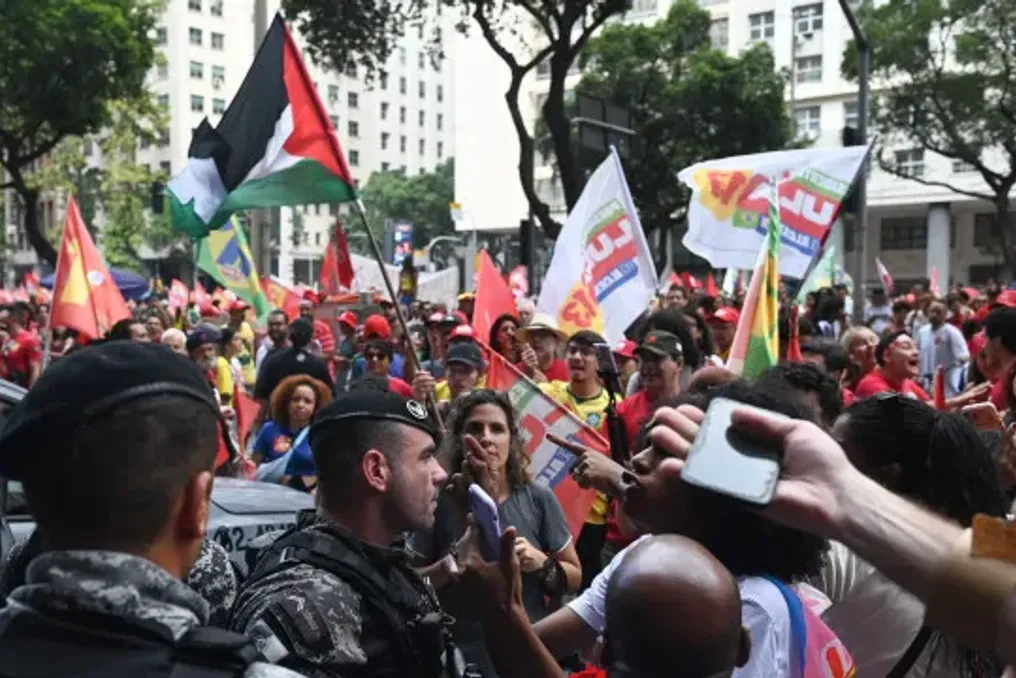
The president of the National Union of Students (UNE) indicated that Flávio Bolsonaro's victory in the first round of the Brazilian presidential elections motivated a new generation of students to actively take a stand, refusing to remain inert in the face of perceived risks to democracy.
The UNE, an institution founded in 1937, has a history of participation in crucial movements, including resistance to the military dictatorship (1964–1985), the campaign for direct presidential elections, known as 'Diretas Já' (1983–1984), and the 'caras-pintadas' movement (1992), which culminated in the demand for the impeachment of President Fernando Collor de Mello.
Bianca Borges, a UNE leader, emphasized that the young people who led these historical movements are of the same age group as the current university students entering higher education. For her, this memory imposes a responsibility on contemporary students, although she clarified that this does not imply equality between different historical contexts.
The leader stressed that the main lesson is not to make automatic comparisons between eras, but rather to understand that democracy in the country is not a permanent achievement and requires continuous popular resistance. Bianca Borges added that this generation is beginning to understand that history is built by decisions made in the present, and not just by what is read in books, reinforcing the need for students to defend democracy.
Among the issues worrying this generation, Bianca Borges cited university funding, student support, scientific and technological development, social and labor rights, as well as the role of democratic institutions themselves. Furthermore, there is apprehension regarding the elected Congress, as the youth recognize that there will be intense political dispute in the coming years, regardless of who wins the Presidency.
According to the leader, the students' reaction to the first round result began to structure itself in less than 24 hours, after the UNE instructed its grassroots entities to hold assemblies across the national territory. In a short time, plenaries were held, auditoriums filled up, and days later, demonstrations moved from university campuses to the streets.
This mobilization reflects that, for this generation, the core issue transcends merely the outcome of an election. Students are focused on a concrete future related to their lives: access to university, job opportunities, income, science, student assistance, labor rights, and the possibility of building a life project in a country that offers prospects.
In the first round, held on October 4th, Flávio Bolsonaro reached 47.03% of valid votes, surpassing Lula da Silva's 45.16%, with a difference of 2,224,965 votes. It is relevant to note that since the implementation of the two-round system in Brazilian presidential elections in 1989, no candidate who finished second in the first vote has managed to win the election.