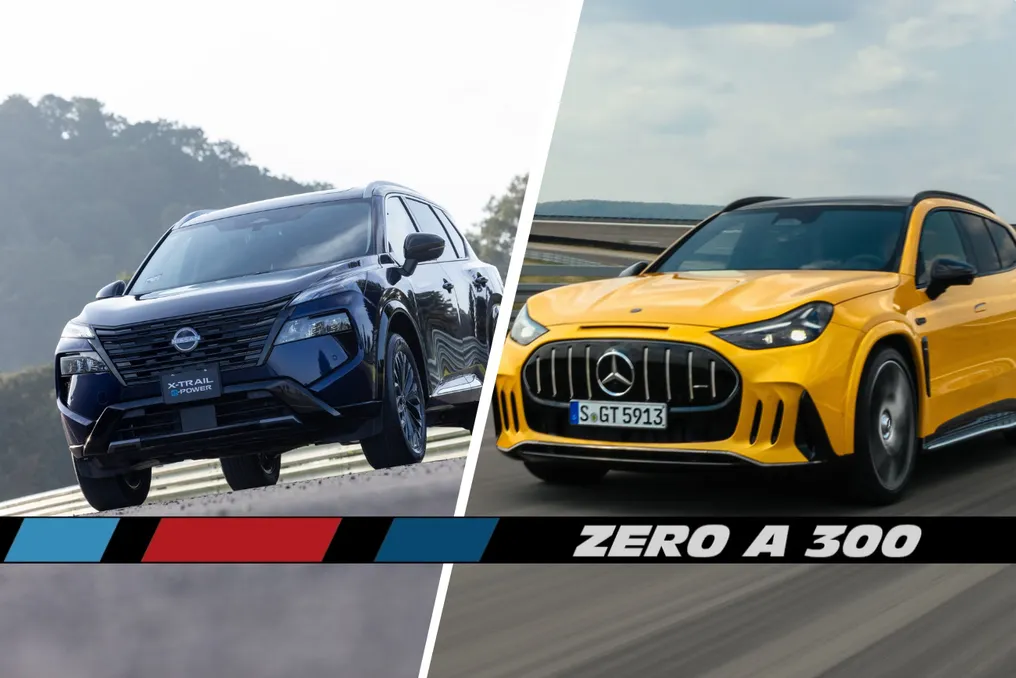
Nissan announced that the new hybrid X-Trail is scheduled to launch in Brazil in the second half of 2027. This utility vehicle aims to occupy a higher position than the Nissan Kicks and serve as a tool for the automaker to compete with growing Chinese competition.
Ricardo Gondo, President of Nissan in Brazil, confirmed that the X-Trail will be marketed with seven-passenger capacity, unlike the rest of Latin America where the model is offered only with five seats. It will arrive in the e-Power and e-4orce versions, configured with a hybrid system and four-wheel drive.
The powertrain consists of a 1.5-liter turbo engine producing 144 hp and 25.5 kgfm of torque, which functions solely as a generator to power two electric motors: one of 204 hp in the front and another of 136 hp in the rear. Together, these components generate a total of 216 hp and 33.7 kgfm of torque. The transmission is direct, with only one gear, and the performance is considered satisfactory, reaching 100 km/h in seven seconds, with a maximum speed limited to 180 km/h.
With dimensions of 4.69 meters in length, 1.84 m in width, and a wheelbase of 2.71 m, the Nissan X-Trail has a size similar to the Toyota RAV4 Hybrid, one of its main competitors. The trunk accommodates 485 liters when the third row is folded down, and with seven occupants, the cargo space is 120 liters.
To compete in this segment, the X-Trail will be equipped with expected features such as three-zone digital air conditioning, a 12.3-inch multimedia center, and a driver assistance package that includes adaptive cruise control, autonomous emergency braking, and lane departure warning.
Although the price has not yet been disclosed, an estimate based on competition suggests the value could range between R$ 300,000 and R$ 350,000. This compares to Chinese models like the Leapmotor C10, which starts around R$ 220,000, and the Toyota RAV4 Hybrid, which exceeds R$ 300,000, with the plug-in hybrid version nearing R$ 400,000.
Mercedes-AMG transforms its 1,169 hp electric GT into an SUV
Mercedes-AMG has transformed its new 1,169 hp electric Mercedes-AMG GT, a sedan featuring three axial flux motors, a large battery, and a weight of 2,460 kg, into an SUV—a decision that, according to the automaker, could generate good revenue.
This is the first large SUV fully developed by AMG. The GT 63 version essentially uses the same architecture as the four-door GT: three axial flux electric motors (two rear and one front) delivering 1,169 hp and 203.9 kgfm. Mercedes states that this model reaches 100 km/h in 2.7 seconds and achieves 270 km/h.
The weight challenge persists, but now on an SUV scale. The GT 63 can be equipped with a 106 kWh battery weighing 2,585 kg, or with the larger 128 kWh package, increasing the weight to 2,695 kg. In the longer-range configuration, it adds 235 kg to the weight of the previous electric GT.
The expanded battery promises a range between 620 and 700 km in the WLTP cycle and supports fast charging up to 710 kW in DC current. Mercedes claims this allows recovering up to 454 km of range in ten minutes or going from 10% to 80% in 12 minutes, depending on charger availability.
To deliver behavior worthy of an AMG despite the weight approaching 2,700 kg, the GT SUV incorporates pneumatic suspension with active hydraulic roll and longitudinal control, rear steering, and independent torque vectoring on both rear motors. Furthermore, it features active aerodynamics, including movable air intakes and an adjustable rear spoiler.
Similar to the four-door model, Mercedes included a mode that emulates the sound of an AMG V8 and simulates gear shifts, now incorporating seat vibrations. This raises questions about whether future electric performance will need to replicate what it replaced so faithfully.
Mercedes admits it underestimated V8 fans
Mercedes-Benz acknowledged that it may have neglected customer preference for the V8 engine when replacing the C63's V8 with a four-cylinder hybrid engine. Mercedes-Benz CEO Ola Källenius admitted that the brand underestimated the appreciation of the so-called 'good old V8 crowd' when implementing this change.
Subsequently, Stefan Weckbach, head of AMG, confirmed that the next CLE 63 will return to using a V8 in 2027, indicating that AMG learned from public reaction and opted to return to what customers appreciate.
This change comes after years of uncertainty on the topic. In 2023, Mercedes sources informed the German press that the idea of returning to the V8 in the C63 and E63 was 'pure nonsense,' and the brand later denied the return of the V8 to the C63.
The situation raised doubts, given that Mercedes planned to convince C63 V8 owners to spend amounts close to R$ 1,000,000 to migrate to a model with a 2.0 four-cylinder engine from the A45 AMG, equipped with technology considered tedious by Formula 1.
Honda Civic hybrid gains Prelude's S+ Shift transmission
Honda will implement the Prelude's S+ Shift transmission system in the hybrid Civic, aiming to make driving more engaging. This feature will only be available for the hatchback version.
In the standard Civic e-CVT system, the car operates mainly with the electric motor at low and medium speeds, while the Atkinson combustion engine serves only to generate electricity via a secondary generator motor. As speed increases, a hydraulic clutch connects the combustion engine directly to the wheels to optimize fuel economy. Because it lacks physical gears, acceleration is constant, which favors consumption but makes the driving experience less dynamic.
S+ Shift resolves this issue by incorporating eight virtual ratios controlled by butterflies behind the steering wheel—previously used only to adjust regenerative braking. By simulating a gear shift, the electronic management causes a momentary decrease in RPM and torque to replicate the impact of a real change. During downshifts, the system mimics the characteristic RPM jump of a downshift, aided by an artificial sound emitted by speakers, synchronizing the audio with the system's behavior.
The software also adapts these simulations in real time, analyzing pedal usage, cornering angle, and track inclination. Currently, this novelty is restricted to European hatchback models. In the Brazilian market, where the Civic is sold only as a sedan (excluding the Type R), Honda has not yet confirmed whether the car will receive the system, a prospect that becomes more remote with the arrival of the Prelude, given Honda's tendency to maintain clear distinctions between models in the country.
Royal Enfield launches its rarest (and most expensive) motorcycle in Brazil
Royal Enfield has consolidated its image as a manufacturer of motorcycles with good performance, sophisticated design, and accessible prices. In a strategic shift, the brand will launch in Brazil a special, limited, and exclusive series priced almost double the average of its motorcycles.
This is the Royal Enfield Classic 650 Hypershift 125th Anniversary Edition, whose name celebrates the 125 years of the original Royal Enfield, the British company that originated the current one, headquartered in India. Mechanically, this limited edition is identical to any Classic 650, equipped with a 47 hp, 5.33 kgfm twin-cylinder engine and a six-speed gearbox.
The exclusivity lies in the design, with the Hypershift finish—a brass base paint covered by a layer that changes color depending on light and viewing angle, varying between gold, red, and green tones. The motorcycle also features specific emblems and hand-painted fillets, in addition to a premium leather-upholstered seat and a black glossy engine. Wheels and exhaust are painted matte black.
Although it is a pleasant motorcycle to ride, this special edition is aimed at collectors. To acquire it, one must register on the brand's website by October 26th, the date of pre-order opening. Only 75 units will be made available in Brazil out of the 650 produced globally, for the price of R$ 49,990.