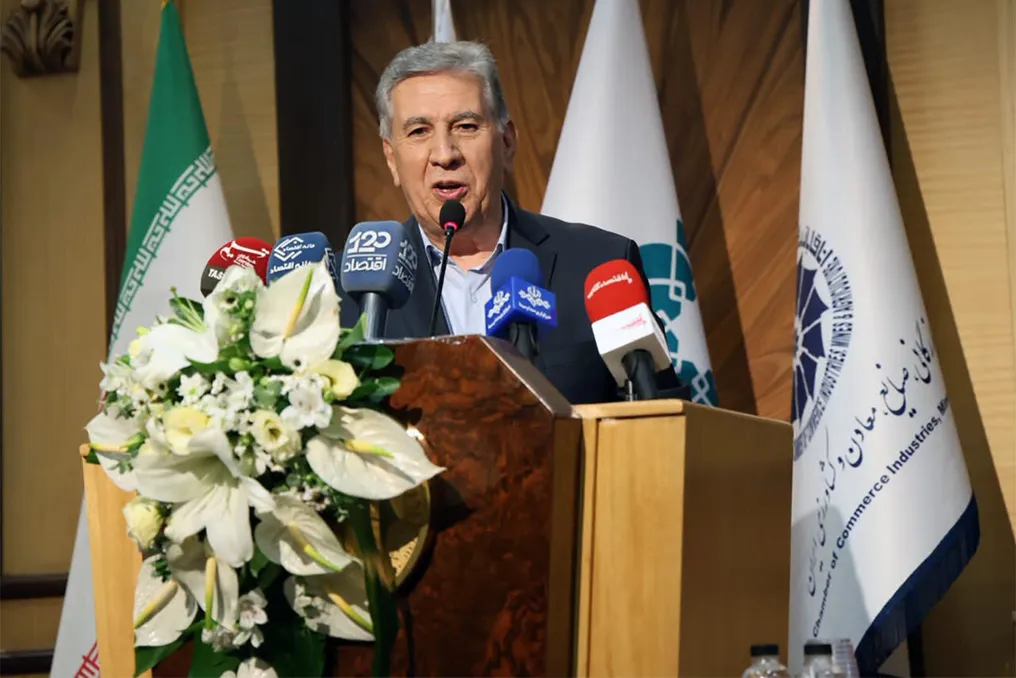
Samad Hassanzadeh, President of the Iranian Chamber of Commerce, stated on Tuesday at the Conference of National Export Associations, held at the Iranian Chamber of Commerce under the slogan 'Competent Exporter, Strong Association, Sustainable Export,' that foreign trade cannot be viewed solely through the lens of import and export statistics, trade balance, or currency inflows.
He emphasized that international trade is directly linked to domestic production, employment, investments, economic security, access to technology, and the country's position in regional and global division of labor. Consequently, any disruption to trade links negatively affects the state's productive and economic capabilities.
Hassanzadeh highlighted the necessity of diversifying transport routes, noting that the primary task for ensuring uninterrupted trade turnover is reducing dependence of foreign trade on a limited number of routes. He proposed developing alternative paths based on an assessment of the capacity of northern ports, railways, land borders, and regional corridors so that a failure on one route does not lead to a halt in exports and raw material supplies.
The Chamber of Commerce President presented a proposal to form a Target Group for Foreign Trade Continuity. In his opinion, such an operational group should be established as soon as possible with the participation of the government, the Chamber of Commerce, Customs, the Central Bank, the Port Organization, and export associations to develop export programs that exclude any interruptions in existing minimum volumes.
He also insisted on simplifying customs and border procedures, warning that increased time and costs for transportation, as well as lengthy customs formalities and unnecessary border stops, inflict double damage on trade. Therefore, he recommended prioritizing, among executive reforms, the expansion of electronic document exchange, coordination of working hours at borders, pre-processing of goods before arrival, and reduction of repeated inspections.
Hassanzadeh deemed it critically important to ensure working capital for exporters, which is necessary for the sustainability of the country's export programs. He added that to prevent production stoppages, job losses, and market losses due to external disruptions, mechanisms for lending, acceleration of claim settlement, and financing corresponding to the real export cycle must be developed. The Central Bank and commercial banks must take measures to provide this working capital to exporters.
He also stressed the need for flexibility in fulfilling currency obligations, arguing that insistence on repatriating export revenues while ignoring operational aspects, differences in market conditions, and actual restrictions on financial transfers is untenable. Effective trade policy, in his view, must link macroeconomic goals with the operational reality of businesses, providing the ability to manage risks and make informed decisions, instead of constantly transferring uncertainty to economic actors.
Samad Hassanzadeh considered codified insurance support for exports and trade risk management necessary. He noted that increased risk on transport routes can increase insurance costs and complicate the fulfillment of export contracts. In this regard, it was proposed to consider developing insurance coverage, credit guarantees, and risk management tools suitable for the new trade conditions, with the participation of insurance companies, financial institutions, and economic associations.
Another necessity for protecting foreign trade flows, according to him, is the diversification of export markets. He cited the example that Iran's largest trading partner was previously Iraq, but currently, following Western countries' policies regarding Iraq's economic programs, Iran's exports to this country are projected to reach a minimum next year. This is because, due to rising export costs and Iranian prices and rates, they are no longer acceptable to the Iraqi market, as India, China, and Turkey supply goods to Iraq with zero tariffs and six- and one-year letters of credit, making the purchase of Iranian goods impossible and not justifying the volume of Iranian exports to Iraq.
The Chamber of Commerce President named the development of economic diplomacy programs a key point, adding that the continuity of foreign trade depends not only on internal capabilities but also on cooperation with neighboring countries and trading partners. Therefore, economic diplomacy must focus on facilitating transit, coordinating customs procedures, developing transport agreements, maintaining legal access to international markets, and reducing trade restrictions through diplomatic channels.
Hassanzadeh noted that the Chamber of Commerce and its Export Development Commission can serve as a permanent link between exporters and decision-making bodies. He expressed confidence that the provincial chambers, commissions, and economic associations of the Chamber of Commerce should present all necessary proposals and measures to officials that contribute to improving the country's economic situation, using a scientific and expert approach.
The Chamber of Commerce President emphasized that systematic collection of problems, presentation of expert solutions, publication of periodic reports, and monitoring the implementation of requirements will help transform business experience into effective solutions and enhance the resilience of foreign trade.
He also viewed the revision of the approach to the private sector as one condition for improving Iran's economy. However, he clarified that the private sector cannot replace sovereign responsibilities nor can it independently bear the burden of all the country's economic problems. The government cannot develop and implement effective economic policy without the active participation of producers, exporters, investors, and specialized associations, so officials must eliminate ambiguities.
Listing the duties of the state and the private sector, the Chamber of Commerce President stated that the main task is to create clear and constructive relations between the state and the responsibility of economic entities. The state must focus on macroeconomics, transparent regulation, provision of public infrastructure, legal stability, and guaranteeing fair competition, while the private sector, within the law, must be responsible for investment, productivity improvement, market development, innovation, job creation, and enhancing the competitiveness of its firms.
Addressing the complex economic situation in the country, Hassanzadeh expressed the conviction that when Iran and the nation are mentioned, everyone bears a great responsibility and duty. He noted that all officials in the country are making maximum efforts to solve problems, and planning is always done well, but the hostile opponent constantly takes actions to neutralize the country's plans.
The Chamber of Commerce President concluded that now is the time for everyone to support the Iranian nation and cooperate with the government's policy. The most conscious recommendation of the Chamber of Commerce in the current conditions is to strive to maintain the functioning of economic enterprises, preserve jobs for Iranian households, and help people so that problems are resolved with the dignity and generosity of the Iranian nation and the authorities of the Islamic Republic of Iran.
The head of the Iranian Trade Promotion Organization emphasized the need to increase the volume and added value of the country's non-resource exports. He stated that to achieve the real potential of the Iranian economy in the export sector, with the support of private sector initiatives, a fundamental transformation in the environment of trade laws and regulations must be created with the participation of responsible institutions and the private sector.
Mohammad Ali Dehghan Dehnavi, at the conference at the Iranian Chamber of Commerce, commenting on the impact of sanctions, transport restrictions, and complex foreign trade conditions on exporter activities, noted that some export problems are outside the jurisdiction of internal bodies, but in the area of legal, regulatory, and administrative obstacles, the responsibility for solving problems lies with internal bodies, and more effective measures must be taken in this direction.
He added that compared to last summer, additional opportunities have been provided to economic entities in some regulatory areas, including the possibility of agreement between the exporter and importer and the possibility of direct deals, at least for second-group goods, as well as openings in customs and trade agreements.
Dehghan Dehnavi continued that reports are coming from economic entities stating that due to pressure and existing restrictions, they have ceased export activities or faced legal and judicial problems. Such conditions demonstrate that the country's regulatory environment needs transformation and review in various dimensions.
Emphasizing that reforming the regulatory environment is impossible by the actions of a single body, he stated that this transformation must occur through the cooperation of legislators, policymakers, regulatory bodies, and the private sector, while economic associations and participants in trade, export, import, and production must also play an active and demanding role in this process.
He added that some obstacles that economic entities face today in the form of normative acts can be eliminated more easily and cheaply with the participation of associations and the development of voluntary mechanisms.
Dehghan Dehnavi announced the Trade Promotion Organization's readiness to support proposals from economic associations. He welcomed any initiative that can help in export development, including the creation of export consortiums, opening trade centers in target countries, dispatching trade delegations, inviting foreign trade delegations, and proposing solutions to facilitate the fulfillment of foreign currency export obligations.
He considered creating special pathways for exporters and proposing practical measures to facilitate trade between regions participating in associations, emphasizing that the Trade Promotion Organization is ready to utilize the potential of associations where cooperation is possible and provide a basis for a greater role of the private sector.
Dehghan Dehnavi, mentioning the designation of Mehr 29 (October 21) as National Export Day, noted that the goal of holding Export Week is to discuss various issues in this field and recognize the contribution of exporters, economic associations, and organizations actively involved in the country's export development.
Expressing gratitude to exporters as pioneers in the field of exports and the Iranian Chamber of Commerce, as well as other guild, industrial, and commercial associations, he added that many meetings have been held over the past two years with associations, federations, commissions, and various organizations to discuss export issues, programs, and development solutions in this sector; however, there is still much to do to improve the country's export conditions.
The head of the Iranian Trade Promotion Organization, commenting on the country's non-resource export figures, reported that in the Iranian calendar year 1403 (March 2024 – March 2025), the country's non-resource exports reached $58 billion, which is one of the highest figures.