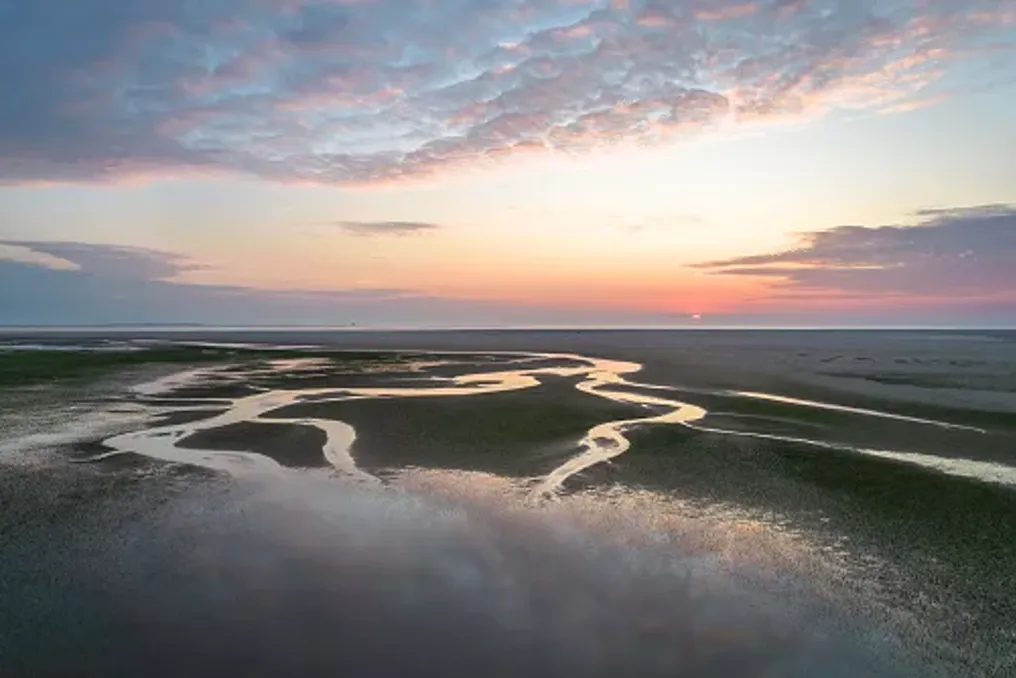
Along the coast of the North Sea in the Netherlands, Germany, and Denmark, an amazing transformation occurs twice a day. The water recedes from the shoreline, exposing vast areas of sand and mud where birds feed, seals rest, and hidden marine life appears.
This is the Wadden Sea, one of Europe's most outstanding natural landscapes and the world's largest continuous system of tidal sand and mudflats. The landscape constantly transforms depending on the rise and fall of the tides.
During high tide, seawater fills the channels and covers most of the mudflats. At low tide, the water retreats, revealing a labyrinth of sandbanks, tidal channels, and muddy plains. These changes are caused by the gravitational pull of the Moon and Sun, which causes tides, as well as the influence of local winds and weather conditions.
As a result, a landscape is formed that rarely remains unchanged. Areas that may appear to be open sea turn into wide expanses of exposed seabed, only to disappear again under the returning water a few hours later.
Beneath the surface lies a rich source of food. Worms, mollusks, snails, and other small creatures thrive in the bottom sediments, supporting a complex food web. When the tide recedes, migratory birds gather to feed on these accessible resources. Sandpipers, dunlins, and other waterfowl probe the mud with their beaks, while larger flocks rest and feed before continuing long journeys between breeding and wintering grounds.
The Wadden Sea serves as a vital stopover point on major migration routes connecting Northern Europe, the Arctic, and Africa. According to UNESCO, an average of 10–12 million birds pass through this vast World Heritage area annually.
Furthermore, harbor seals and grey seals inhabit the Wadden Sea, using its sandbanks for resting and giving birth. At low tide, seals can often be seen lying on the exposed flats, conserving energy between feedings. When the water returns, they dive into the sea to hunt fish and other prey.
The survival of these animals depends on healthy coastal habitats, abundant food, and undisturbed resting places.