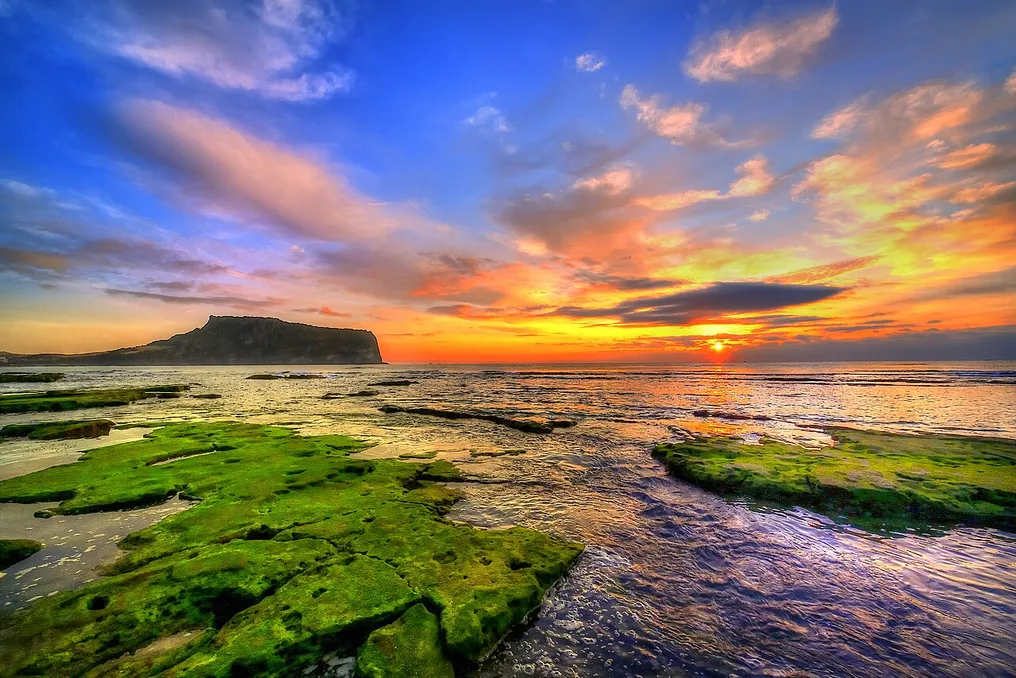
Jeju is recognized as one of Asia's most famous tourist destinations and is one of the most visited places by South Korean residents to enjoy beaches and vacations. Due to its predominantly subtropical climate, this territory, located in the Korea Strait, also attracts many tourists from Japan and Taiwan, especially during the summer months, between July and August.
The lava tunnels of this volcanic island were classified as a UNESCO World Heritage Site in 2007. In addition to beautiful volcanic landscapes and paradise beaches, Jeju offers historical temples and a rich local culture.
Notable Volcanic Landscapes
Volcanic landscapes constitute one of the highlights of the island. Among them, Mount Hallasan, known as Halla, stands out, as it is the highest point in South Korea, reaching an altitude of 1,950 meters. This volcano, which is no longer active, has a crystal-clear lake at its summit. The experience of visiting Hallasan is valued both for the superior view and the hike, which consists of a long and steep trail to the top.
Another important volcano is located on Seongsan Ilchulbong Peak, situated on the eastern tip of the island. It is possible to hike in this area, taking between 30 and 50 minutes to cover its 182 meters, providing a panoramic view of the ocean and an impressive sunrise.
For those who wish to explore the famous lava tunnels, the Manjanggul Cave is unmissable. This system of lava tunnels, one of the largest in the world, spans 13 kilometers, although only one section is open to visitors.
For beach enthusiasts, the island also meets expectations, featuring white sand beaches and clear waters, such as Hyeopjae, Hamdeok, Geumneuung, and Sehwa. The region is also rich in waterfalls. Jeongbang Waterfall, located in Seogwipo, south of Jeju, is unique in Asia for having its waterfall flow directly into the sea. It is worth mentioning that the city of Seogwipo gained worldwide notoriety for hosting four matches of the 2002 World Cup, including the Brazil 4x0 China group stage game.
Cultural Attractions and Tours
The Olle Trails offer the possibility of integrating all these landscapes into a single itinerary. It is a network composed of 21 interconnected routes that circle the entire island, totaling 436 kilometers and passing through farms, rock formations, and beaches.
The Haenyeo, nicknamed Jeju Mermaids, are a cultural pillar of the island. They are women who practice diving fishing without using oxygen tanks. These divers reach depths of up to 20 meters to collect seaweed, shellfish, and abalone. This tradition was recognized by UNESCO as Intangible Cultural Heritage of Humanity and symbolizes the island's autonomy. More information can be obtained by visiting the Haenyeo Museum of Jeju.
When traveling around the island, one is likely to encounter the Dol-Harbang, known as 'Grandfather Statues'. These sculptures made of volcanic stone are distributed throughout the island and, for the locals, they represent spiritual guardians that bring protection and fertility.
Jeju's typical cuisine also deserves mention, including black pork barbecue, porridge made with abalone caught by the Haenyeo, and the famous Hallabong tangerines.
Jeju's Buddhist temples are also worth visiting, as they combine spirituality with coastal and volcanic landscapes, with many located by the sea. Yakcheonsa Temple, located in Seogwipo, is one of the largest in Asia, featuring a three-story wooden Buddha statue in its main hall.
Furthermore, Jeju is known for its themed museums, such as Jeju Loveland, a theme park that displays about 140 erotic sculptures. Other unusual places include the Teddy Bear Museum and the Gimnyeong Labyrinth Park.