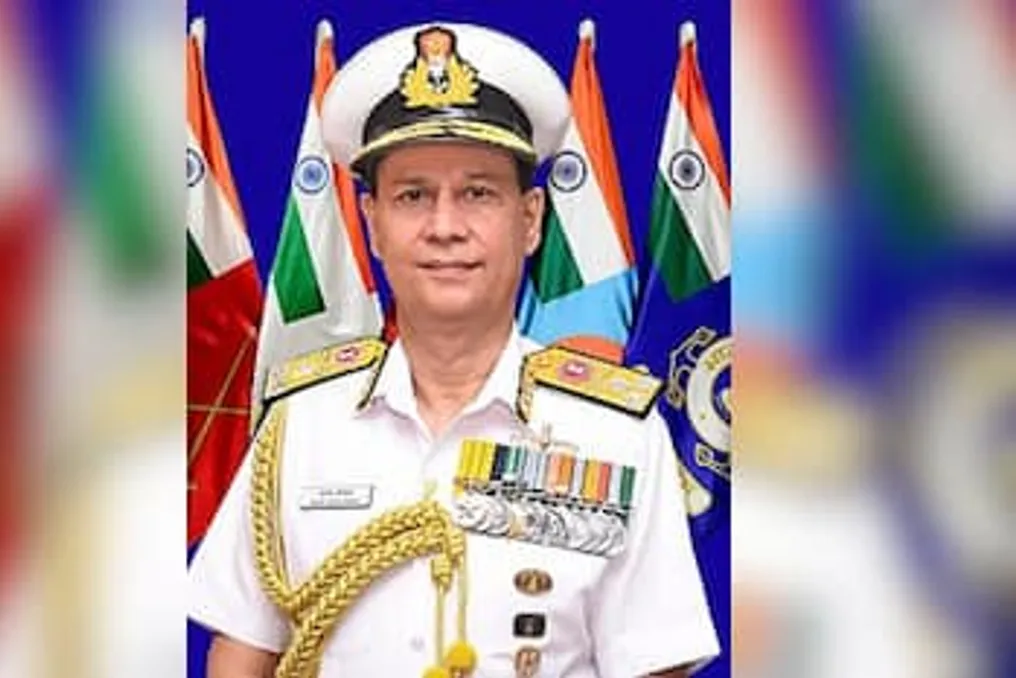
The Vice Chief of Naval Staff (VCNS) reported that forty-two naval assets have been ordered, along with seventy-eight more platforms and one hundred twenty fast interceptors, totaling approximately 2.41 trillion rupees, which have received official recognition of need (AoN).
Vice Admiral Ajay Kochhar stated on Monday that the program for procuring Landing Platform Docks (LPDs)—warships designed for transporting and deploying troops, vehicles, and equipment—is also progressing, and qualified shipyards have recently been invited to submit competitive bids.
Vice Admiral Kochhar addressed a press conference in New Delhi to present information about the Swavlamban 2026 event—the Navy's flagship seminar on innovation and import substitution, scheduled to take place in the capital on October 26 and 27.
Strategy for Development and New Technologies
He emphasized that the Navy is engaged in developments across all domains: air, sea, underwater, cyber, space, asymmetric, and new technologies. Consequently, the Navy employs a platform and capability-oriented approach and has developed a Plan for Future Naval Capabilities. The Navy is also considering new technologies such as artificial intelligence, cognitive and deception systems, as well as niche areas including advanced propulsion systems, Intelligence, Surveillance, and Reconnaissance (ISR) technologies, drones and anti-drone systems, and quantum technologies, especially for secure encrypted communication.
Kochhar noted: "All this must also be integrated and incorporated into our platforms and into our fleet so that we become a multi-dimensional, networked force capable of operating across multiple domains."
He explained that the procurement process for naval platforms that have received AoN is at various stages and actively developing. AoN signifies the official confirmation by the armed forces of the need for specific equipment or capabilities and is the initial step in the procurement process.
Progress in Procurement Programs
Responding to media queries, Vice Admiral Kochhar reported that they have already initiated programs under the 'Make' category (Defence Procurement Procedure) for the development of a domestic diesel engine. Furthermore, AoN has been granted for a 24–28 MW marine gas turbine, including gas turbine generators, under the same scheme. Several memorandums of understanding have been signed for the implementation of electric drive, and these have also received government approvals. Regarding LPDs, he happily announced that a Request for Proposal (RFP) was issued last week for four LPDs among selected shipyards. Similarly, an RFP for a next-generation frigate was released a couple of weeks ago, and responses are awaited.
Integrated Full Electric Propulsion (IFEP) technology will be developed under an intergovernmental agreement with the United Kingdom. In such systems, the ship's marine gas turbines, diesel generators, or both sources generate electricity instead of directly driving the propellers. This energy simultaneously powers the propulsion motors, lighting, computers, life support systems, sensors, and weapon systems. The IFEP system is intended for the four amphibious LPDs that the Navy plans to acquire.
Swavlamban Seminar
At the Swavlamban seminar, Vice Admiral Kochhar stated: "As the Indian Navy prepares for its fifth edition, our overall goal remains unchanged: to bring India's technological talent closer to the operational needs of the fleet and transform domestic innovations into practical capabilities at sea."
He mentioned that Swavlamban grew from approximately 800 participants at its first edition to nearly 3000 last year, which, according to him, reflects the expanding participation of the country's defense ecosystem.
Additionally, over 4000 proposals were received from Indian innovators through the Innovation for Defence Excellence (iDEX) framework, involving about 150 MSMEs and startups. "AoN has been provided for projects worth over 3500 crore rupees, and contracts worth over 1900 crore rupees have been awarded."
The significance of Swavlamban lies not only in its scale but also in the increasing complexity of the challenges it addresses. These challenges range from quantum positioning systems and high-power directed energy systems to super large autonomous underwater vehicles and indigenous rocket engines for fixed-wing aircraft.
Vice Admiral Kochhar added: "The growing use of unmanned systems, artificial intelligence, advanced sensors, and network capabilities is changing how naval forces gather information, make decisions, and operate at sea. For the Indian Navy, keeping pace with these changes is not just about adopting new technologies; it is about ensuring that we can develop, integrate, and apply the necessary capabilities to meet our operational requirements—and all this at significant speed."