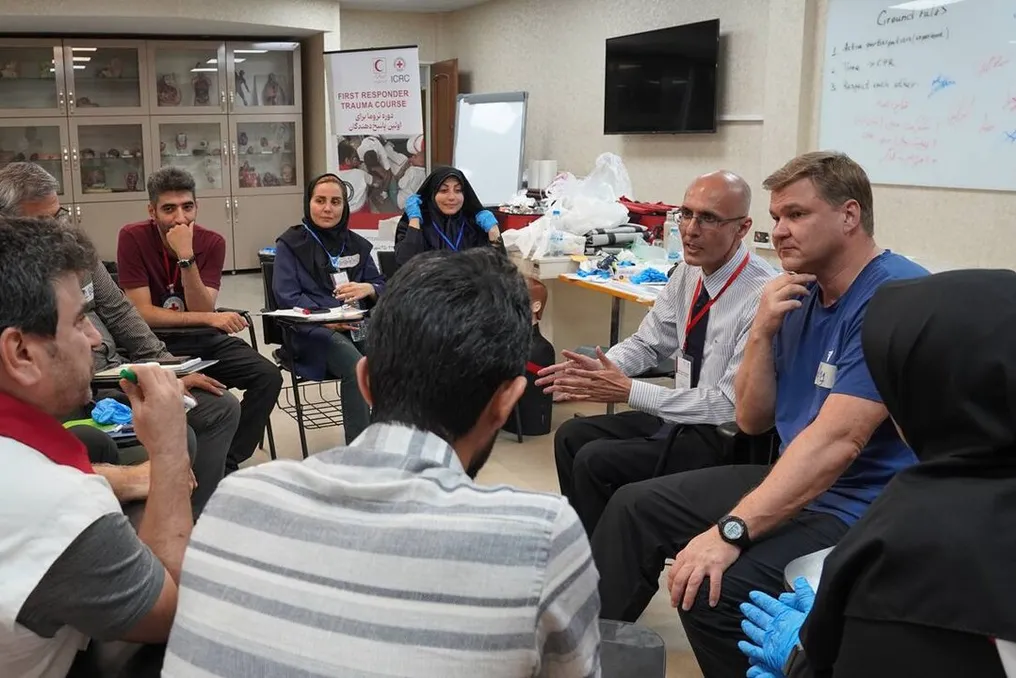
The Iranian Red Crescent Society (IRCS), in collaboration with the International Committee of the Red Cross (ICRC), conducted a three-day training seminar titled 'Trauma for First Responders' for selected IRCS staff. The training primarily focused on trauma management and pre-hospital care.
According to an ICRC website press release dated September 26, the goal of this training is to enhance the capabilities of IRCS personnel in emergency response and pre-hospital care, particularly during mass casualty incidents. This is necessary to ensure timely and effective life-saving services, as well as the safe evacuation and transportation of injured and sick individuals.
The recent escalation of hostilities has created significant operational challenges for the IRCS Relief and Rescue Organization, which is a key participant in emergency response. Teams from this organization are often the first on the scene of multiple casualty incidents, and in high-risk areas, they are responsible for victim evacuation, patient stabilization, and emergency transport. This underscores the importance of strengthening technical readiness through specialized training in mass casualty management.
Eight IRCS employees from the training, assistance, and rescue departments, as well as emergency health departments from Tehran and Alborz provinces, participated in the training. During the opening ceremony, Dr. Rajaei, Deputy Secretary General of IRCS for Education, Research, and Technology, noted that the course aims to raise the knowledge and skills level of the personnel, bring education closer to international standards, and form a specialized team for pre-hospital trauma.
Navid Dadbin, Health Program Manager at ICRC, explained that the planning for the course began last year after the start of the initial hostilities. He added that the implementation will take place across three three-day courses, after which a list of participants will be selected to train as instructors, and a further development plan will be drawn up at the end.
The program includes theoretical and practical sessions, group work, scenario-based exercises covering various types of incidents, and simulation drills.
This seminar is part of broader capacity-building cooperation between ICRC and IRCS aimed at strengthening the capabilities of IRCS operational staff.
In August, IRCS and ICRC organized a Training of Trainers (TOT) seminar on 'Providing Psychosocial Support for Specialized Iranian Red Crescent Teams.' This three-day seminar, held from August 24 to 26 in Tehran, was designed to strengthen the mental health and psychosocial support for IRCS staff involved in emergency response.
It was a response to the psychological pressure faced by rescue and aid workers operating in conflict, crisis, and other stressful situations, as reported by the ICRC press service on August 26. Approximately 20 IRCS psychologists from across the country participated in the training. The seminar combined theoretical study, practical exercises, and discussions on the well-being and resilience of responders, mutual support, identification of psychological distress, referral pathways, supportive interventions, and self-help.
Roman Paramanov, Deputy Head of the ICRC Delegation in Iran, stated at the seminar's opening that this initiative follows four previous seminars held last year, which trained about 160 IRCS staff involved in first aid.
The seminar utilized a two-phase cascade training model to disseminate psychosocial support throughout the IRCS Relief and Rescue Organization. In the first phase, participants from the provinces underwent this three-day Training of Trainers (ToT), strengthening their skills in responder well-being, self-help, mutual support, identifying psychological distress, and referral. In the second phase, the trained psychologists work in pairs to conduct activities, holding workshops on mental self-care and psychosocial support for base managers and rescue operational staff. Through this cascading approach, the program aims to reach approximately 600 IRCS staff members, with continuous supervision, online monitoring, and technical support helping to ensure consistent application and sustainability of the program.