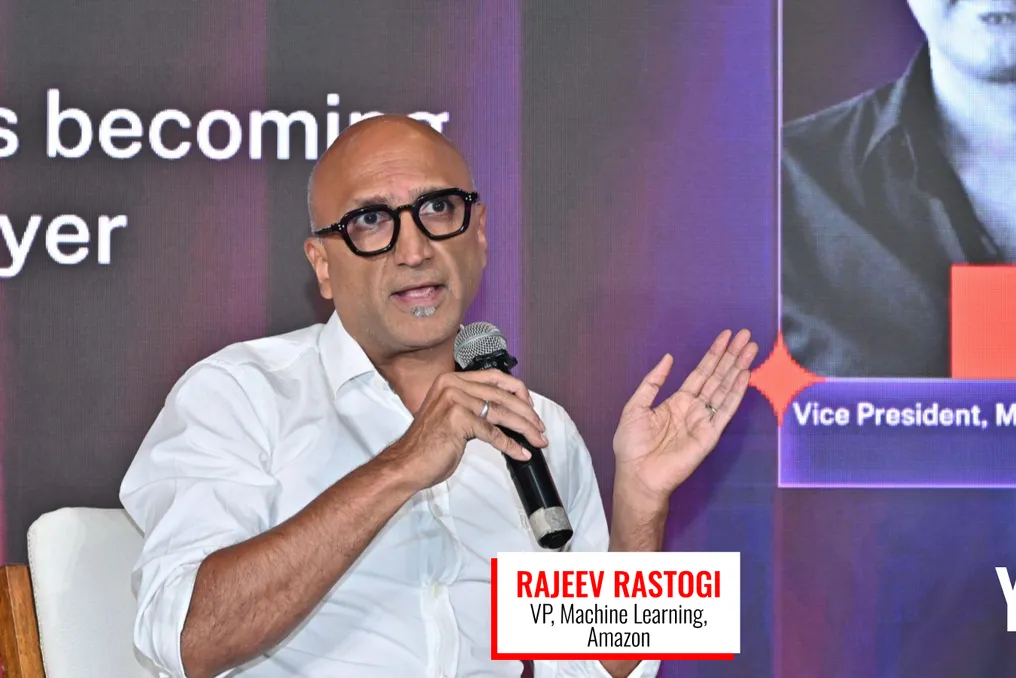
Rajiv Rastogi, Vice President of Machine Learning at Amazon, stated that there is a profound transformation in business technologies, noting that the entire operational layer is becoming agentic.
This signifies a shift from static software to autonomous systems capable of interpreting instructions in natural language. Unlike traditional software, which follows rigid, predefined scripts, agentic systems possess dynamic execution paths.
During a discussion at the TechSparks event, Rastogi explained that agents independently develop plans to solve tasks and activate relevant tools. Instead of constant human intervention, these autonomous agents analyze requests, formulate sequences of actions, and use specialized digital tools to complete complex processes from start to finish.
Within Amazon, this operational layer is used in systems like Rufus, a shopping assistant that can parse customer requests, apply price filters, call search engines, and guide users through product comparison and checkout. Similarly, autonomous seller assistants help fill out product listings, manage inventory, and advise small businesses on international export compliance.
Despite the market's huge enthusiasm for Generative AI (Gen AI), Rastogi emphasized that generative models are not a universal solution for all computational problems. Generative AI excels in complex argumentation, text summarization, review analysis, and creative tasks, such as editing product image backgrounds. However, it struggles in applications requiring high throughput and low latency.
Rastogi noted that for certain tasks, the performance of traditional machine learning models can never compare to that of generative models. Classic algorithms, such as gradient boosting decision trees or standard neural networks, process structured numerical data with exceptional speed.
For large-scale operational needs, such as product search in e-commerce, where tens or hundreds of billions of items must be processed, generative models face prohibitive computational costs and slow response times. Therefore, high-performance architectures utilize agent-type orchestrators to understand human intent while relying on basic search engines for lightning-fast data retrieval.
When generative capabilities are truly required, enterprises do not necessarily have to rely solely on massive foundational systems. Frontier models, representing the largest and most resource-intensive AI architectures, carry significant operational expenses. Rastogi proposed a more economical alternative, stating that 'fine-tuning some open base models... can give you models that perform much better than some of those big models... at one-fifth or one-tenth the cost.'
Fine-tuning involves taking a smaller, publicly available open model, such as Qwen, and training it on specific proprietary application data. By adopting open fine-tuned models, companies can achieve equal or superior accuracy for specialized classification or forecasting tasks compared to giant closed models like Claude or ChatGPT, while significantly reducing their computational overhead.
For tech entrepreneurs and enterprise architects, the most promising opportunities lie in automating vertical workflows, rather than attempting to build foundational models. Developing new frontier models requires unsustainable financial capital and computational infrastructure. Instead, Rastogi advises: 'building on top of frontier models, using agentic AI to automate workflows in domains... is definitely promising.'
Drawing inspiration from coding tools like Cursor, great potential exists in specialized fields, including law, finance, healthcare, agriculture, and human resources. A particularly valuable untapped area is the automation of standard operating procedures—natural language documents detailing step-by-step instructions for employees to solve complex operational problems.
An agentic automation platform is capable of refining poorly written instructions using internal knowledge bases, breaking down long procedures into manageable subtasks, and delegating them to networks of specialized sub-agents that automatically browse internal tools, extract data from documents, analyze images, and solve problems.
Looking ahead, the fundamental structure of AI models needs to evolve to maintain sustainability. Current frontier models face serious physical and financial limitations. Rastogi noted: 'Frontier models today are enormous, computationally very expensive, consume a lot of energy and resources... and I don't think that is sustainable.'
Furthermore, today's monolithic models function primarily as mechanisms for statistical prediction of the next token, guessing the most probable next word in a sequence, without genuine understanding of the laws of physics, three-dimensional geometry, or causality. In Rastogi's view, to overcome these boundaries, the future landscape will transition to networks of small, domain-specific models managed by central routing orchestrators. Instead of storing vast amounts of world knowledge in the parameters of a giant model, future AI architectures will separate core reasoning capabilities from data storage, relying on external high-speed search engines for information retrieval. Ultimately, the industry will advance toward true world models possessing an intrinsic understanding of physical spaces and environmental behavior, creating a practical and economically viable foundation for corporate automation.