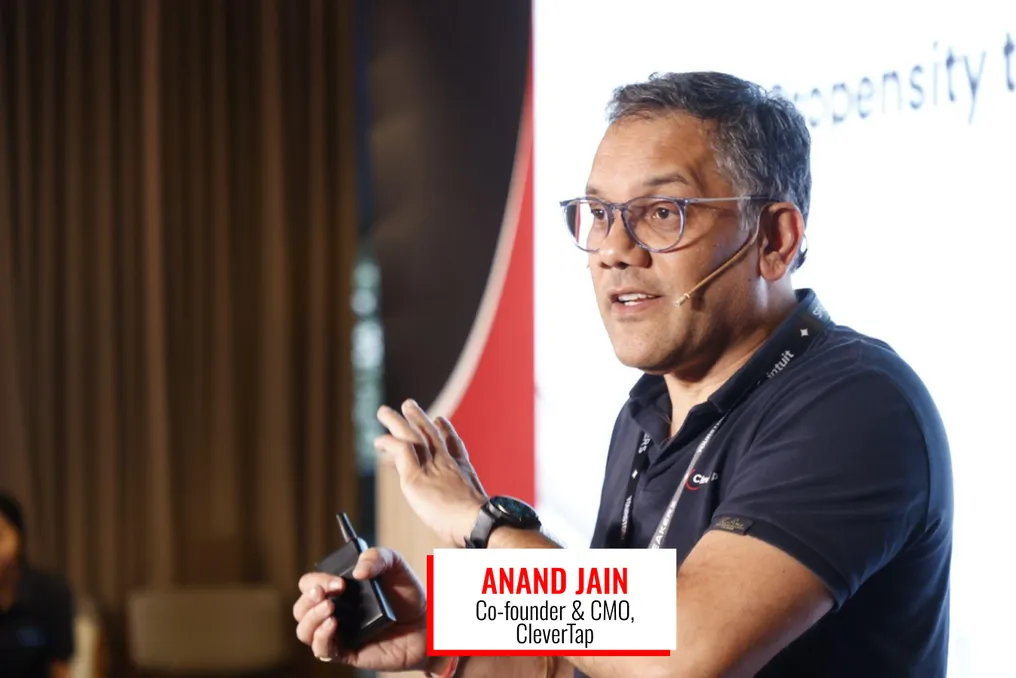
Most modern marketing teams use artificial intelligence to save time on tasks such as drafting emails, creating image variations, and summarizing long documents. However, Anand Jain, co-founder and CMO of CleverTap, a platform for marketing automation and customer engagement, argues that basic tools performing these functions rarely contribute to increased company profit.
During a marketing strategy masterclass at the TechSparks 2026 event, Jain urged leaders to look beyond simple ways to speed up work. He emphasized the need to shift from using AI for entertainment to applying it for real business results.
While AI-powered content creation speeds up work and saves time, Jain questioned whether this truly contributes to growth, asking: 'Will this actually impact business outcomes, or is it just the same thing?'
Traditional digital campaigns usually operate on a 'push' model, where companies decide what they want to sell instead of understanding what consumers want to buy. In contrast, an offline consultant remembers a client's personal preferences, notices instant reactions, and suggests products matching their budget and style. Digital marketing must adopt a similar approach.
Jain stated: 'Not what I want to sell, but what my customer wants to buy. That's how it needs to be flipped.' Instead of blasting general promotions to wide audiences, modern marketing systems should analyze customer actions in real time to match individual needs.
This method marks a transition to the highest level of AI maturity, known as 'real-time decision making.' Marketing technologies typically evolve through three stages. The first level focuses on basic time-saving tasks, the second covers experiments like A/B testing (comparing two ad versions to determine the best), and the third achieves true automated decision-making.
Jain noted: 'You start with productivity, then you run experiments, and the hardest part is decision-making. When you are actually building an entire system for one group of people, and that one person could be one of several millions appearing in your app or on your website.'
Instead of bombarding users with promo codes, a decision-making system first offers soft, helpful steps, such as building brand trust or explaining product benefits. Real-time decision-making relies on a single data hub that combines the historical customer profile with their recent real-time actions. Traditional A/B testing usually stops after selecting one fixed winner, whereas a decision-making system uses reinforcement learning—a smart system that continuously learns from user responses and adjusts offers on the fly.
Furthermore, instead of relying solely on propensity scoring (calculating the probability of purchase), a decision-making system uses uplift modeling. This method identifies the specific nudge, message, or channel needed to prompt an individual user to take the next positive step.
As automated systems manage campaign delivery across thousands of message variations, the marketer's role shifts from execution to strategic guidance. Instead of manually creating creative variations, marketers define high-level goals and set strict operational constraints. Jain emphasized: 'Your job is to create budget constraints, brand constraints, regulatory constraints. Do not use the word 'free' if you are offering something, if you are a bank.'
By setting clear boundaries, marketing leaders allow intelligent decision-making systems to operate autonomously, maintaining the safety of brand messaging while simultaneously ensuring genuine commercial profitability, he added.