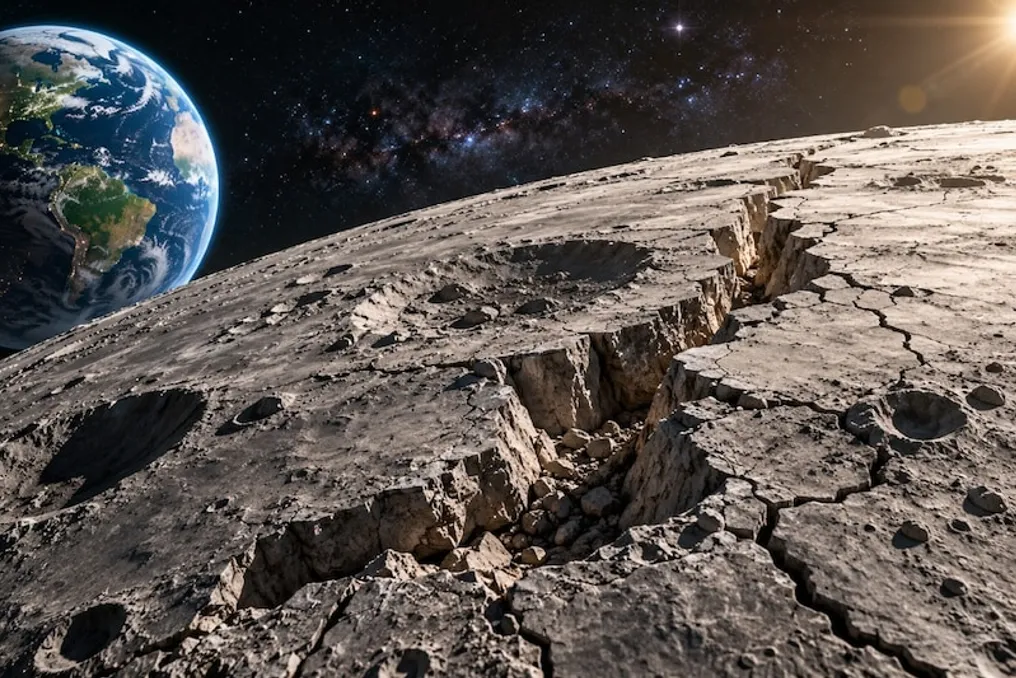
Scientists who studied images obtained by the Lunar Reconnaissance Orbiter Camera (LROC) from NASA discovered more than ten thousand structures on the lunar surface that could be sources of seismic activity. This data was published in The Planetary Science Journal.
According to the study, the interior of the Moon is gradually cooling, leading to a reduction in its size. Over the last approximately 400 million years, the Moon's radius has shrunk by almost 45 meters. This finding makes the selection of safe locations for future NASA Artemis missions aimed at landing humans on the Moon critically important.
The scientists analyzed the images provided by the LROC camera and identified over 8900 lobate scarps and more than 2000 smaller mare ridges. These structures form as a result of the Moon's compression. As the Moon shrinks, pressure increases on its surface, which leads to the formation of these cracks. Movement within these cracks could potentially cause earthquakes on the Moon.
The study also showed that over the past approximately 400 million years, the Moon's radius has decreased by about 45 meters. Scientists predict that if the compression process continues at the same rate, the radius could decrease by 6–11 centimeters every 1 million years, indicating ongoing changes within the Moon.
Earthquakes on the Moon, known as moonquakes, occur due to the gradual cooling of its inner core and subsequent compression. This compression creates pressure on the surface, which either generates new cracks or triggers activity in existing ones. Previously, in 2019, scientist Tom Waters and his team provided evidence linking lunar cracks and earthquakes using seismograph data collected during Apollo missions, as the centers of these tremors were close to the cracks.
Unlike Earth, whose outer shell is divided into approximately 15 major plates, with about 90% of tectonic and seismic activity occurring at the boundaries of these plates, the lunar surface is a single large plate. The absence of multiple constantly colliding major plates complicates the determination of earthquake epicenters on the Moon. Therefore, there is a constant risk of seismic activity, which may manifest as movement in old cracks or the formation of new ones.
This research is highly significant for preparing the NASA Artemis mission, which aims to send humans back to the Moon. Understanding the threat of earthquakes is crucial. The 2024 study identified areas of increased seismic hazard near 13 potential sites selected for the mission. Earthquakes could lead to ground and rock displacement on the surface, posing a danger to astronauts and their equipment.
Nevertheless, this discovery does not mean that landing on the Moon is impossible. The work also established that in areas where the lunar crust is thicker, the number of cracks was lower, and such zones may be considered more suitable for future missions. Scientists emphasize that the process of cooling and compressing the Moon is ongoing, necessitating thorough study of these areas to ensure the safety of human landings.