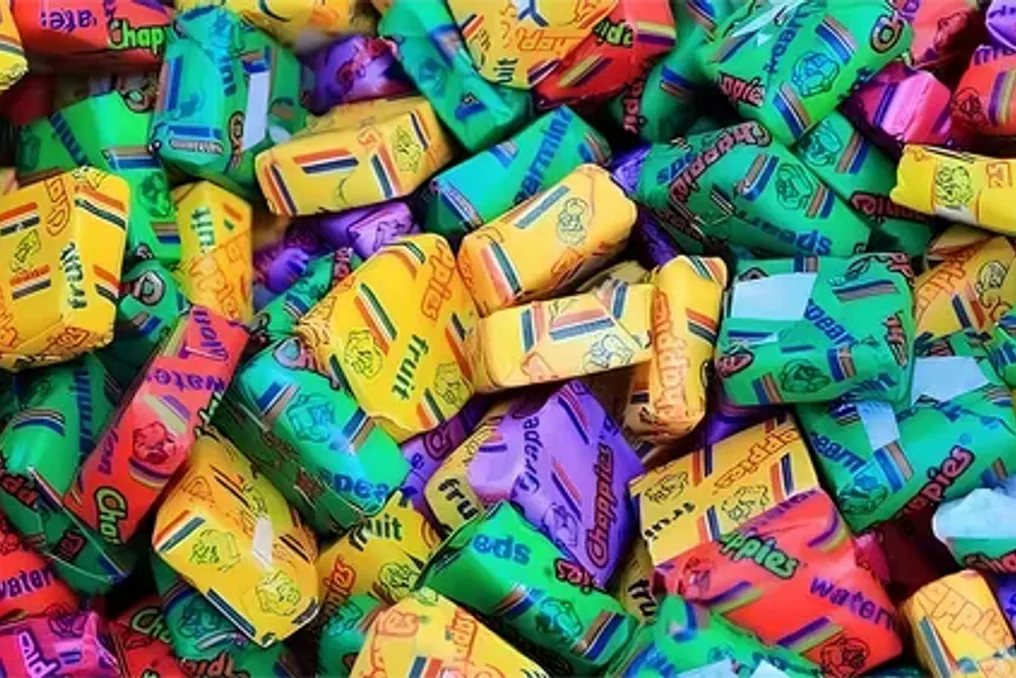
Long before the search engine Google could answer most questions, children in South Africa found information on the wrappers of Chappies chewing gum. These small, colorful squares with recognizable red and blue stripes offered more than just the taste of gum. Upon unwrapping, a question such as 'Did you know?' would be revealed, requiring an answer.
The topic of the question could relate to an animal, a distant country, or the human body; the subject itself was not of great importance. The main pleasure was discovering something unexpected, and then the opportunity to share that knowledge with those willing to listen.
Furthermore, Chappies played a special role in South African culture. In local cafes where families bought bread, milk, and other daily necessities, vendors sometimes gave out chewing gum instead of small change. Thus, the gum turned into a kind of currency.
The Birth of the Brand in Johannesburg
The history of this product began in the suburb of Three Hills in Johannesburg in the late 1940s when Arthur Ginsberg created the brand that became one of the most recognizable in the country. In an interview with journalist Lucile Davie, first published in 2003 and later reprinted in The Heritage Portal, Ginsberg recalled noticing that competing chewing gum, Wicks, was sold for one penny. He wondered if he could create a product that sold two for the same price.
This resulted in Chappies, named after the confectionery factory Chapelat where he worked. Initial flavors included lemon, orange, strawberry, cherry, and pineapple. However, the most inventive ingredient was not the gum itself, but the information printed on the wrapper.
'Did You Know?' Questions
'Did you know?' questions became an integral part of Chappies' identity. According to Davie, the first facts came from the 'Three Wise Men' panel on the Test the Team program on Springbok Radio. Later, academics from the University of the Witwatersrand provided questions, helping to compile a collection that Ginsberg estimated at 5,000–6,000 items. This was a brilliant idea that gave new life to a cheap treat. Ginsberg did not limit himself to facts; Chappies was advertised through weekly cartoons in the Sunday Times newspaper, illustrated by artist Bob Connolly. One memorable cartoon depicted the use of gum to fix a leak in a submarine.
Contests and Market Dominance
The company also distributed promotional school supplies, including a million Staedtler pencils and rulers with the slogan 'Make Chappies your rule.' Then, contests for collecting wrappers appeared. For children, discarded packaging suddenly became valuable. By collecting enough wrappers, one could win prizes such as televisions, radios, and motorcycles. According to Ginsberg's memories recorded by Davie, by the late 1970s, Chappies held about 90% of the chewing gum market in South Africa. A squirrel mascot helped distinguish the original product from counterfeits, and the name itself became so familiar that Chappies was sometimes used as a synonym for chewing gum.
The Legacy of Chappies
According to Davie's historical report, Chappies was acquired by Cadbury in the late 1970s, but the trivia-filled wrappers remained a central element of the brand. In 2012, Chappies invited South Africans to share their own 'Did you know?' facts. Over 50,000 submissions were received, from which 170 facts were selected for printing on wrappers and illustrated by South African artist Jacob Haasbroek. This was a modern evolution of an idea that had helped sell chewing gum for over six decades: offer people something interesting to discover, and they will keep coming back. Chappies celebrated its 70th anniversary in 2019, surviving changes in taste, ownership, and generations of children who grew up with its wrappers. Today, answers to obscure questions are available in just a few clicks. There is no longer a need to buy gum to learn an unusual fact, nor is there a need to carefully unwrap the sticky wrapper to find it. Nevertheless, this sweet had its own unique charm—it could entertain, educate, and sometimes substitute for a coin. For generations of South Africans, Chappies was a small piece of childhood accompanied by a question.