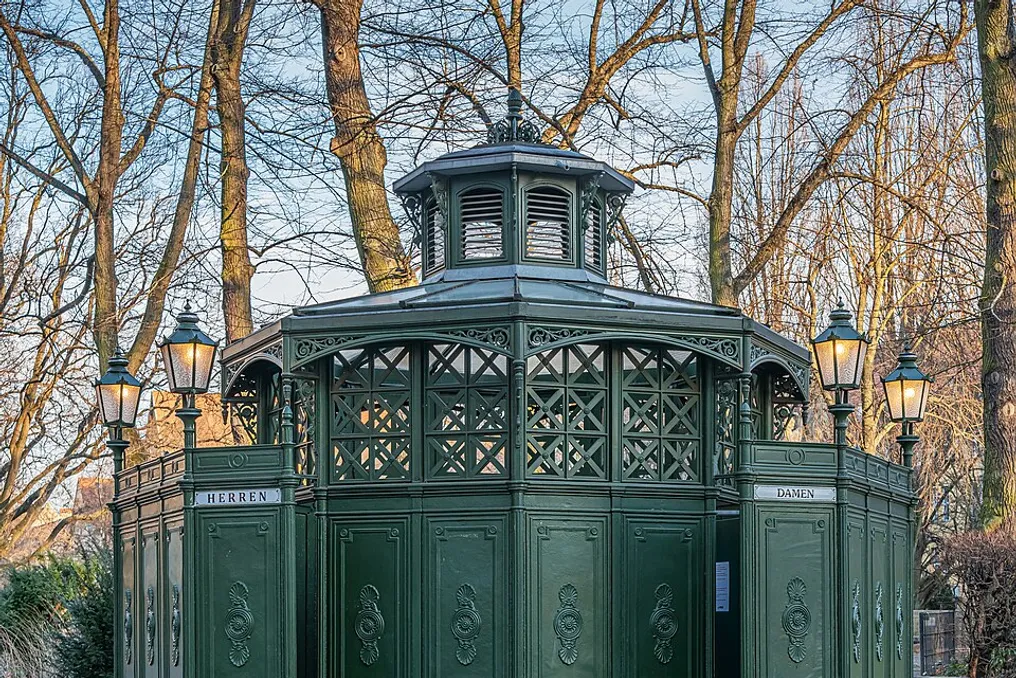
In the late 19th century, before easy sanitary options existed in Berlin, residents often had to resort to cafes for urgent physiological needs. This necessity gave rise to the historical nickname given to the public urinals of the German capital: Café Achtek, or 'Octagon Cafe.'
These urinals were implemented in city squares starting in 1879 with the aim of raising public hygiene standards, offering a suitable place to urinate without citizens having to use makeshift walls.
Although they are now considered relics of the past and have been largely deactivated, it is still possible to visit and use some of these fixtures at specific points in the city.
Beyond representing a significant change in urban sanitation, the public urinals of Berlin also symbolized efficient resource management. The concept envisioned a simple and replicable design throughout the city, and the octagonal shape allowed multiple men (initially, all restrooms were exclusively male) to use it simultaneously, with one individual on each side of the geometry.
The Café Achtek were constructed from cast iron and painted green, featuring skylights on top to ensure ventilation and natural light throughout the day. It is estimated that, during its peak usage period, more than 140 units were installed in the city, and in the early 20th century, models intended for women began to appear.
Over time, they became obsolete and were gradually deactivated, but about a dozen of these old urinals remain, properly restored, and accessible in the city.
The octagonal urinals are located in public areas that historically had high foot traffic, typically squares. Examples of their locations include Gendarmenmarkt and Stephankiez in the Mitte district; Rüdesheimer Platz in Wilmersdorf; near the Senefelderplatz subway station in Prenzlauer Berg; and Chamissoplatz in Kreuzberg, among other locations.
In addition to the Café Achtek, which are the most notorious from the golden age of public sanitation, the city preserves other similar urinals made of cast iron and painted green, but featuring a different shape: rectangular. Currently, the most famous of these rectangular models has undergone a complete renovation and has been transformed into a burger joint, Burgermeister, which has been operating since 2006 in the former urinal at the Schlesisches Tor subway station.