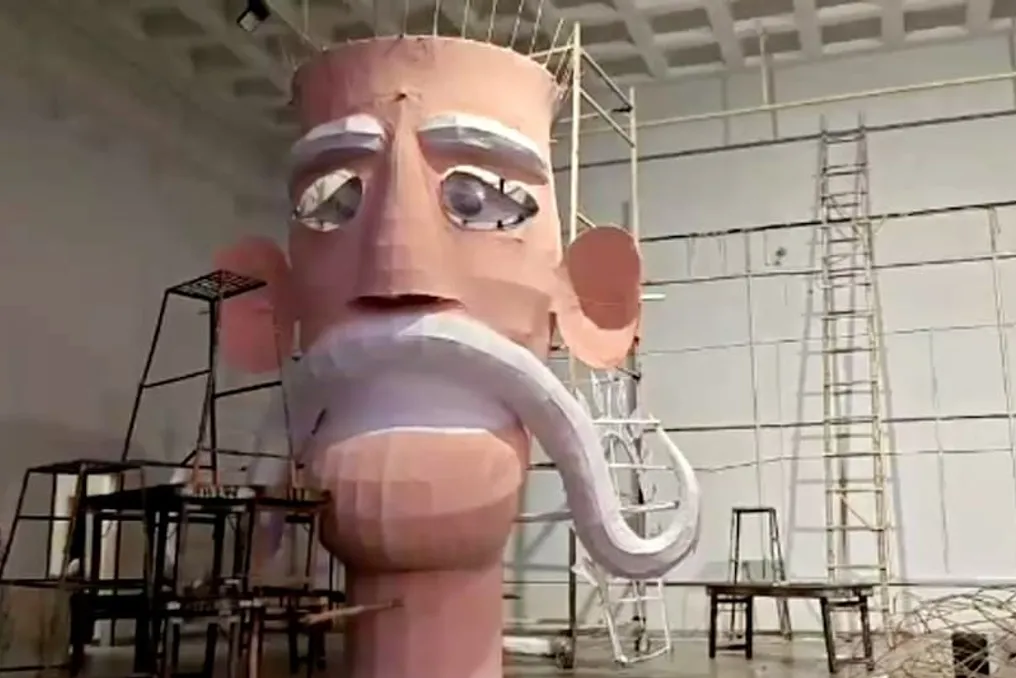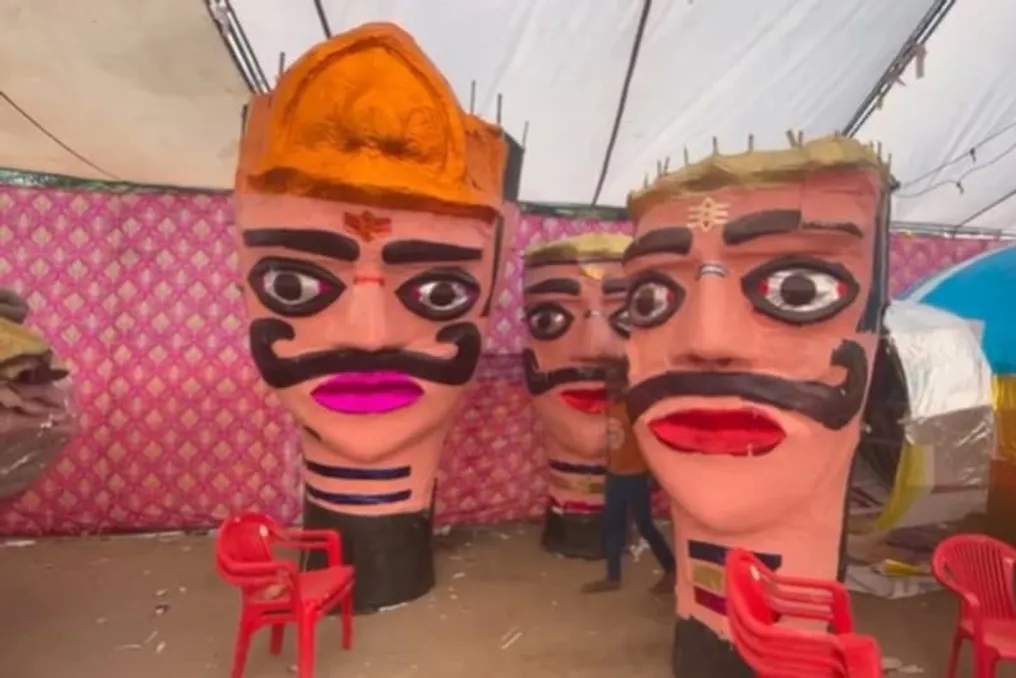
Dussehra symbolizes the victory of truth over falsehood. On this day, rituals involving the burning of effigies of Ravana, Kumbhakarna, and Meghanada are held, which represent characters playing the roles of Lord Rama and Lakshmana. However, the tradition of Ravana Dahan is gradually modernizing, and modern technology is now actively used in the making of these effigies.
Muslim families from Uttar Pradesh create these figures for regions such as Rajasthan, Madhya Pradesh, and Gujarat, thereby demonstrating an example of harmony between the Ganga-Yamuna cultures and the brotherhood of Hindus and Muslims.
To celebrate Dussehra on October 20th, a grand effigy burning will take place in Alwar (Rajasthan): Ravana at 65 feet, Kumbhakarna at 60 feet, and Meghanada at 55 feet. Muslim artisans have arrived from Agra (Uttar Pradesh) to create these figures and have been working on them for about a month. These craftsmen note that the festival of Dussehra is a significant source of livelihood for their families.
According to the artisans, in Pali, Rajasthan, Ravana effigies are made year-round and then sent to various cities across the country. Preparation for this process begins approximately four months before Dussehra. More than 150 artisans participate in this work, all belonging to the Muslim community, and for them, it is not just a profession but a long-standing tradition.
The artisans reported that modern technology is increasingly being applied to the effigies of Ravana, Kumbhakarna, and Meghanada. Whereas figures were previously made using traditional methods, they are now integrated with elements such as motors and lighting systems. Specifically, this year, Ravana's head will rotate, his limbs will move, and the sword in his hand will appear to spin.
Furthermore, features such as flames or sparks flying out of the eyes and mouth are being added to the effigies. The goal of these changes is to enhance the attractiveness and impressive appearance of the effigies. The craftsmen assert that the demand for light- and technology-equipped figures is constantly growing, leading to large-scale Ravana Dahan events even in small towns and villages.
Bamboo is mainly used to make the effigies, which is sourced from Bareli. Bright paper is then pasted onto the frame to create the figures of Ravana, Kumbhakarna, and Meghanada. Thanks to the work of the artisans, their appearance becomes very attractive so that spectators can enjoy the spectacle during the Dussehra burning.
The artisans emphasized that creating Ravana effigies is their hereditary occupation, and their ancestors also engaged in this craft. They regard Ravana as a learned pandit and prepare his effigy with great respect. According to them, Ravana up to 100 feet tall is made in Pali (Rajasthan), and figures are also produced according to the needs and demands of different cities.
These artisans, arriving from Agra and other parts of Uttar Pradesh, have worked in several states, including Rajasthan, Gujarat, Madhya Pradesh, as well as Delhi, Mumbai, Nashik, Bihar, Punjab, Haryana, and Uttarakhand. Their effigies are valued for their beauty and modern technology, which is why they are invited from different places. The income from Dussehra allows their families to cover expenses for the entire year.
Since Alwar is part of the National Capital Region (NCR), green firecrackers will be used for fireworks, for which special pyrotechnics specialists will arrive from Ghaziabad. For years, the Mursharti society has organized the Ravana Dahan in Alwar, and thus, through the combination of tradition, technology, and the participation of various communities, the celebration of Dussehra takes on a new form every year.