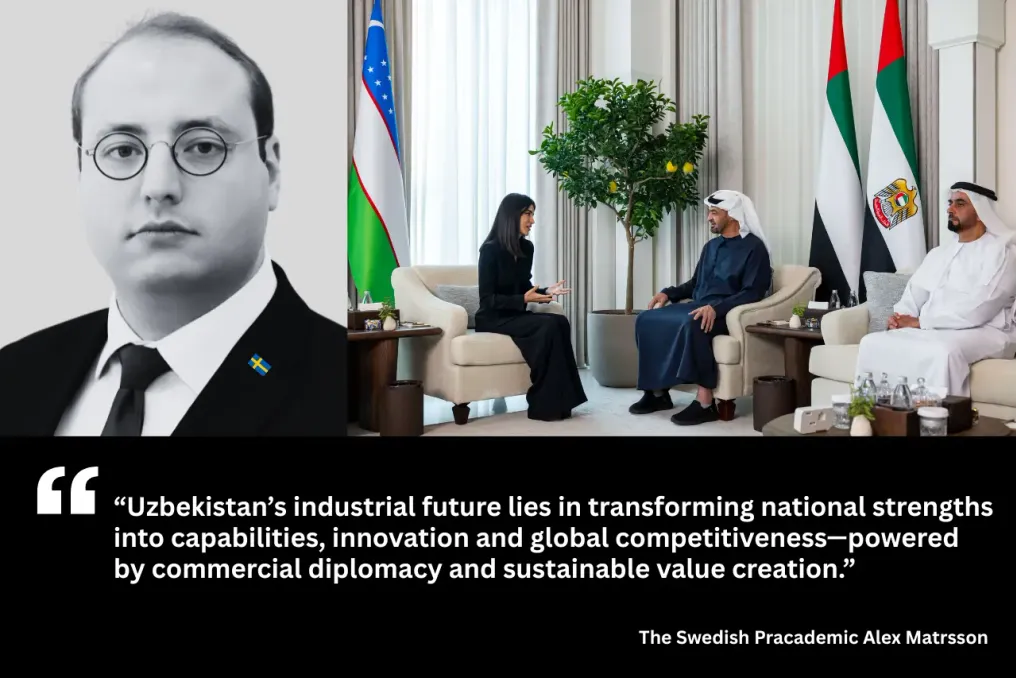
In an exclusive interview, Alex Matsson, a Swedish associate professor and international business strategist, emphasized that the future competitiveness of Uzbekistan's industry will depend not only on the assets held by large enterprises but also on their ability to transform these assets into globally transferable competencies.
According to Matsson, Uzbekistan's industrial transformation is fundamentally a question of capabilities: how existing enterprises can combine production excellence, technological innovation, internationalization, commercial diplomacy, and sustainable value creation to achieve international competitiveness.
Industrial giants possess advantages that new competitors find difficult to replicate, such as established production systems, infrastructure, customer relationships, engineering knowledge, supply chains, access to capital, and institutional experience. However, these advantages can also generate inertia. Outdated technologies, complex structures, and entrenched decision-making mechanisms can slow down adaptation in the face of growing global competition driven by innovation, speed, data, talent, and changing customer expectations. This conflict between inherited strength and organizational renewal is a central element of the industrial strategy outlined by Matsson.
Scale remains valuable, but scale without renewal is increasingly becoming a vulnerability. Therefore, a modern giant must develop dynamic capabilities: the ability to sense technological and market changes, seize emerging opportunities, and continuously transform its existing resource base. For Matsson, the decisive difference lies between an enterprise that merely defends its current position and one that is capable of renewing, internationalizing, and strategically repositioning itself.
For Uzbekistan, this task is of national importance, as industrial enterprises stand at the intersection of economic diversification, productivity, exports, technological development, employment, investment attractiveness, and economic sustainability. Natural resources, production base, agro-industrial potential, energy capabilities, domestic market, and strategic geographical location provide important foundations for industrial growth. Nevertheless, Matsson argues that these advantages should be viewed as starting points for competency accumulation, not as an end goal.
Uzbekistan's strategic path must move from resource advantage to industrial competence, from industrial competence to technological advantage, and then from technological advantage to international competitive advantage. Matsson's core idea is that owning industrial assets does not automatically equate to owning competencies. Long-term advantage belongs to enterprises capable of transforming inherited assets into knowledge, technology, intellectual property, engineering expertise, customer relationships, and international market positions.
Shifting the Basis of Industrial Competitiveness
Industrial competition is now defined less by price, production capacity, and scale. Competitive positioning is increasingly shaped by speed, innovation, data, talent, proximity to the customer, intellectual property, operational excellence, sustainability, financial capability, and access to the global market. For Matsson, the strategic shift is not just about competing in established markets, but about influencing ecosystems, standards, partnerships, technologies, and global value chains.
This changes the meaning of industrial digital transformation. Industry 4.0, artificial intelligence, automation, digital twins, predictive maintenance, and smart manufacturing should not become purely technological projects without an economic objective. According to Matsson, technology creates strategic value when it enhances productivity, quality, flexibility, sustainability, decision-making quality, or customer value. The goal is not digitalization for digitalization's sake, but the creation of industrial competencies that are difficult for competitors to copy.
Business model innovation is also critically important. Servitization can transform products into long-term customer relationships; outcome-based models can shift competition from selling products to delivering results; open innovation can accelerate technological development; and international joint ventures can provide access to technologies and opportunities that would be difficult to develop internally. Matsson also views selective vertical integration and selective vertical disintegration as strategic decisions regarding which competencies an enterprise should own, acquire, or coordinate.
Uzbekistan's Industrial Transformation: From Assets to Competencies
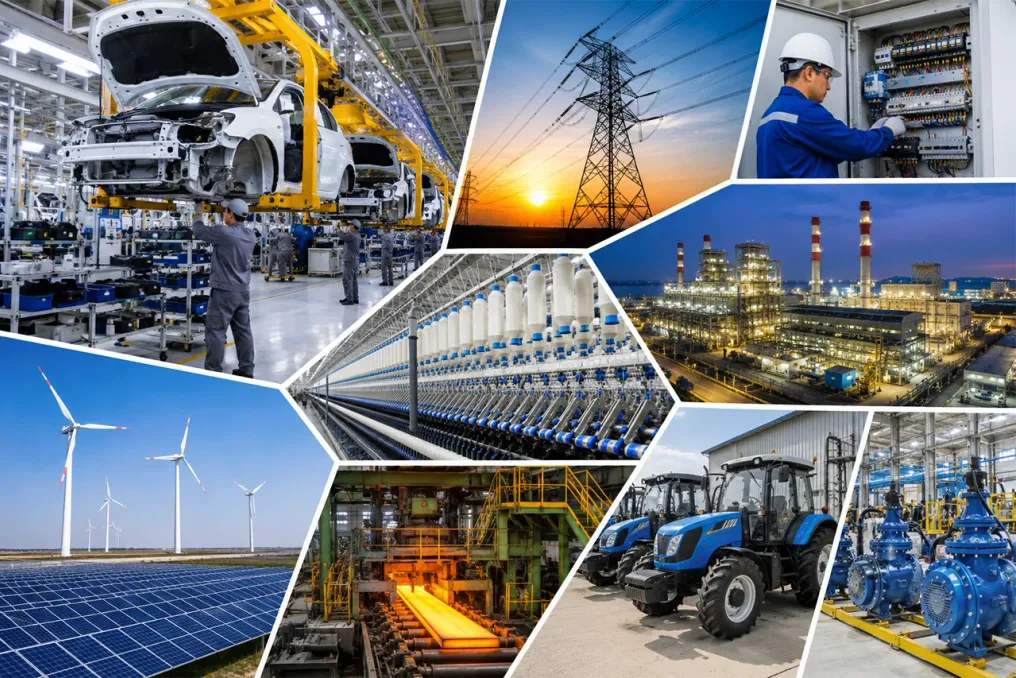
The most crucial strategic opportunity lies in transforming Uzbekistan's existing industrial strengths into more valuable competencies. Mining enterprises can move beyond extraction to advanced processing, metallurgy, engineering, resource efficiency, and technological partnerships. Textile companies can transition from production to design, advanced materials, traceability, branding, and international customer relations. Chemical and energy enterprises can focus on creating added value at subsequent stages, specialized products, and cleaner industrial processes. In these sectors, Matsson sees potential for transforming Uzbek production into a more sophisticated foundation for international competitiveness.
This principle applies to all industrial giants in the country. The Navoi and Almalyk mining and metallurgical companies illustrate the strategic importance of combining resource positions with processing, technology, engineering expertise, and international ties. The relevant question for Matsson is not simply what these enterprises produce, but what competencies their industrial systems can continuously develop and commercialize internationally.
The same analytical approach applies to Uzbekistan's energy, petrochemical, automotive, aviation, railway, textile, and manufacturing sectors. Enterprises such as UzAuto Motors, Uzbekneftegaz, and Uzbekistan Airways represent different potential paths to strengthening international positioning. Matsson's strategic view focuses on how established enterprises can deepen technology, develop international customer networks, strengthen supplier ecosystems, and participate more effectively in global value chains.
Internationalization and Commercial Diplomacy
Internationalization must be understood as more than just increasing exports. It is the deliberate shaping of positions among international customers, technologies, supply chains, partnerships, talent markets, intellectual property, and investment networks. For Matsson, an internationally competitive Uzbek enterprise must learn to operate across borders, not just sell across them.
Commercial diplomacy gains particular importance within this model. State institutions, diplomatic missions, investment organizations, development and financing institutes, trade organizations, and corporate leaders can help build trust, facilitate market access, support strategic partnerships, and connect Uzbek enterprises with international ecosystems. However, Matsson emphasizes a core principle: commercial diplomacy opens doors; competitive ability determines whether the enterprise stays in the room.
This makes internationalization a two-way strategic process. Uzbek institutions can help create access, trust, and connectivity, while companies must provide the technology, quality, productivity, management, and customer value necessary to maintain international relations. Therefore, Matsson views commercial diplomacy not as a substitute for industrial competitiveness, but as an enhancing factor for enterprises that already possess genuine competitive capabilities.
Sustainable Competitive Advantage
Sustainable competitive advantage increasingly arises from combinations of competencies, rather than isolated assets. Industrial assets combined with talent, technology, data, customer knowledge, capital, international networks, and disciplined execution can create systems of advantages that are significantly more protected than mere scale. Matsson argues that Uzbek industrial champions must build competencies that are valuable, difficult to imitate, adaptable, and internationally transferable.
Sustainability must become part of this competitive architecture. Energy efficiency, resource productivity, water efficiency, circularity, cleaner technologies, and climate resilience can simultaneously reduce operational risks, increase productivity, and strengthen access to international customers, investors, and technological partners. For Matsson, sustainable industrial growth is strongest when environmental, economic, and social value mutually reinforce each other, rather than competing for management's attention.
The social aspect is also strategic. Uzbekistan's industrial transformation will require engineers, technicians, digital specialists, managers, and commercial leaders with international experience. Thus, talent development, attracting international expertise, and knowledge transfer can become sources of national industrial competence. In Matsson's view, talent is not just an organizational resource; it is part of the infrastructure of international competitiveness.
From National Champions to Global Industrial Leaders
The strategic trajectory envisioned by Matsson represents a progression from a national champion to a regional platform, an international enterprise, a participant in the global value chain, an ecosystem orchestrator, and ultimately, a sustainable industrial champion. Each transition requires stronger governance, more complex capital allocation, faster commercialization of innovations, international market awareness, and organizational agility.
Uzbekistan's regional connectivity can support this progress, but Matsson believes the region should be seen as a bridge to broader international markets, not as a final strategic horizon. Cross-border supply chains, logistics networks, and regional partnerships can serve as platforms for expansion, while global customers, technology suppliers, investors, and knowledge institutions can accelerate competency accumulation.
The fundamental strategic distinction, according to Matsson's formulation, remains between asset ownership and competency ownership. The future of Uzbekistan's industry will be determined not only by its resources, factories, infrastructure, or domestic market potential. It will depend on whether existing enterprises can repeatedly transform these foundations into innovations, international relations, patented knowledge, and long-term competitive advantage.
The ultimate measure of success is not merely industrial growth. It is the ability of Uzbekistan to develop enterprises capable of creating economic value through productivity, innovation, and internationalization; social value through skills, knowledge, and quality employment; and environmental value through efficiency, circularity, and sustainability. For Matsson, these metrics are becoming increasingly interconnected: sustainable competitive advantage will belong to those enterprises that can create multiple forms of value while remaining internationally competitive.
In conclusion, Alex Matsson, a Swedish associate professor and international business strategist, advocates that Uzbekistan's industrial giants should define their future not by what they currently possess, but by who they can continuously become on the international stage. Matsson's strategic model links Uzbekistan's industrial strategy, industrial competence, technological innovation, internationalization, and global value chains.