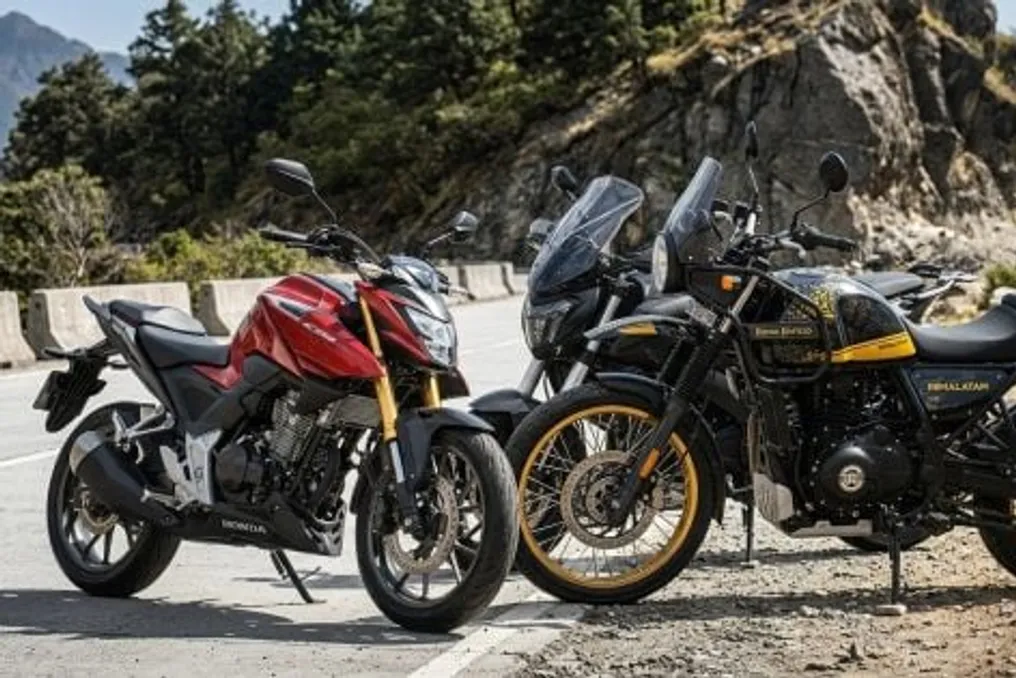
The 2027 Honda CB300F Twister was recently launched with improvements focused on sportiness, including a new variant. Despite having an initial price ranging between R$ 26,880 and R$ 27,680, values close to those of the Indianas motorcycles that entered the market, the debate about the real cost and suitability of each model persists.
Although comparisons arise on social media between the CB300F Twister and models like the Bajaj Dominar 400 and Royal Enfield Himalayan 450 due to the proximity of their initial prices, it is observed that the Indianas are larger and offer more features. However, it is warned that those who prioritize size may end up acquiring a vehicle unsuitable for their needs.
It is important to note that these motorcycles are not direct competitors to the Honda 300; the comparison arose solely because of the price. The closest rival within Royal Enfield would be the Guerrilla 450, a naked version of the Himalayan, but this would be superior, possessing a 452 cm³ engine and a starting price of R$ 28,990.
The true competitors of the CB300F Twister are others, such as the Yamaha FZ25, costing R$ 25,190, and the Bajaj Dominar 250, priced at R$ 23,800. These models share size, engine range, and urban vocation, indicating that the discussion boils down to what the consumer gets for the sticker price.
The decision to buy a motorcycle involves several factors, including acquisition cost, intended use, riding style, maintenance, resale value, and comfort.
Detailed Cost Analysis
Despite the suggested starting price of the Honda CB300F Twister being R$ 26,880, this value does not include shipping or other commercial charges. In practice, the cost of the Japanese motorcycle easily exceeds R$ 30 thousand. According to the Fipe Table, its average price for the brand new standard version reaches R$ 30,233, potentially reaching R$ 31,373 in the 'S' sport version.
In contrast, the Bajaj Dominar 400 and the Royal Enfield Himalayan 450 are marketed with fixed prices of R$ 27,490 and R$ 29,990, respectively. For the price of a Japanese 300, the buyer can opt for two bikes with almost double the power. The Dominar 400 uses a 373.3 cm³ single-cylinder, DOHC, liquid-cooled engine, generating 40 hp at 8,800 rpm and 3.57 kgfm at 6,500 rpm. The Himalayan 450 has the 452 cm³ Sherpa, also DOHC and liquid-cooled, delivering 40.02 hp at 8,000 rpm and 4 kgfm at 5,500 rpm.
The 2027 CB300F Twister produces 24.5 hp with gasoline and 24.7 hp with ethanol at 7,500 rpm, accompanied by 2.61 and 2.67 kgfm at 5,500 rpm, using a 293.5 cm³ air and oil-cooled OHC single-cylinder. This represents a difference of 15 hp compared to the Indianas, and the 2027 line did not receive updates in this aspect, as the engine was only revised to comply with the second phase of Promot 5.
Equipment also shows differences. The Dominar 400 offers four riding modes (Rain, Road, Off-Road, and Sport), while the Himalayan 450 features a 4-inch color TFT display with Google Maps navigation and adjustable seat height. Honda, on the other hand, equips its model with an LCD panel.
Despite this, the 2027 Twister evolved with HSTC traction control (disengageable), 38 mm Showa SFF-BP inverted front suspension, ESS emergency braking signaling, forged aluminum fork mounts, a 10 mm wider handlebar with pads, and dual-wheel ABS in all versions, an unprecedented package in the previous generation.
A unique differential of the Japanese model is the flex engine. Since the Dominar 400 and Himalayan 450 run only on gasoline, this is relevant in a country where ethanol is a common option, being a point where Honda has no direct comparison.
The analysis of cost per kilometer driven reveals that the CB300F Twister undergoes its first service at 1,000 km and subsequent ones every 6,000 km, totaling five services up to 24,000 km. The Indianas require 5,000 km intervals, needing six visits to cover a similar distance.
In this metric, the Twister costs R$ 3,589.23 up to 24,000 km, while the Dominar 400 is at R$ 3,280.74 and the Himalayan 450 at R$ 3,246.38 (Royal Enfield's official value for three years or 25,000 km). When converted to cost per thousand kilometers driven, Honda presents R$ 149.55, Bajaj R$ 131.23, and Royal Enfield R$ 129.85, making the Japanese one the most expensive of the three, even with longer service intervals.
Negative points for Honda include two costly services in the plan, valued at R$ 1,150.30 and R$ 1,438.10. Bajaj distributes costs more uniformly, without exceeding R$ 800 in any service, and Royal Enfield alternates three services of R$ 231.92 (paying only labor) with others reaching R$ 1,130.35.
Recently, there have been improvements in the Indianas scenario. In July 2026, Royal Enfield reformulated its service plan in Brazil, raising the first visit from 500 km/45 days to 1,000 km/six months, and reduced the accumulated cost of the 450 platform (Himalayan and Guerrilla) by 32%, corresponding to savings of R$ 1,527.78, addressing previous criticisms about after-sales service.
Maintenance and Parts
Besides scheduled services, the cost of wear parts such as tires, brake pads, clutch, oil, filter, and drive chain kit is a decisive factor. The CB300F Twister has the simplest set of the three, with an air and oil-cooled engine, no radiator, water pump, or additive, and 17-inch wheels with common tire sizes. The Himalayan 450, conversely, uses a 21-inch front wheel with a 90/90-21 tire and a 140/80 R17 rear tire, more specific sizes and higher cost.
There is also a difference in origin: Honda is manufactured in Manaus and was the seventh best-selling motorcycle in Brazil in 2025, which guarantees scale, an established network of workshops, and a consolidated parallel parts market. Royal Enfield, on the other hand, imports almost all its products, a justification used by the Royal Enfield Latam executive director, Gabriel Patini, to explain its prices.
Data collected by AutoPapo show disparities in parts costs. A drive chain kit for Royal Enfield's more affordable bikes costs R$ 952.84, while the dashboard of a Classic 350 costs R$ 2,170.92; the same item for the CB300F Twister can cost half that amount. At the same establishment, the dashboard of a Himalayan 411 reaches R$ 5,755, reflected in almost all models of the brand.
The availability of Honda parts, whether original or parallel, is easier, allowing the Twister owner to choose where to buy and install. For the owners of the Indianas, this choice is limited in most cities.
The financial scenario reverses over time. Initially, during the warranty period, the 2027 Twister is the most expensive in scheduled services. After this period, or in cases of corrective maintenance, the focus shifts to tires, chain, pads, and accidental damage, items where the Japanese bike offers cheaper parts and greater availability of alternative workshops.
Adding the flex engine and declared consumption of about 28 km/l, the cost per kilometer driven for the Honda tends to decrease. This difference is subtle for someone who changes bikes in two years, but becomes evident for someone who keeps the vehicle for five years.
Intended Use and Ergonomics
When financial aspects do not convince the potential rider, the difference lies in what the bike allows them to do. Being larger, the Indianas are heavier: the Dominar 400 weighs 192 kg ready-to-ride, and the Himalayan 450, 196 kg, compared to the Honda's 142 kg dry (less than 160 kg ready-to-ride).
The Indianas are also wider: the Twister measures 765 mm in width, while the Himalayan measures 852 mm and the Dominar 863 mm. In length, the Japanese model is 2,084 mm, compared to 2,156 mm for the Bajaj and 2,245 mm for Royal Enfield. The wheelbase follows the same order: 1,390 mm, 1,453 mm, and 1,510 mm. The seats vary between 789 mm on the Honda, 800 mm on the Dominar, and 825 mm on the Himalayan (which can reach 845 mm with standard adjustment or drop to 805 mm with optional low seat).
These distinctions, combined with the manufacturer's adjustments in dimensions and weight distribution, define the proposals of each model. The Himalayan 450 is ideal for trails and moderate trips, despite its weight and dimensions hindering urban use (230 mm ground clearance and 21-inch front wheel). The Bajaj Dominar 400 positions itself in the middle, suitable for short trips and urban traffic. The Honda CB300F Twister stands out for those who travel predominantly in the city and occasionally on avenues, being economical, compact, light, and extremely easy to ride.
Comparing these three models only by the sticker price is the fastest way to choose the wrong bike. The 2027 Twister is more expensive at the dealership, delivers half the power, and loses in the initial service count. If the criterion is immediate financial return, it does not win. However, Honda compensates for this difference in use: cheaper parts, accessible workshops, flex engine, and a weight of 142 kg facilitates maneuverability, in addition to its narrow profile allowing access to restricted areas.
The fundamental question is not which is the cheapest, but how many kilometers of trail, road, or lane the buyer intends to cover annually. Those seeking trips and off-road excursions will find something in the Himalayan 450 that the Twister does not offer. Those who commute daily in the city will realize that 50 kg more and 10 cm more width have a high cost in another way.