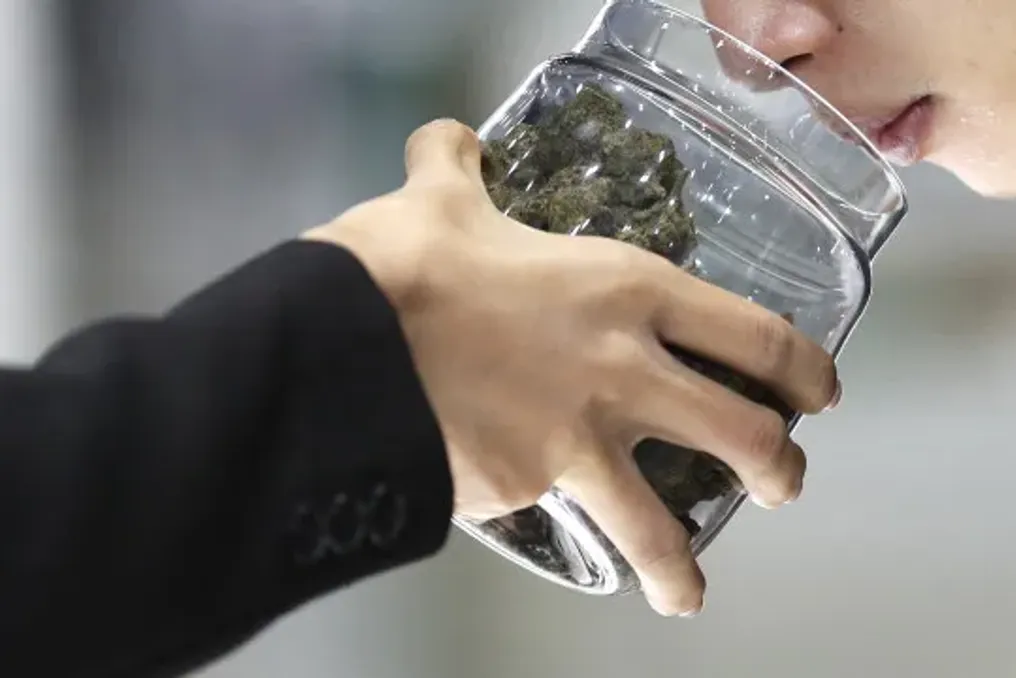
Four years after Thailand became the first Asian country to decriminalize cannabis, the sector has undergone a reduction, become more regulated, and progressively shifted towards medicinal purposes.
The removal of cannabis from the list of prohibited substances occurred in June 2022, which spurred rapid expansion in production, trade, and tourism related to the plant.
In a store called Weeden, located in the center of Khlong Tan, Bangkok, the atmosphere resembles more a perfume or cosmetics shop, being well-lit and displaying various types of cannabis sativa. The labels feature creative names, such as 'mango sweet rice' and 'better than sex.' Like many other stores in the country, WeedeN offers a variety of cannabis-related items, including the herb, snacks, cosmetics, and creams. There is also an area designated for smokers, equipped with music and a PlayStation 5.
Founded in 2022, WeedeN has consolidated itself as a cannabis retail chain that grew rapidly, reaching the status of one of the largest dispensary chains in the country, with a total of 50 to 58 stores. Kai, a 25-year-old employee at the store, described the scene by saying: 'It's like the 7-Eleven of cannabis. We are in all the major tourist spots.' He added that the location receives customers from various nations, from the Maldives to China, due to the presence of many foreign residents and tourists in the region.
A couple of Chinese tourists was seen examining products in the store, with the young woman asking if he would really smoke, to which the man replied affirmatively, mentioning that it was legal there. Currently, the Chinese constitute the main visiting nationality, and the Travel Agents Association projects receiving seven million visitors this year. Since use and possession are strictly illegal in China, as in most Asian countries, many take advantage of the trip to try this local novelty.
According to industry representatives, after legalization in 2022, thousands of establishments were opened across the territory, concentrating mainly in Bangkok and major tourist destinations. This attracted investors, farmers, and entrepreneurs to one of Thailand's most promising economic sectors.
Win Sinhaseni, executive director of the distributor NagaExpress, reported that he studied Law but entered this field in the first year of legalization because he saw an excellent opportunity. He observed that in the initial years, there was great investment and the business was in a phase of strong expansion.
Yasmin Pathan, a salesperson at Iridescent Med, started her involvement with the sector during university through a research project on cannabinoids, a period when legislation already permitted such studies. She emphasized that cannabis has always contributed to tourism, even before legalization. Pathan participated in the first wave of retail shortly after decriminalization, when stores recorded daily revenues of hundreds of thousands of baht, occasionally reaching over one million baht (equivalent to 26,614 euros).
However, the period of accelerated growth gave way to a more restrictive framework, implemented by the Government this August. Previously, a commercial license was enough for stores to sell products; now, the new regulations require buyers to undergo a medical consultation conducted by a traditional Thai medicine professional, present clinical data, and obtain a valid prescription at the store.
Current store licenses expire in 2028, and their renewal is conditional on transforming the premises into authorized medical units. Restrictions remain on sales to minors under 20 and pregnant women, in addition to limitations on commercial activity near schools, parks, and temples, along with restrictions on sector advertising.
Sinhaseni pointed out that these measures resulted in the closure of thousands of establishments, particularly affecting operators who could not or did not want to meet the new requirements. He noted that those operating in gray areas faced greater difficulties. For Pathan, the new rules mark a drastic transformation for small merchants, forcing them to migrate to a model resembling clinics, with significantly higher costs.
Pathan expressed skepticism, stating: 'Honestly, it seems like we are guinea pigs while the Government tries to understand how this industry works.' After managing a store in Bangkok for about three years, Sinhaseni closed the business when the lease expired and the owner showed concern about regulatory instability. However, he considered that, in practice, for those working in the sector, the situation is not that serious, provided they comply with the regulations.
For these entrepreneurs, the changes are accelerating the transition from a market initially focused on recreational consumption to an industry more focused on medicinal cannabis and exports. Sinhaseni emphasized that as long as Thailand maintains its status as the only legal market in Asia and this part of the world, the potential will be immense, making the sector extremely attractive.
Marika Graham-Woods, CEO of the Cannabis Trade Association, informed Lusa that 'considerable investments are being made to develop pharmaceutical quality products' in the country, capable of meeting the strictest international standards. Graham-Woods, a representative of the medicinal cannabis industry in the United Kingdom, believes that Thailand is well-positioned to surpass the 'European Union and North America' in terms of user numbers.
Sinhaseni concluded by highlighting that social acceptance of cannabis has increased in Thailand, especially among young people. He commented that many young people nowadays prefer consuming cannabis instead of drinking alcohol or smoking tobacco. Concluding, he reflected that 'the world is moving too fast. People need to slow down a bit, and I think cannabis is a good way to do that.'