Residents of South Africa are facing relentless economic pressure due to unprecedented increases in fuel prices, which affect all aspects of daily life. As pump prices rise monthly, a domino effect spreads to food, transport, and basic utilities, pushing household budgets to a critical state. This forces millions of people to make an impossible choice between survival and financial collapse amid an increasingly harsh economy.
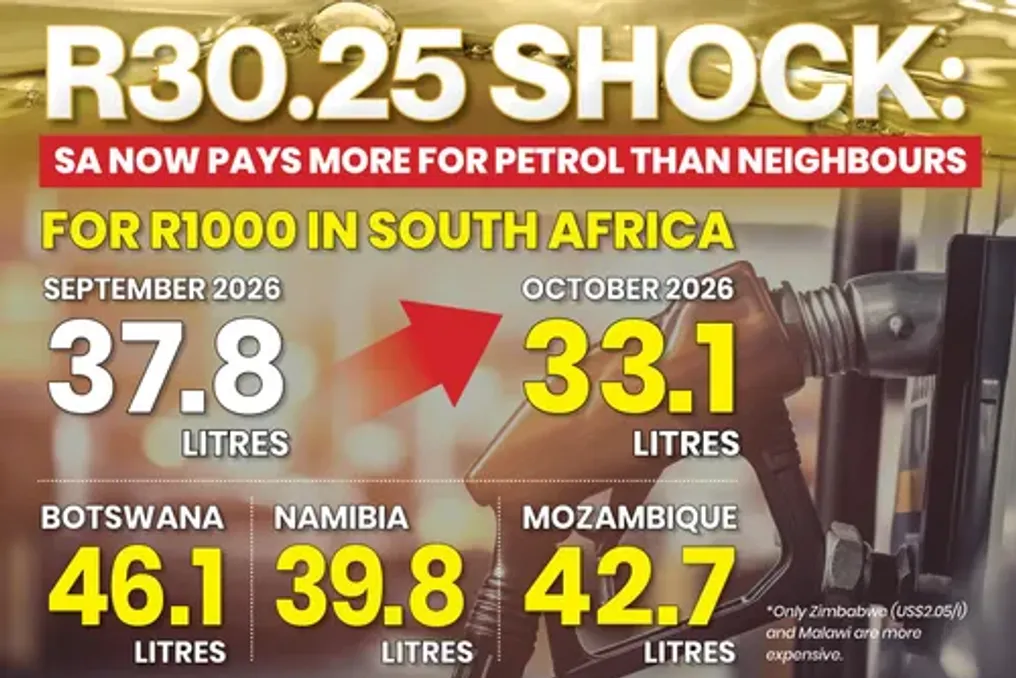
Fuel prices have exceeded all historical records: in October 2026, AI-95 gasoline reached 30 rand per liter for the first time, putting pressure on families already struggling to cover expenses. Drivers are now paying approximately 9 rand per liter more than at the beginning of the year, and preliminary data from the Central Energy Fund (CEF) indicates a potentially even more significant increase in November.
Mamasole Maduna, a scientist driver transporting schoolchildren in Evaton, in the Vaal, spoke about the difficulties associated with rising fuel costs and its impact on her business profitability. Maduna and two colleagues often park near Evaton Mall to save fuel, avoiding unnecessary idling and trips between orders. The 40-year-old reported that her expenses have risen from 1200 rand per week to 1600 rand, and monthly fuel expenditures have increased from 4800 to over 6000 rand, not including groceries.
She also noted the rise in gas prices, which exacerbates her problems. Since electricity is expensive, she uses gas for cooking, and the need to buy it twice a month depletes her funds for groceries. Maduna added that due to the expected further rise in gasoline prices next month, she does not know how her family will survive, as it affects the cost of everything.
Furthermore, she fears increasing transport fares, worried about losing customers among families already facing financial difficulties. Her friend Gladys Mkhlambi said she often wants to go home after morning deliveries, but high fuel prices make this impossible, forcing her to wait until the afternoon school route, i.e., until 5:00 PM.
Mkhlambi also mentioned that she relies on gas for cooking, whose price recently rose from 300 to 330 rand, increasing her financial burden. Personal transport provider Thabang Ramaisa expressed doubt about his ability to cope with another rise in gasoline prices next month, asserting that only the wealthy will survive in this situation. He noted that during busy periods, he earns about 5000 rand per week, while in quiet weeks, income drops to 4000 rand, and current transport costs are around 600 rand, so any future increases will make the situation very tense.
He also suggested that the situation might force many drivers to abandon their vehicles, which is not a solution, as fares could increase at some point.
Maria Tekiso, an 81-year-old woman, stated that the situation has forced her to drive only in emergencies, as she can barely afford to fill up the tank. She relies entirely on her social grant, making life incredibly difficult against the backdrop of rising food prices. The organization United Against Hunger warned that the crisis of hunger and malnutrition will be exacerbated by the combination of the fierce El Niño phenomenon, which will bring very high temperatures and low rainfall, as well as by the rise in oil and fertilizer prices caused by Donald Trump's violent and illegal interference in the Middle East.
The organization also emphasized that there is still a lack of political or corporate will in the country to address hunger and malnutrition issues. Rene Munsami, chairman of the National Debt Counselling Association (NDCA), added that a regular salary is no longer enough for many South Africans, as the explosive growth in the cost of essential goods such as electricity, transport, and food outpaces the average wage growth of 4.1%.
Although the National Treasury transferred 10 billion rand as a reserve fund in accordance with the Public Finance Management Act, these funds remain unused because the government has not yet finalized the design or operational details of consumer intervention measures. Despite South Africa being a regional fuel supplier to countries like Lesotho and Botswana, local taxes and government regulation result in higher pump prices compared to neighbors.
As of October 2026, retail gasoline prices vary significantly across South Africa: Angola has prices ranging from 5.50 to 6.23 rand per liter, thanks to large domestic oil production and significant state subsidies; Botswana (18.76–21.17 rand per liter) is lower than in South Africa due to a different structure of road accident and fuel levies; Lesotho (18.55–21.50 rand per liter); Namibia (18.27–22.15 rand per liter).
When asked why the Basic Fuel Price (BFP) model allows fuel to be sold to SADC neighbors at a lower price than at South African pumps, Lerato Ntsoko from the Department of Mineral Resources and Energy acknowledged the questions, adding that the department would provide an answer in due course, but the department did not respond at the time of publication.
Regarding how a 10 billion rand intervention will directly lower pump prices, the National Treasury stated that the period is currently closed and it cannot comment on this issue. Energy expert David Walwein noted that the BFP formula has long been used because it fully links domestic fuel costs to the international price of refined oil imported from the Mediterranean or Singapore, ignoring the actual cost of local production. He added that Sasol benefits from high global oil prices but suffers when they are low, as its production costs are tied to stable local coal, while fuel is sold at international prices. Walwein also noted that the National Treasury benefits from strong Sasol performance through tax revenue and an indirect share through the Industrial Development Corporation (IDC).
Economist George Glynnos stated that instead of discussing the progressive nature of fiscal levies, which heavily burden both rich and poor, focus should be placed on the government's inability to control corruption, wasteful spending, and social expenditure.