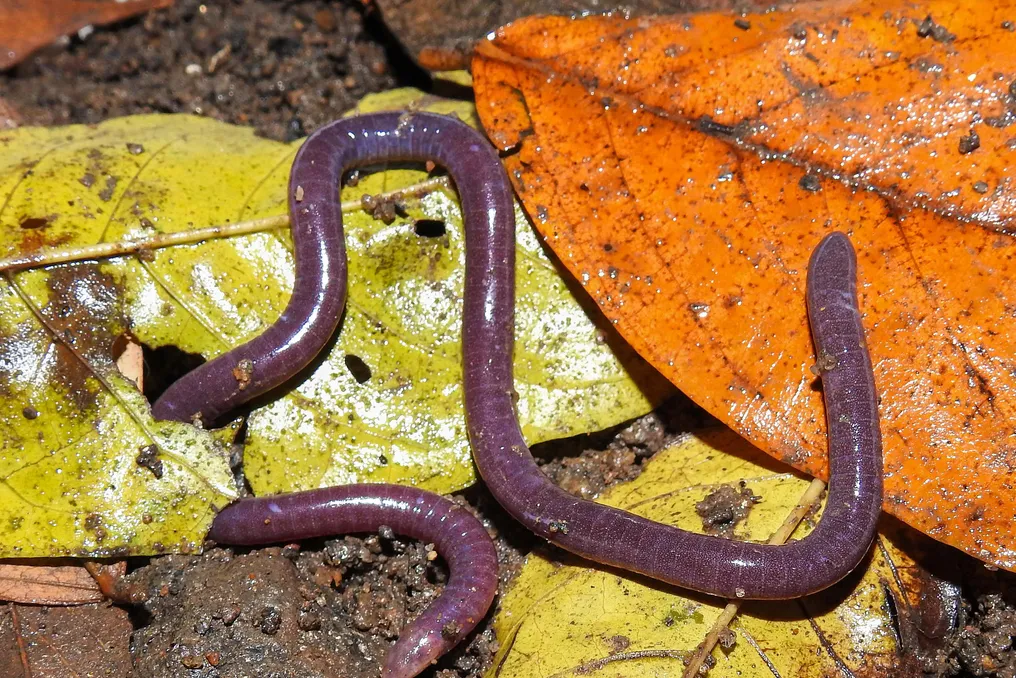
A new species of cecilia, a type of amphibian popularly known as the blind snake, has been named after 'Maria,' the most common female name in Brazil and worldwide. Researchers decided to use this name to raise awareness about this animal, which is little known even among specialists in the field. The scientific name of the new species is Siphonops maria.
Amphibian expert Luis Felipe Toledo, a professor at the Institute of Biology of the State University of Campinas (IB-Unicamp), who participated in the work with support from FAPESP and is one of the co-authors of the publication in the Zoological Journal, noted that he had only seen this animal once in the field.
This new species was discovered based on samples collected in Rio de Janeiro. Initially, the name was given in honor of a specific Maria who was part of a group of 11 slaves who planted over 100,000 trees in the Tijuca Forest between 1861 and 1874. This area later became part of Tijuca National Park, the world's largest reforested urban grove.
Adriano Oliveira Masiel, a researcher at the Paranaense Emilio Goeldi Museum (MPEG) in Belém and the first author of the paper, added that it is also a tribute to Brazilian women, as Maria is the most popular name in the country and one of the most frequently used globally. He emphasized that there are over 12 million Marias living in Brazil.
Cecilias are subterranean amphibians, meaning they spend most of their time underground. With reduced eyes, their vision is limited (the name cecilia comes from the Latin caecus, meaning 'blind'), but they possess sensory organs on their heads that allow them to perceive their surroundings. The morphological features of the body across different species are very similar, which makes them difficult to distinguish with the naked eye.
Nevertheless, in recent years, genetic tools and microtomography have helped better understand the evolution of this group. However, such studies still require collecting numerous samples for comparison, which may take years.
The holotype of the new species, the specimen serving as the standard for the entire group, was collected in 2015 in Serra dos Órgãos National Park, Rio de Janeiro, and deposited in MPEG. Masiel initially assumed it was the species Siphonops hardyi, but upon receiving the sample, he noticed differences in the number of body rings and dental structure compared to the known species. After sequencing some genes used for species differentiation, it was confirmed that it was a distinct lineage.
Over time, other colleagues, such as Toledo from Unicamp, were able to find more individuals with very similar external morphology. In 2018 and 2022, years after the discovery of the sample in Serra dos Órgãos, Masiel visited the Natural History Museum in Paris and the National Museum in Rio de Janeiro to compare other cecilias of this genus with the potentially new species. There, he found specimens identified as S. hardyi, but possessing characteristics of S. maria, one of which was collected in 1902 in Serra dos Órgãos.
In addition to genetic data and external morphology, the use of high-resolution computed tomography helped characterize the new species. Studying the animal's skeleton using this method allowed visualization of subtle cranial features that also distinguish it from closely related species.
The complex of analyses went beyond simply describing a new species. When compared with other genera in the same family, researchers found that the genus Luetkenotyphlus is not distinct from Siphonops, the genus cecília maria. Thus, the study establishes Luetkenotyphlus as a synonym of Siphonops.
Masiel explained that three species previously belonging to the genus Luetkenotyphlus are now named Siphonops brasiliensis, S. fredi, and S. insulanus.
Comparing the new species—which is apparently endemic to the state of Rio de Janeiro—with others, researchers discovered two more cecilia lineages resembling S. hardyi that potentially represent two new species. One was found based on samples collected in Ubatuba, on the coast of São Paulo state. The other was found in the municipalities of Castelo and Domingos Martins, Espírito Santo state.
However, as Toledo reported, they do not have samples from Porto Real [RJ], the collection site of the S. hardyi holotype, nor the holotype itself for comparison with these samples from Ubatuba and Domingos Martins. Furthermore, at least two specimens from Porto Real are housed in the Natural History Museum in London, United Kingdom. These samples were collected in Brazil in the 19th century and sent to England. A request was made to extract a small piece of tissue for sequencing using modern methods that extract DNA from degraded samples, but the museum refused permission.
The collection of scientific materials from Global South countries for storage in institutions of the Global North began during the colonial period and continues. Among other issues, this practice hinders developing countries from studying their own biodiversity. In recent years, scientists from the Global South have proposed ways to mitigate or eliminate this problem, such as facilitating access or even repatriation of collected specimens.
Another way to confirm whether the lineages from Ubatuba and Espírito Santo are new species is to search for and analyze additional samples with similar characteristics in other parts of the Atlantic Forest. 'This may take several more years, but we continue the search,' concluded Masiel.