In the late 1970s and early 1980s, engines equipped with turbochargers were viewed with suspicion, often being associated with unreliable vehicles, despite offering superior performance compared to what the Brazilian public was accustomed to. This technology was seen as a major novelty but was also linked to problems such as overheating and failures.
During this period, the available gasoline had a high sulfur content, low octane rating, and contained anhydrous alcohol additives. Although fuel alcohol, which began to be distributed regularly at gas stations in 1979, was more suitable for turbo engines, the combination of alcohol and turbo still presented difficulties for engine tuners.
The arrival of turbo technology
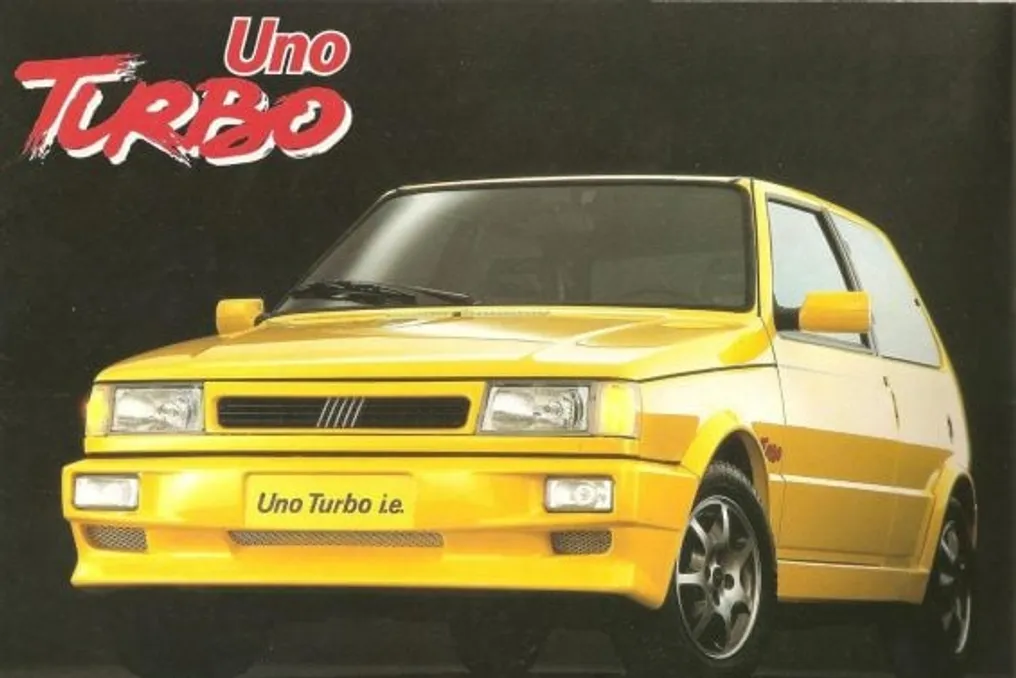
European manufacturers were eager to launch models with this technological solution, as turbo engines were considered the future. In 1985, Fiat introduced a version of the Uno called Turbo to the European market. This Italian model came equipped with a 1.3 engine that used a small water-cooled Japanese IHI turbine. Fueling was done via digital electronic injection, working together with an electronic ignition system, giving the small four-cylinder engine a power of about 105 hp.
The Uno Turbo i.e. was notably light and could accelerate from 0 to 100 km/h in approximately 8.5 seconds, reaching a top speed of about 200 km/h. At the time of its launch, some units of this small sports car arrived in Brazil for testing and demonstration purposes of the new European technology, which could potentially be implemented in the country in the future.
However, it took several years for Fiat to make a Uno Turbo manufactured in Brazil available. The Brazilian Uno Turbo was finally launched in 1994, nine years after the presentation of the Italian model. This vehicle became the first car produced in Brazil to come standard with a turbocharger.
Evolution and consolidation of the technology
The technology began to overcome the image of being restricted to problematic cars, starting to offer performance gains controlled by factory engineers without compromising engine longevity. This represented an important conceptual shift, moving turbo engines away from a reputation for instability and insecurity, and positioning them as an option for higher performance in smaller displacement engines. The effort of the engineering teams was crucial for this change in perception.
Maintaining momentum in 1994, and taking advantage of growing interest from Brazilian consumers in turbo technology, Fiat, which had been investing in this feature for years, also launched the Turbo version of the popular Tempra. Thus, that year, the Italian brand placed two factory turbo models on the national market, which was considered audacious, especially considering the specifications of Brazilian gasoline at that time.
Even under these conditions, the Brazilian Uno Turbo, which used a 1.4 engine imported from Italy, delivered 118 hp and generated 17.5 mkgf of torque. The Tempra Turbo, meanwhile, was equipped with a 2.0 eight-valve engine, producing a maximum power of 165 hp and 26.5 mkgf of torque. These results were significant for the time and placed both Fiat models among the highest-performing national automobiles.
New models and technological advances
Increasingly mastering turbo technology, Fiat introduced the Marea Turbo and its station wagon version, the Weekend, to the national market in 1998. Both were equipped with the unusual 2.0 five-cylinder engine with four valves per cylinder. In a more moderate configuration than that used in certain European models, this engine produced 182 hp and generated a maximum torque of approximately 27 mkgf, making it a suitable choice for Brazilian conditions and providing excellent performance to the Marea and its station wagon.
Fiat's confidence in turbo technology was so great that the company developed a competition version of the Marea Weekend for endurance tests, or long races, which tested both the performance and reliability of the mechanical assembly. This station wagon went on to win the 1,000 km route in Brasília in 2004, demonstrating the union between performance and durability.
Later came the Punto T-Jet. Its turbocharged version was launched in 2009 and transformed the small Fiat into a high-speed vehicle. Equipped with a 1.4 16V turbo engine, the sporty Punto accelerated from 0 to 100 km/h in about eight seconds and reached a peak speed slightly over 200 km/h. This engine generated 152 hp, and its maximum torque was in the range of 21 mkgf. This same engine was later applied to the Linea sedan and the Bravo hatchback.
At this point, it became evident to the Italian brand that turbo represented a viable solution for creating smaller, lighter, and more compact engines that could deliver high power and good torque values even at low RPMs. Over the years, improvements in injection systems, electronic management, fuels, and the turbocharger technology itself allowed for an even greater expansion of their applications.
Starting from the late 1990s and the beginning of the current century, the quality of Brazilian gasoline also underwent significant improvements, while progressively stricter emission regulations drove engine evolution. Currently, turbochargers are common in vehicles of various segments, frequently associated with low-displacement engines that balance performance, efficiency, and pollutant control. However, it is important to remember that, among the automobiles produced in series in Brazil, this trajectory began in 1994 with the Uno Turbo i.e., followed by the Tempra Turbo in the same year.