According to a working paper by economists from the Eurasian Fund for Stabilization and Development (EFSD), the economies of Kazakhstan, Kyrgyzstan, Tajikistan, and Uzbekistan remain focused on exporting primarily raw materials and minimally processed goods. The majority of added value and technological profit goes to countries that carry out subsequent processing stages, while economic integration in the region remains weak.
The study conducted by the fund examines the participation of Central Asian countries in global value chains in detail. The authors note that the dominance of raw materials in export flows limits productivity growth and increases the region's vulnerability to global commodity market volatility.
Economists used the Kupman-Wang-Way decomposition methodology, value chain participation indices, and indicators of production chain length and distance from final demand. Calculations are based on the Asian Development Bank's intercountry 'input-output' tables.
The research identified four different models of integration. Kazakhstan acts as a major supplier of oil, ores, and metals, which are then subjected to several stages of processing abroad. Kyrgyzstan has the most open export economy in the region but is heavily dependent on imported components and functions as a regional logistics and transit hub.
Tajikistan is at the early stages of production chains, acting as a supplier of raw materials with limited processing capacity, and high transportation costs hinder deeper product processing.
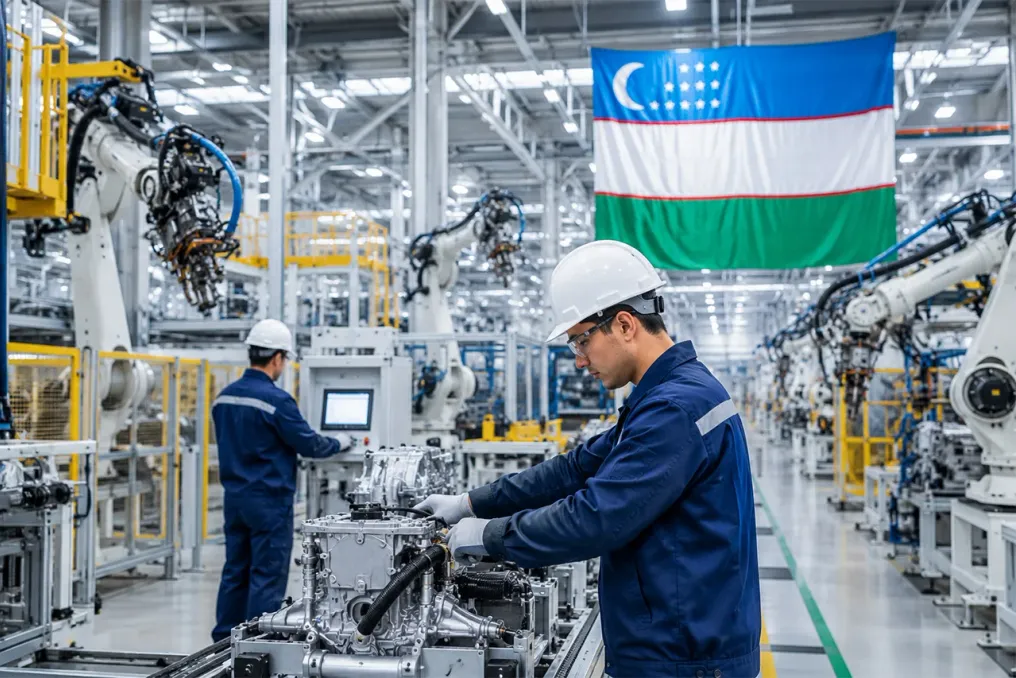
Uzbekistan demonstrates a different approach, developing a more balanced industrial model by increasing the import of technologies and capital goods to support automotive manufacturing, engineering, and other high-tech industries.
In 2024, Uzbekistan's intermediate exports accounted for 13.1% of GDP, while final exports reached 4.5%. Between 2022 and 2024, the domestic added value in intermediate exports increased from 11.5% to 13.1% of GDP. The country's overall index of participation in the global value chain reached 55.8% in 2024, compared to 55.6% in 2022.
The authors emphasize that between 2022 and 2024, Uzbekistan achieved the most noticeable progress in moving up the value chain. With a constant production chain length, the distance to the end consumer increased from 2.76 to 2.97. According to the economists, this indicates that Uzbek products, including textiles and goods produced by industrial clusters, are becoming more complex intermediate raw materials for global production.
The automotive industry in Uzbekistan recorded the longest production chain—2.89, which is interpreted as evidence of the deep integration of this sector into global production networks. The textile industry is also a positive exception in the region: where domestic added value was previously concentrated on cotton cleaning, it now includes spinning, weaving, design, and branding.
Switzerland is the largest buyer of Uzbekistan's added value, purchasing $1.71 billion, accounting for 17.9%. The authors attribute this to Switzerland's role as a gold processing center. It is followed by China with a share of 7.5%, and Turkey with 4.7%.
The main imports of added value come from Russia amounting to $2.25 billion (29.9%) and China amounting to $1.64 billion (21.7%).
Economic integration among Central Asian countries remains limited. Of Kazakhstan's $48.6 billion in added value embodied in the exports of other countries, only 1.6% comes from neighboring Central Asian countries, mainly Uzbekistan, which contributes $579.7 million. Conversely, of Uzbekistan's $9.7 billion in added value embodied in the exports of other countries, Kazakhstan participates with $132.8 million. Horizontal production links between Kyrgyzstan and Tajikistan are virtually non-existent.
The authors recommend deepening regional cooperation to form cross-border value chains, gradually shifting from raw material exports to more processed products according to each country's specialization, and attracting foreign direct investment related to local processing and technology transfer. Furthermore, they propose harmonizing regulatory frameworks and reducing transaction costs in trade between countries in the region.