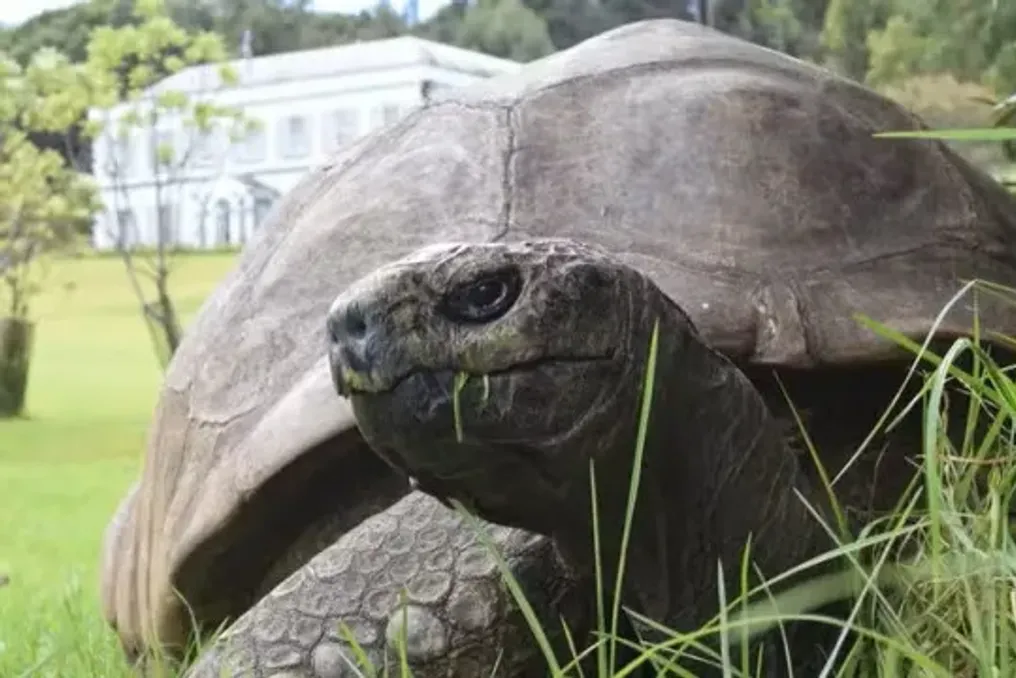
The giant tortoise Jonathan is the oldest land tortoise in the world. He has reached 194 years of age and resides on Saint Helena Island in the South Atlantic, possessing exceptional health. He has survived two world wars as well as major pandemics, including the Spanish flu and COVID-19.
A recent genetic study conducted by an international team of scientists from centers in the USA, the UK, Denmark, and Germany revealed the reason for his longevity. The article, published in the scientific journal Science Advances at the beginning of the month, reports that researchers collected genetic material via a cheek swab and blood analysis. For this, the animal was distracted with food, which allowed scientists easy access to its jaws.
For comparison, four other tortoises of the same species were also analyzed. Scientists concluded that Jonathan possesses not only good genes, like most of his relatives, but also does not show signs of genetic degradation, which constitutes his secret.
Researchers found 287 genetic variants in the animal that reduce typical aging effects. These variants regulate vital bodily processes, preventing cellular aging such as DNA damage repair, reduced inflammation, insulin regulation, and cancer suppression.
More technically, scientists studied Jonathan's complete methylome—the collection of chemical 'tags' in his DNA that determine which genes are activated or deactivated in cells, i.e., the precise instructions guiding the tortoise's development and function.
In the case of the analyzed animal, problems with these chemical 'tags' are minimal both in genes related to mitochondrial function and in RNA processing and genome repair. Thanks to this, Jonathan possesses what scientists call 'high-precision genetic transcription,' which gives him unique resistance to aging. This means that the animal's metabolism and DNA repair genes are very similar to those found in younger tortoises participating in the study.
One of the study's authors, Justin Gerlach from Cambridge University in the UK, told the publication that 'Jonathan's regulatory genes involved in energy production and DNA repair remain stable for almost two centuries, which is an outstanding achievement.'
In turn, Stephen Clark, director of the Callell Foundation, which studies aging processes and participated in the research, emphasized that 'Jonathan's genome represents a model of cellular resilience.'
Currently, the scientists' goal is to 'use this knowledge and apply it to humans.'
Jonathan was born on the Seychelles islands, but in 1882, he was brought to Saint Helena Island as a gift to Governor William Grey Wilson. When the tortoise was already 50 years old, it settled in the gardens of the governor's residence. Nevertheless, it seems to have adapted well to the location, as it has lived there for 144 years.