This week, the highlights in Science and Space on Olhar Digital included the NASA rover that set a new distance record on Mars, the SpaceX Starship rocket returning to the ground base after navigating the ocean, and the Moon moving away from Earth.
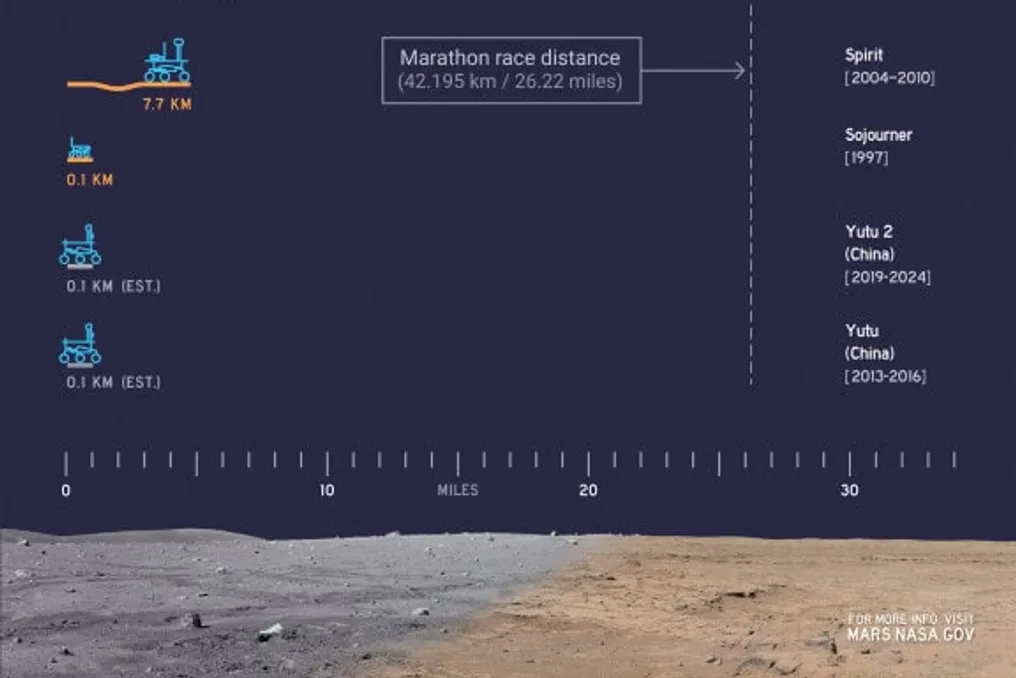
The Perseverance rover, belonging to NASA, registered a new milestone in distance traveled on Mars, exceeding 45.2 km since its arrival on the planet in February 2021. This achievement was reached on the 11th in the Jezero crater area and was communicated by the Jet Propulsion Laboratory (JPL) on Monday, the 12th, which is the agency responsible for managing the vehicle.
With this performance, the robot surpassed the total mileage recorded by Opportunity, another NASA rover that explored Mars between 2004 and 2018. However, the progress of Perseverance did not occur as initially planned, as the team had to change course to investigate light rocks, which may be some of the oldest studied on the planet, resulting in a delay of about two months in achieving the record.
Meanwhile, SpaceX transported the Ship 40 back to Texas, in the United States. This was the first Starship to survive an ocean landing after a space journey. The vehicle arrived at the company's base almost three months after its launch and will undergo a detailed analysis by engineers.
This inspection aims to evaluate the components subjected to the severe conditions of atmospheric reentry. The collected data may assist the company in developing a Starship capable of returning to base and conducting new flights.
Ship 40 was launched on July 24, coupled with the Super Heavy Booster 20, during the 13th test flight of Starship. The mission culminated in a controlled landing in the Indian Ocean. In previous tests, other ships had exploded after falling into the water, but Ship 40 remained practically intact and buoyant, leading SpaceX to decide to rescue it despite the complexities of an open-sea operation.
Two issues related to the Moon were highlighted this week. One concerns a study suggesting that it is undergoing a process of 'shrinking,' a phenomenon that is intensifying 'lunamotes' (moonquakes) and affecting the surface of the natural satellite. According to the research, this process occurs slowly: over the last 400 to 800 million years, the lunar radius has decreased by approximately 45 meters.
Additionally, the Moon reached its apogee this Friday, the 16th. This means it reached the farthest point from Earth in its current orbital trajectory. It is observed that this distance tends to increase progressively, and one possible consequence of this increase is the disappearance of total solar eclipses.