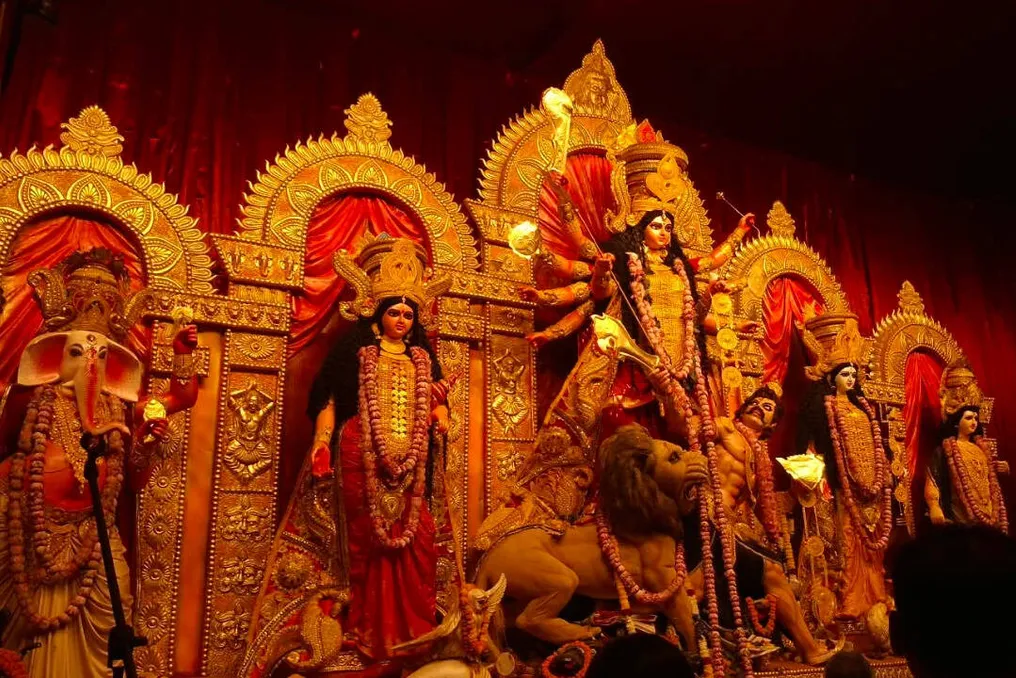
Long before the first beat of the dhak drum, the decision to hold Durga Puja is made, the budget is set, and partial construction begins. Although the goddess arrives in autumn, the people who bring her to the area start preparations many months in advance, determining the theme, creating the budget, and collecting necessary permits from various institutions.
For visitors passing through the pandal gates, Puja is just a few days of light, sound, and color. However, for the club organizing the event, it is an annual project funded by funds collected in the locality, a small group of skilled artisans, and a large number of people who must be in place on the right day. In West Bengal, this project is repeated in every locality, with each maintaining its own accounts.
Financial accounting is not insignificant. A medium-scale Puja costs several lakhs of rupees, and the largest portion of the budget goes not to the central idol, but to the structure built around it. Most guests never see these figures, deadlines, or the people behind the organization, and this is how the organizers want it. Puja must look like a finished work.
Nirmal, a Puja organizer from West Bengal who has been involved for the last ten years, knows this financial side well. He notes that 'a medium-scale Puja in West Bengal will cost approximately 10–15 lakhs.' He also emphasizes that 'the budget increases every year according to market inflation.'
This second statement is as important as the first. A committee that spent a certain amount last year should expect that the expenses for the same Puja this year will be higher before adding any new ambitions. Since the club operates with money collected from neighbors, the target amount constantly rises, and neighbors have to meet this increase.
When asked about the most expensive items, the answer comes immediately: 'The pandal is the most costly.' It is not the lighting, the idol, or the food. He estimates the cost of the pandal at 3 to 5 lakh rupees for a medium-scale Puja, making it the foundation around which the rest of the budget is built.
The idol accounts for one-fifth. Nirmal says: 'Regardless of how much the pandal costs, the idol costs one-fifth of it.' For a medium-scale Puja, this amounts to about 80,000 rupees. This is a striking ratio: the figure at the center of the festival, which all guests come to see, costs only a small fraction compared to the structure that shelters it.
Within the idol's cost, the most expensive element is gold. Certain gold ornaments are designated for it, including the jewelry provided by the club organizing the Puja. This jewelry represents a special type of expense because it comes from the organizers themselves.
The pandal requires a theme, and this theme requires time. Nirmal explains that 'the theme is determined at least six months' before the start of Puja. This is a long period for a festival that lasts only a few days.'
Who makes this decision varies. In some committees, he says, there is a specific person whose sole task is theme determination. In others, the creators of the pandals themselves make the decision. The choice is important not only from an aesthetic point of view, as the budget is also determined by the chosen theme. Once the idea is fixed, the construction cost can be calculated, and the money follows.
This is why the calendar starts so early. A theme chosen six months in advance allows time for pricing the work, finding a suitable artisan, and agreeing on the budget before construction begins. By the time neighbors see the first bamboo structures being erected, all important decisions have already been made.
Construction introduces uncertainty into the schedule. When asked how long it takes to build a medium-scale pandal, Nirmal honestly replies: 'It depends on the workers, frankly.' He adds that some might build the same pandal in two months, while others might take longer.
The reason for this, as he describes, lies in the shortage of skilled labor. 'There are few skilled pandal artisans.' Mainly, one experienced artisan works, and many people work under him. This structure explains a lot: the quality and speed of the pandal's erection heavily depend on one person followed by a large team. Thus, for the organizer, choosing a pandal artisan is not only a financial but also a scheduling decision. A slow or busy artisan can jeopardize the entire schedule.
The funding model is local. Nirmal explains: 'Each locality or colony has an assigned club that builds the pandal. Then they receive chanda, donations, and advertisements, which ultimately form the Puja.' There is also state assistance. He reports that this year the Government of West Bengal provides 1 lakh rupees for small Pujas, and electricity is provided free of charge. Free energy eliminates a bill that would otherwise need to be accounted for alongside lighting and pandal expenses. However, the 1 lakh rupee grant is intended for small Pujas. With a medium-scale Puja budget of 10–15 lakhs of rupees, the majority of the funds still has to come from neighbors, donors, and advertisers.
People who are paid. Some expenses are smaller but equally fixed. The priest's expenses, according to Nirmal, range from 30,000 to 40,000 rupees. The dhaki, whose drumming is as much a part of Puja as the idol itself, receives about 10,000 rupees, plus free food, accommodation, and clothing.
These additional expenses are part of agreements. The dhaki, who is housed and fed during the Puja, is an extra expense item borne by the committee beyond the basic fee. Nirmal also answered about the deity's expenses, but his answer only concerned the priest and the dhaki.
What is not included in the figures. If you add up the items listed by Nirmal—pandal, idol, priest, and dhaki—the total amounts to approximately 4.2 to 6.3 lakh rupees. His estimate for the entire Puja is 10 to 15 lakh rupees. This gap is significant and covers all other needs of the Puja, including lighting and food, which he mentioned to exclude as the largest expenses. Nirmal did not detail how these funds are distributed.
The biggest challenge. When asked about the biggest problem organizers face, Nirmal did not name any expense item. He stated: 'The biggest problem is that everything, from beginning to end, must be done properly.' This includes obtaining proper permits, such as from the police and fire department, and requires the involvement of many people to complete the Puja and give it the desired appearance. The pandal artisan and his team, the artist working on the idol, the priest, the dhaki, and the fundraising club members all work towards the same date. Thus, 10–15 lakh rupees is only part of what Puja requires; the rest is coordination, and much of Nirmal's decade in this work has been dedicated to that. For people passing through the gates, Puja appears as a finished product. For the club behind it, it all started at least six months earlier with the decision on the theme, and next year it will start again with a higher cost.