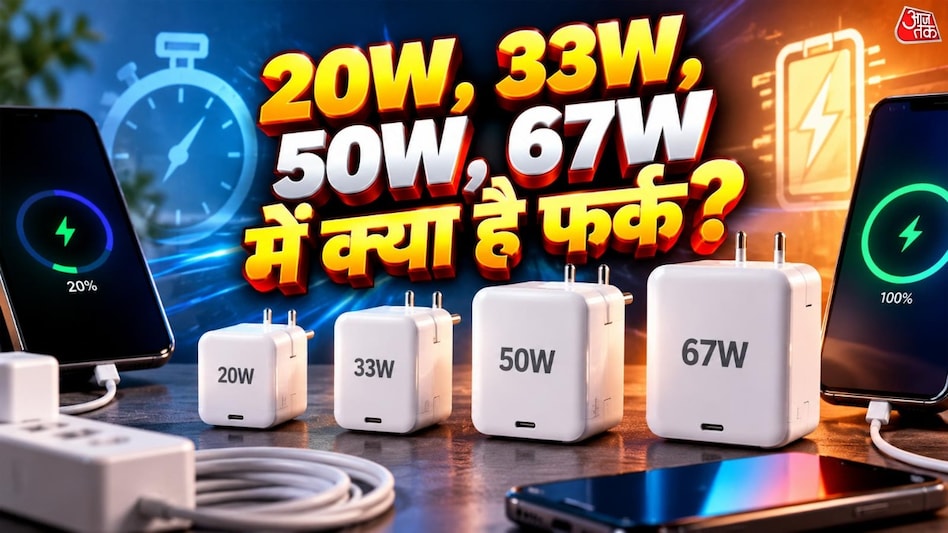
When purchasing a new mobile phone, users often pay attention to the markings on the charger, such as 20W, 33W, 45W, or 67W. Sometimes the same company releases chargers with different power levels for different phone models, and it is easy to find both weaker and more powerful options on the market. However, many wonder about the real meaning of these numbers and whether a higher-power charger truly charges a phone faster.
Essentially, these numbers indicate the amount of electrical energy the charger can supply to recharge the phone's battery. Let's look at this in simple terms.
The letter W on a charger stands for Watt, which is the unit of measurement for electrical power. Simply put, the watt indicates the power the charger can provide.
What do 20W, 33W, and 67W mean on a mobile charger?
A 20W charger can output up to 20 watts of power. If your phone supports 20W charging, it will charge at a good speed. A 33W charger can supply more power than 20W; if the phone also supports 33W charging, it will charge faster than with 20W.
A 67W charger has the capability to deliver greater power. If your phone supports 67W fast charging, it can charge in less time. Nevertheless, it is important to remember that a 67W charger will not provide fast charging for every phone; the phone will consume as much power as it supports.
The assumption that a 67W charger will charge a phone three times faster than a 20W one is not always correct. If your phone is designed for 20W charging, even when using a 67W charger, it will accept power within its own capacity. However, if the phone supports 67W charging and the charger meets these requirements, the charging will be fast. Charging speed also depends on the battery level and its temperature.
The speed at which a phone charges is determined not only by the number on the charger. Many factors are taken into account here. First and foremost is the phone's own charging capability: it will consume as much power as it can accept. Furthermore, some phone models are equipped with special fast-charging technologies, so using a compatible charger is critical. The phone may charge quickly at a low battery level, but the speed slows down as it approaches full capacity. Also, if the phone starts to overheat significantly, charging may slow down for safety reasons. One must also not forget the quality of the charging cable, as using a low-quality cable may prevent the phone from receiving all the necessary power.
Simply connecting a higher-power charger will not damage the phone's battery. If the charger works correctly with your phone, it will consume energy according to its needs. However, using low-quality chargers can harm the phone. Therefore, you should always choose a reliable charger from trusted manufacturers.
Before purchasing a new charger, you need to check what charging power your phone supports. You should buy a charger that matches this specification. It is pointless to buy a more expensive high-power charger if your phone is designed to accept less energy, as it will not be able to utilize the full potential of the more powerful block.
In short, the 20W, 33W, or 67W marking indicates the maximum power the charger can output, but the actual charging speed depends on the capabilities of the phone itself and the characteristics of the charger.