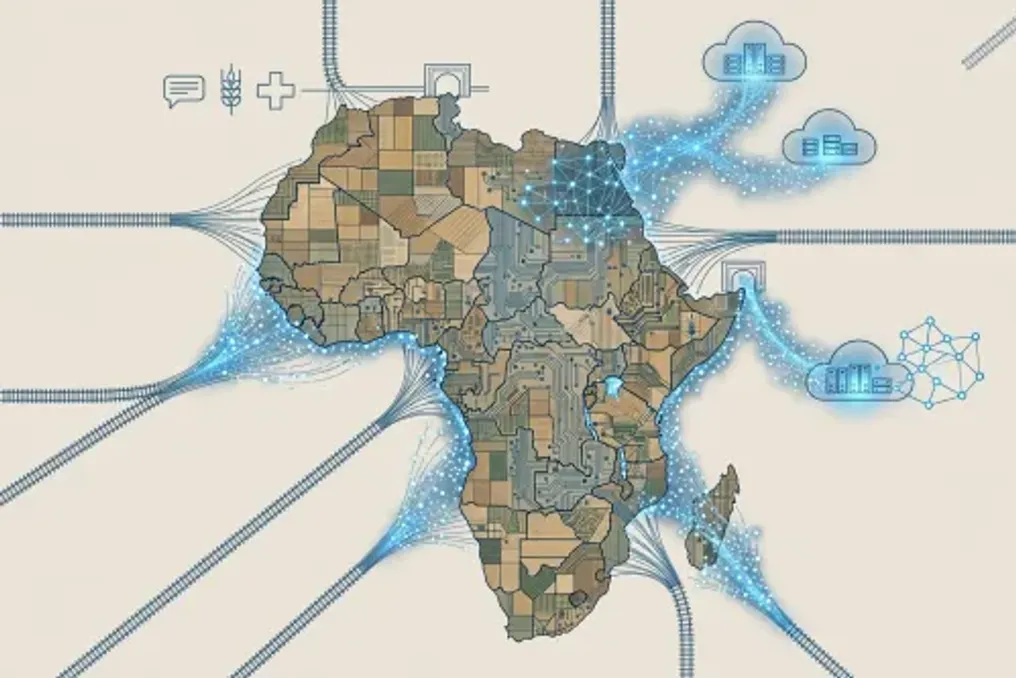
Instead of traditional colonial methods such as warships, Bibles, or geodesists, new players have arrived on the African continent offering cloud credits. They speak of inclusion, innovation, democratization, and 'capacity building,' providing universities with access to powerful language models, governments with opportunities for digital transformation, and African startups with cloud credits. These tools are what the continent could not create on its own.
However, the hidden clause of the deal is the requirement to provide data. This is where the new race for Africa lies. If the 19th century was characterized by crude exchange, where Europe demanded land, minerals, labor, and ports, the transaction of the 21st century is much more sophisticated. The new empire does not necessarily have to own territory; it just needs to know people better than they know themselves.
Data has become one of the exponentially growing currencies of the modern world because it possesses a capability unavailable to gold. Gold can be spent, but data can be copied, combined, analyzed, trained, profiled, and repeatedly transformed into intelligence. A mineral eventually runs out, whereas the population generates fresh behavioral data every minute simply by living. Thus, Africa possesses what Silicon Valley cannot produce in California: only Africa itself can create it.
This valuable information includes our languages, diseases, consumption habits, agricultural crops, weather conditions, classrooms, accents, informal economies, migration patterns, banking behavior, and cultural archives. Our movements, preferences, anxieties, and failures are not just digital trash, but economic ore. There is a danger that we will export it in its raw form.
Africa has previously experienced such exchanges: exporting cocoa for chocolate, crude oil for refined fuel, copper for electronics, diamonds for jewelry. Now, however, there is a risk of exporting human experience and importing intelligence trained on it. This can be compared to colonialism, but with an improved user experience.
The key difference lies between access and agency. Access means someone provides you with an account and password. Agency implies that you decide where your data is stored, who can use it, for what purpose, and at what price. It also means the ability to audit what is created based on the data, retain corresponding intellectual property rights, and participate in creating subsequent value.
This is why 'free access to AI' should alarm African politicians. The word 'free' is one of the most expensive in capitalism. When complex digital services are offered cheaply or for free on a massive scale, governments must ask what economic asset is on the other side of this deal. Sometimes that asset is us ourselves.
The asymmetry here is striking. The holder of a valuable dataset can receive research funding, computation discounts, or cloud credits. The company extracting patterns from this data can integrate the acquired knowledge into its own system. This system is monetized millions of times. One party provides the raw material, and the other owns the machine that turns the raw material into capital.
Economists have elegant expressions for uneven value capture, but Africa has enough historical experience to recognize exploitation when it happens.
The question of sovereignty is not whether Africa's data should ever cross borders—certainly, science requires exchange, medicine requires cooperation, and commerce requires compatibility. Digital isolation will lead to impoverishment, not the protection of Africa.
The main question is whether the value returns. A fair digital economy requires Africans to retain enforceable rights, bargaining power, technological capacity, and meaningful participation in the wealth that helps create their data. Therefore, data sovereignty cannot be reduced merely to privacy notices and consent windows; it is increasingly a matter of economic independence.
Nevertheless, Africa is entering the AI era, transferring old structural weaknesses into a new economy. While fiber may reach the shores, smartphones can fill pockets, and governments can enact excellent data protection laws, data ownership without sufficient computational power, capital, technical competence, and commercial ownership can direct decisive economic power elsewhere.
The old colonial map is being redrawn into architecture: a mine becomes a dataset, a railway becomes a fiber optic cable, a refinery becomes a model, and a concessionaire becomes a platform. And again, the most profitable part of the value chain risks ending up somewhere else.
India offers a useful warning, although not as categorical as the assertion that its technological infrastructure brought little wealth. This is clearly untrue. India's global centers of excellence now employ about 2.36 million people and generate around $98.4 billion annually. They have created impressive engineering potential, jobs, expertise, and increasingly complex product development and research. However, there is a lesson here that Africa must learn: infrastructure and technical labor do not necessarily occupy the top of the digital value chain. Ownership does.
Many of these centers ultimately serve multinational corporations whose parent companies retain control over global brands, platforms, intellectual property, distribution networks, and customer relationships through which value is multiplied. India earns billions, deservedly and increasingly so. But the owners of globally scaled digital platforms can command corporate valuations measured in hundreds of billions or even trillions. The comparison is imperfect, but the principle is sound: the money is in building and servicing the digital machine; significantly greater economic power lies in owning that machine.
Africa must ensure that it does not spend the next thirty years proudly counting jobs in the lower and middle parts of the value chain while someone else owns the top. Consider Anthropic. Founded in 2021, this AI company reached a valuation of approximately $61 billion by March 2025, and its annual revenue reached about $3 billion by May of the same year. Regardless of opinion on the AI hype valuation, capital markets signal that Africa would be foolish to ignore this.
An extraordinary premium is attached to owning the model, the intellectual property, the platform, and ultimately, the customer relationship. Africa must hear this cry. We simply cannot become the digital equivalent of a country that owns the mine shaft while someone abroad owns the mineral rights.
This does not mean technological nationalism. Africa cannot create every cutting-edge model tomorrow. Rejecting useful technologies simply because they originated elsewhere would be absurd. It is necessary to use their models, license them, collaborate with their creators, and attract investment. But one must stop confusing partnership with capitulation.
It is time for African governments to view strategic datasets as economic assets. Public health medical information, agricultural records, indigenous language corpora, geospatial information, educational datasets, and government records should not quietly migrate out of Africa's control through memoranda adorned with pleasant words like innovation, inclusion, and transformation.
Any major public data partnership must pass five extremely simple questions: Who owns the source data? Who owns the derived data? Who owns the improvements created based on it? Where is the computation performed? And where does the resulting money go?
If these questions cannot be answered clearly, the smiling delegation at the gate must remain outside. Because this is about something much bigger than just money. Models trained on African populations can increasingly influence who gets a loan, insurance, a job, medical care, or government support. If these systems belong to foreigners, are opaque, and are built on assumptions that Africans cannot adequately verify, we could ultimately find ourselves governed by automated judgments that we neither wrote nor understand.
This is not just a technological problem; it is constitutional power dressed in a hoodie. The AI divide could simply overlay every previous African rift: electricity, communication, education, research, capital, and computation. Artificial intelligence can generate exceptional productivity gains, but countries without the infrastructure, skills, and institutional capacity to use it will participate mainly as consumers. And consumers pay. Owners collect.
Perhaps Africa needs something less glamorous than another conference titled 'AI for Good.' It needs reliable electricity, data centers, high-performance computing, and datasets in African languages. Serious research funding, regional cloud capacity, procurement rules encouraging internal value creation, and universities that graduate builders, not permanent technological renters are also necessary. Above all, it needs political leaders capable of saying 'no.' No to contracts exporting strategic data without mutual benefit. No to 'free' platforms that become indispensable before anyone discovers the real cost. No to digital philanthropy that enhances someone else's proprietary intelligence while leaving African institutions dependent. And yes, sometimes they can keep their large language models.
Africa does not need to win a children's competition to create the largest generative language model on Earth. Africa needs systems that understand African law, agriculture, medicine, logistics, languages, markets, and social realities. The next important African tech company may never try to create another ChatGPT. Instead, it might create a specific intelligence system for African agriculture, pathology, mining safety, rural retail, logistics, education, or public administration.
But Africans cannot build the industries of the future if we carelessly give away today's raw materials. For centuries, Africa was told that foreigners came because Africa had too little. The terrible joke of history is that they usually came because Africa had a great deal. Gold. Rubber. Copper. Oil. Diamonds. Human labor. Now add data. This resource is invisible this time. It is produced every second by ordinary Africans using screens, speaking in languages, visiting clinics, buying food, taking loans, attending schools, traveling through cities, and simply living their lives. Extractors understand its value. They probably wouldn't stand at the gates otherwise. The question is whether we understand its value before signing the contract. The gates are open again. This time, before admiring what the visitors bring, Africa must ask the question that history taught us too late over several centuries: not just 'What are you coming to give us?', but 'What are you coming to take from us?'