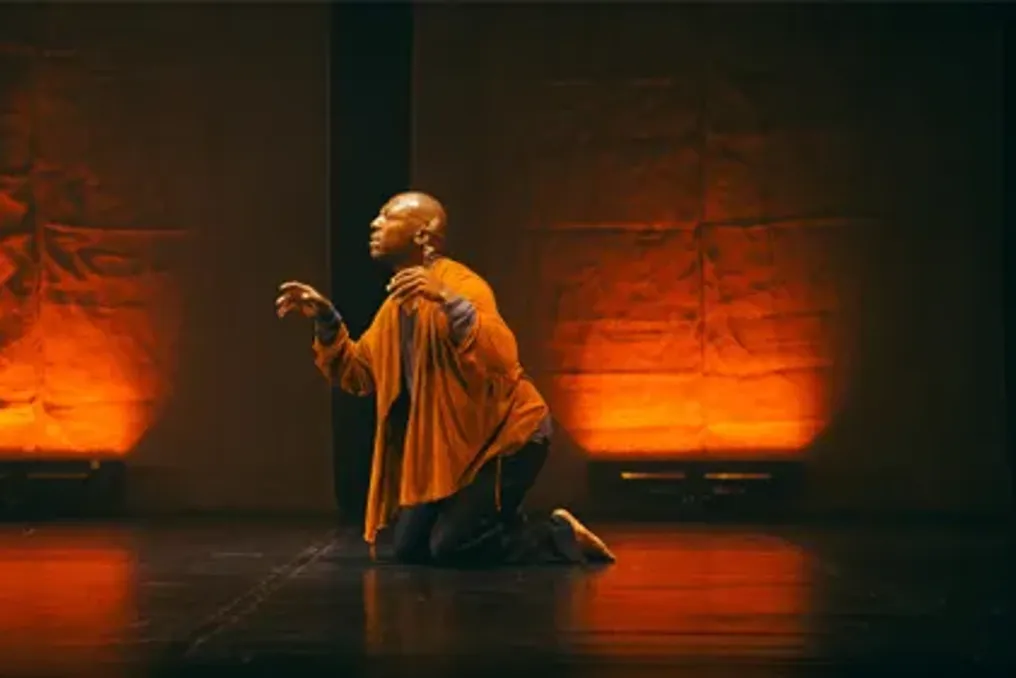
Choreographer and performer Vincent Sekvati Koko Mantso is returning to the University of Johannesburg (UJ) with a new dance work focusing on themes of identity, ancestry, and spirituality. Mantso was appointed as an UJ Artist-in-Residence in dance for 2026.
The first version of his work, titled Mpeyane’s Dream/Ipupo, will be presented at the UJ Arts Centre on October 25th. The performance is scheduled for 3:00 PM at the Keorapetse William Kgositshile Theatre and will take place only once.
This residency follows the premiere of his piece Desert Poems, which took place at the UJ Arts Centre in April 2025.
The work Mpeyane’s Dream/Ipupo is based on more than three decades of Mantso's creative activity. It reinterprets elements of his artistic journey, adapting them for the stage and lecture hall. At the center of the production is a character who tries to understand their identity. Through dreams, they embark on a journey to their ancestors, spirits, and their own life path.
Mantso views this work as a continuous process of development, rather than a finished piece. He notes: 'It is a process of development. There is nothing concrete yet.' He continues: 'I am trying to shape it like a dream to engage various ideas and see how they manifest physically and emotionally.'
The residency provides him with the opportunity to return to elements of his early work and refine them, which is different from simply recreating past performances. For this project, Mantso is also composing music and developing set designs. The music uses isiXhosa sounds, linking the protagonist's dreams to the spiritual world and reflecting Mantso's own background.
He emphasizes the connection between music and spirituality: 'Music is connected to spirituality because that is who I am and where I come from.' Adding that he comes from a Sangoma family, he says: 'Without this, I would just create for the sake of creation.'
Beyond performing arts, Mantso hopes his production will contribute to higher education. He sees this work as an example of studying his artistic development, allowing students to explore and interpret his creative process. The project also continues his research into teaching methods based on Sangoma rituals.
For Mantso, integrating traditional spiritual practices into a contemporary presentation requires special attention and understanding. He asserts: 'These are sacred movements that I use on stage and in rehearsals.' He insists on the need for respectful treatment of them, understanding their origin and implications.
Thus, the production explores something more than just movement and choreography; it examines the relationship between cultural heritage, spirituality, and artistic self-expression.
Mantso expects his performance to leave the audience with something more than just an appreciation of dance. He aims for the work to prompt deeper reflection and evoke an emotional response. He states: 'My work is not easy. I want to penetrate deeper into the essence.' He adds that ancestors speak to him in different ways, and he portrays this without guilt or reservations. 'It goes beyond entertainment. People must be touched by something greater than themselves.'
Through Mpeyane’s Dream/Ipupo, Mantso merges movement, original music, and spiritual influences into a work that reflects his ongoing artistic journey. The performance will take place on Sunday, October 25, 2026, at 3:00 PM at the Keorapetse William Kgositshile Theatre, UJ Arts Centre. Tickets cost 150 R and are available through Quicket.