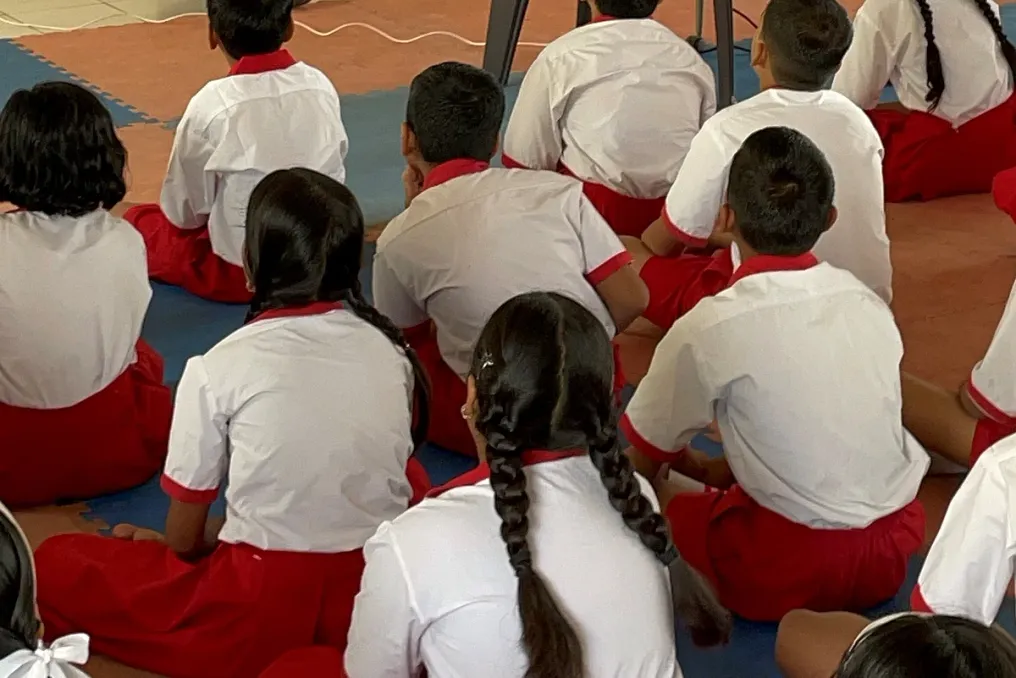
A student from Dubai is using artificial intelligence to assist children in overcrowded municipal schools across India, where they often lack individual attention in classes that can exceed 50 students.
Ishan Palicha, a 13th-grade student at Jumeirah College, launched the platform VIDYA.AI in May 2024 while he was in 11th grade. This initiative followed visits he made to schools in Pune and Mumbai, where he witnessed the difficulties faced by both students and teachers.
The AI-powered educational platform has reached approximately 5000 learners in the state of Maharashtra. It provides study materials, summaries, flashcards for revision, practice exercises, and progress tracking, all aligned with the curricula of the National Council of Educational Research and Training (NCERT) and Balbharati.
During his visits to municipal schools in Pune and Mumbai in 2023, Ishan observed that classrooms often housed over 50 students with only one teacher. He noted that providing individualized attention to every student under such conditions is extremely challenging, especially when many lack access to private tutors or other academic support.
The goal of this initiative is to bridge the gap between traditional classroom learning and the students' need for personalized attention to absorb and retain material, without increasing the burden on teachers.
VIDYA.AI utilizes speech-to-text technology and large language models to convert lesson recordings into structured educational resources. Students can review lessons at their own pace, complete exercises, and identify areas needing further assistance.
The platform also features a function called 'Teach It Back.' This feature was developed after Ishan and teachers noticed that some students could reproduce their recordings but struggled to explain scientific concepts in their own words. The function prompts students to explain concepts independently, and the AI identifies gaps in understanding and provides feedback.
Work on the platform was conducted with consultation from an education specialist holding a doctorate. Research from IIT Madras in speech recognition and post-processing for Indian languages also formed the basis of the project. This helped Ishan learn how to adapt AI tools to various languages, accents, and real-world classroom conditions.
Ishan emphasized that they are working on speech recognition technology capable of handling background noise and overlapping voices in classrooms. He believes that AI should reflect real learning environments, including language, curriculum, and classroom setting, rather than requiring every student to adapt to the same tool.
The user-facing platform is available on Google Play and the Apple App Store. The initiative collaborates with the Udaan Foundation and has attracted interest from organizations such as Teach For India, P&G Shiksha, and Akanksha Foundation.
Despite the growing reach, Ishan acknowledges that access to technology remains a challenge for the children intended to benefit from the platform. Students without reliable internet access or smartphones may face difficulties using the service independently. One potential solution is allowing teachers to download and print AI-generated materials so students can access them without a device, though he admits this is only a partial solution.
He also views the platform as a support tool for teachers, not a replacement for them. Educators can transform recorded lessons into review resources for students and use progress tracking to identify those needing extra help. Feedback from teachers has already influenced the platform's development, including the implementation of the 'Teach It Back' feature. Ishan hopes that partnerships with schools and NGOs will help deliver this technology to more children who cannot afford additional academic support.
The team aims to reach 10,000–15,000 learners by the end of 2026, striving to expand VIDYA.AI into a broader resource for underprivileged municipal schools across India.
For Ishan, this project also highlighted the contrast between his education in Dubai and the classrooms he visited in India. He noted that living in Dubai while working with schools in India showed him how vastly different educational environments can be. In Dubai, he benefited from smaller classes, more individual attention, and like-minded peers who motivated him, whereas in the Indian schools he visited, teachers often managed over 50 students simultaneously.
Teachers at Jumeirah College assisted him in testing early versions of the platform, reinforcing the importance of incorporating feedback from educators and students. Ishan concluded that young people do not have to finish their education before starting to solve issues that matter to them.