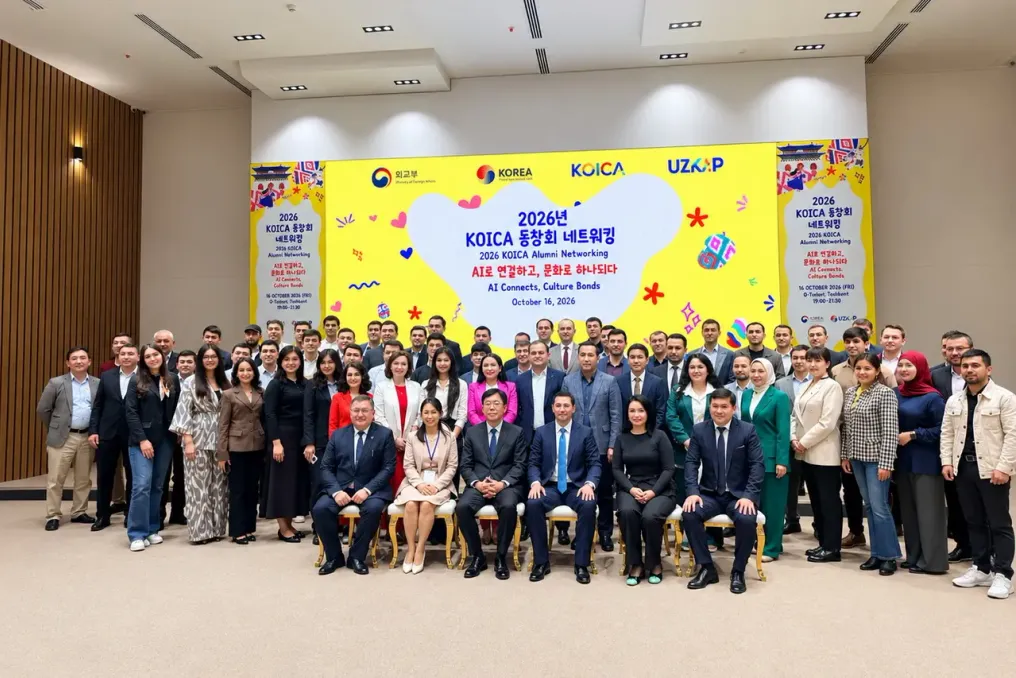
The Korea International Cooperation Agency (KOICA) office in Uzbekistan organized the event 'KOICA Graduates Networking 2026' under the slogan 'AI Connects, Culture Bonds' on October 16 in Tashkent, at the U-Enter venue. The event gathered over one hundred KOICA graduates and representatives from partner organizations with the aim of strengthening the alumni network and promoting cultural interaction between Korea and Uzbekistan.
The event was attended by His Excellency Won Do Young, Ambassador of the Republic of Korea to Uzbekistan, Kim Myung Jin, Director of the KOICA office in Uzbekistan, as well as representatives from key partner institutions, including the Ministry of Investment, Industry and Trade, the Ministry of Foreign Affairs, and the Institute of Professional Training of the Ministry of Internal Affairs.
In his welcoming remarks, Ambassador Won emphasized the significant role of KOICA graduates as bridges of friendship and mutual understanding between Korea and Uzbekistan. He noted that the connections established through participants' experiences in Korea form a valuable foundation for strengthening mutual trust and deepening the long-standing partnership between the two countries.
KOICA in Uzbekistan presented its main achievements in cooperation for 2026 and analyzed the activities of the first executive committee of the KOICA Alumni Association in Uzbekistan (UzKAP), established in 2024.
A significant moment was the transition to the second executive committee of UzKAP for the period 2026–2028. The new committee, headed by Jafar Khidirov from the Center for Economic Research and Reforms, presented its vision for enhancing graduate engagement, encouraging knowledge exchange, and expanding cooperation among those who have completed KOICA training programs.
Another part of the program included various cultural performances and interactive sessions. These included a traditional Korean flute performance (daegeum) by KOICA project volunteers, a traditional Uzbek performance, and an introduction to Korean culture such as the 'tuhō' archery game, playing with 'ddakji' paper tiles, playing 'jegichagi' badminton, and trying on traditional Korean clothing (hanbok). Participants also enjoyed a selection of traditional Korean and Uzbek dishes, strengthening friendly ties through food and cultural exchange.
Since the establishment of the KOICA office in Uzbekistan in 1995, KOICA has supported Uzbekistan's development through various grant projects and capacity-building programs, providing training and scholarships in Korea to approximately 3,300 Uzbek specialists. The Alumni Association, founded in 2024, serves as a platform to unite graduates of KOICA training programs, facilitate knowledge exchange, and promote sustainable partnership between the two states.
Commenting on the event, Director Kim Myung Jin stressed that the true value of KOICA's CIAT (Capacity Improvement and Advancement for Tomorrow) programs lies in transforming the knowledge and experience gained in Korea into a meaningful contribution to Uzbekistan's development. She also affirmed KOICA's commitment to supporting the further growth of the alumni association as a platform for knowledge exchange, professional networking, and long-term cooperation between the two countries.