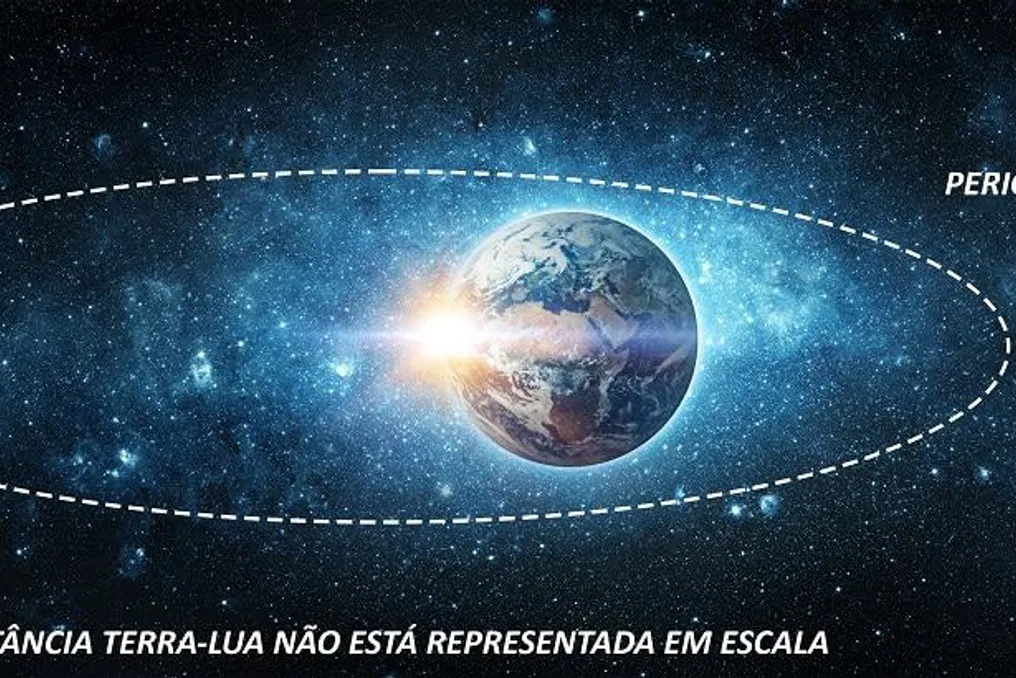
Tonight, the Moon reaches its apogee, which is defined as the farthest point the natural satellite reaches from Earth during each planetary orbit.
It is observed that the distance between the Earth and the Moon has a growing trend. According to NASA, the engine of this gradual recession is the movement of terrestrial seas itself. The gravitational attraction of the Moon generates tides in the oceans. However, because the planet rotates significantly faster than the Moon moves around it, the volume of water accumulates slightly ahead of the satellite.
This small positional discrepancy causes the mass of water to apply an extra gravitational force on the Moon, which transfers energy and causes its progressive recession. Since the Apollo missions, the distance between the two bodies has been measured with high precision, using reflectors installed on the lunar surface by NASA. Scientists fire lasers at these mirrors to time the return of light, confirming that the Moon is moving away from Earth by approximately 3.8 centimeters annually, a rate comparable to the growth of a human fingernail.
This exchange of forces acts as a subtle brake on the Earth, directly influencing its rotation. As the Moon uses the planet's energy to move away, Earth's rotation slows down due to the tides, resulting in the gradual increase in the duration of our days. This effect is not noticeable in daily life, adding only about 1.7 milliseconds every century. However, on geological scales, the difference is immense: when the Moon formed, about 4.5 billion years ago, a day on Earth lasted approximately six hours.
In a very distant future, the continuous recession of the Moon will bring visible changes to the Earth's sky. For example, total solar eclipses are threatened. As the Moon gets farther away, its apparent size in the sky decreases, preventing it from completely covering the solar disk. It is estimated that in about 600 million years, humanity will only be able to witness annular solar eclipses, where a circle of sunlight will remain visible around the satellite.
Josina Nascimento, an astronomer at the National Observatory (ON) and manager of the Division of Communication and Popularization of Science (DICOP) for over 45 years, summarizes that with the Moon's recession, it will never have an apparent diameter equal to or greater than that of the Sun, thus ending total solar eclipses after a certain period.
The question then arises as to when this distancing might become a real threat. Fortunately, the answer points to such a remote future that it does not require immediate concern. Theoretically, the orbital expansion would culminate in a total tidal locking, a moment when the Earth day would be 47 times the current length and the Moon would be fixed in the sky of a single hemisphere. However, the timeframe for this is measured in billions of years. Before the recession impacts the climate or planetary balance, the Sun will consume its fuel. In approximately 5 billion years, our star will become a red giant, swallowing both the Earth and the Moon long before any definitive separation between them.
Thus, despite the Moon moving away minimally each year, it will continue to illuminate our nights and regulate the tide cycle for billions of years. There is no reason for alarm, as our natural satellite will remain visible for a long period.