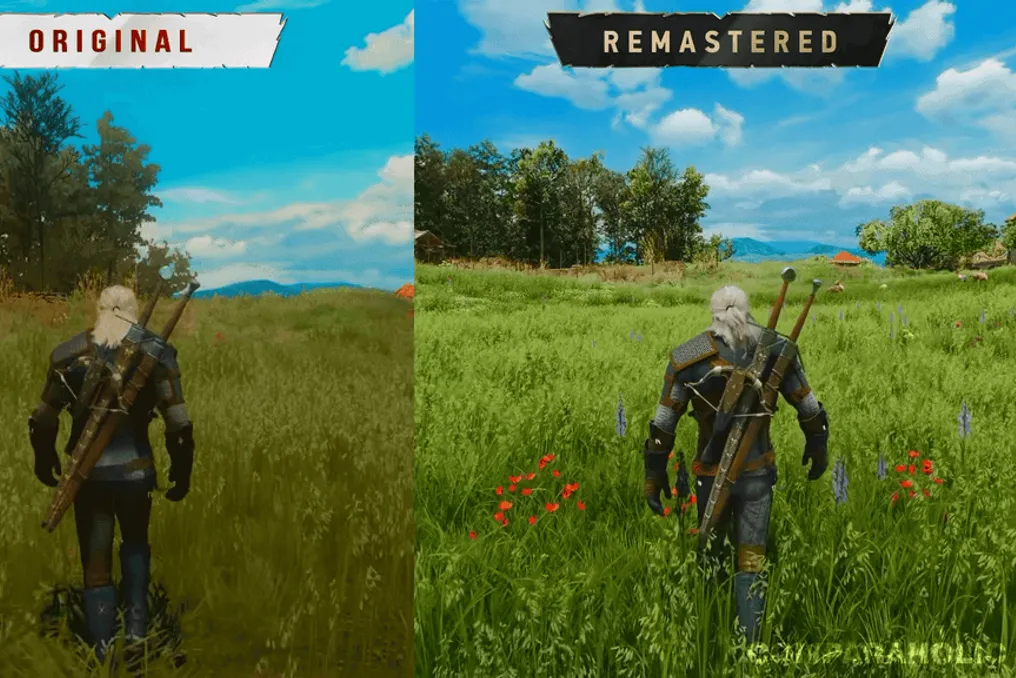
Eleven years after its release, The Witcher 3 has been launched in an updated version for PS5, Xbox Series, Switch 2, and PC. The update is available free of charge for existing owners and includes the expansions Hearts of Stone and Blood and Wine. The author questions CD Projekt's decision to re-release the old game instead of creating an expensive remake.
CD Projekt demonstrates its commitment to the community following the unsuccessful launch of Cyberpunk 2077. Meanwhile, while The Witcher 4 is under development, players receive a free remaster that serves as preparation for the paid expansion Songs of the Past, scheduled for 2027, and also introduces new players to Geralt's world.
This analysis is based on impressions from the PC version, although opinions on the console versions were gathered from other reviews. The remaster was released on September 29, 2026, and owners of The Witcher 3 received the update for free, including Switch 2 for buyers of the Switch 1 version. The expansions Hearts of Stone and Blood and Wine are available at no extra cost.
The new version features a global lighting system supporting Path Tracing and Ray Reconstruction, which affects even Geralt's hair. The lighting has been completely reworked for a full day and night cycle, adding volumetric effects and contrast between light and shadow, which is particularly noticeable in caves and sewers where the effect of the Igni sign looks more spectacular. Sunrise and sunset light reflects in the water, forests have gained greater depth, and nights have become more realistic. HDR has also been improved, and support for ultra-wide formats 21:9 and 32:9 has been added, along with controls for hair, shadows, and upscaling, while retaining the option to play with the original visuals.
The HD Rework by modder Halk Hogan is available on all platforms, improving textures, character models, monsters, vegetation, and environment. Foliage now has a new shading system, and wild areas are denser with a larger field of view. Geralt is more detailed thanks to added scars, improved clothing appearance, and eye shine; similar improvements apply to armor, skin, and surfaces. NPC faces have significantly improved, and monsters have been updated: drowned men have iridescent skin, trolls have metallic scales, and barghests have dark markings.
Some aspects have not been updated: on consoles, models still look old, the skin appears 'ceramic' and shines under direct light. In Ray Tracing mode on PS5, the sunset can look 'radioactive-orange'. On PC, the image sometimes appears dull, which can be corrected with the bloom setting. In dark areas, such as Kaer Morhen, walls may glow purple, and Geralt's hair may turn black. Minor lighting issues in some areas were fixed by a patch.
On PC, Path Tracing is the most demanding element, providing more realistic lighting that requires a powerful graphics card and enabled upscaling. On test hardware (Ryzen 5 5600, RTX 5060 Ti 8GB, 32GB RAM), the game ran stably at 145–170 frames per second at 1080p resolution with DLSS and Frame Generation. Other reviews noted severe stuttering when Ray Tracing was enabled in Novigrad and frequent FPS drops in 4K targeting 60 frames per second.
On portable PCs, the game had a ready configuration for Steam Deck. On the ROG Ally X, reducing environment and detail settings from low to medium did not cause an FPS drop or rapid battery drain, although using mains power is recommended for maximum performance. The base PS5 has two modes: Performance (recommended, targeting 60 FPS in 4K) and Ray Tracing (30 FPS, without Path Tracing and some visual enhancements). On PS5 Pro, Ray Tracing reaches 60 FPS, and Performance reaches about 90 FPS when using a 120Hz TV with VRR and PSSR. Nevertheless, FPS drops are observed when completing missions, auto-saving, and during active combat moments, and the freezing issue during auto-save in Complete Edition remains unresolved.
On Switch 2, the game runs with stability from 30 to 40 FPS at 720p resolution in handheld mode and 1080p on TV with variable frame rate (VRR). Although texture and FPS dips are observed, they are better than on Switch 1. Handheld mode offers a cleaner image, whereas the TV version has jaggedness and uneven HDR. Loading times have significantly improved compared to Switch 1, but transitioning between Novigrad and Skellige still takes over 30 seconds. Minor delays are also noted when opening the map or save menu, and small lighting dips occur when changing scenes, while Geralt's hair appears blurry and jagged due to DLSS.
The camera has become dynamic: it pulls back when there are many enemies, zooms in during duels, interrupts combat less, and follows Geralt during dodges. The combat system has become faster and heavier, with more lively and varied animations for steps and dodges for both Geralt and monsters. New finishers and counterattacks have been added, improved target locking, and a sword with a greater 'magnetic' ability to attract enemies. Quick signals allow skipping animations, and new combat mechanics can be disabled. Artificial intelligence has also changed: enemies now coordinate attacks and try to stay in groups, and wolves no longer run in circles to prolong the fight. At high difficulty levels, it is impossible to simply spam attacks.
Geralt reacts better to commands, without unnecessary movements when releasing the stick, and climbing has become smoother and more precise. The horse Karpead tires less, does not get caught on branches, and responds better to a gallop; one can now loot while riding, making the process less tiring. The skill tree has been reworked into a visual format with three levels per skill, requiring previous skills and unlocking faster. Points have been reset for returning players. New skills from the Viper, Manticore, and Griffin schools have been added, and new schemes allow concentrating points on complementary skills. Sign and alchemy skills now increase sword damage, and vice versa. The limit of 12 active slots is maintained, and the mutagens system from Blood and Wine is available from the start.
The interface has also undergone changes: the character menu now has a top panel, making it faster and providing clearer notifications, and equipment display is more intuitive. Quest tracking is simplified, with easier switching between tracked quests on the map, which by default only shows part of the indicators. Meditation now shows the passage of day and night instead of the interface screen. Witcher Senses are easier to see but require focus on the correct point. The photo mode has been expanded, although placing NPCs remains a difficult task. Cross-save functionality has been added, synchronizing progress across platforms via the CD Projekt account. The missions themselves have not changed.
On Switch 2, the right Joy-Con functions as a mouse, its rotation activates magic, and the gyroscope assists with aiming. The touchscreen is used for map and menu navigation.
Despite the improvements, some problems remain: combat is still based on dodges, feels 'floaty' and repetitive; targeting groups remains clumsy, and dodging is slow. Geralt sometimes slides towards enemies and has extra inertia when turning. On keyboard and mouse, modern combat feels unnatural and requires getting used to, but it is smooth with a controller. The skill tree does not eliminate rigidity, as most skills are related to combat. Karpead still collides with invisible barriers and has trouble with fences, and some facial animations seem outdated compared to the environment.
The game has received a mod menu in the main menu, integrated with mod.io, where the community publishes its creations. On PS5, the catalog is curated by CD Projekt. Cross-platform support has been implemented for the first time on consoles. Initially, most catalogs are cosmetic, with minimal gameplay changes. The transmutation system, called Reforja, allows changing the appearance of armor and weapons without altering characteristics. This service is provided only by the blacksmiths Yoana (armor) and Hattori (weapons), who must be unlocked during the campaign. New visual elements become available if the corresponding gear or blueprint is in the inventory.
Accessibility has received its own section in the settings menu with a 'Bard's Ballad' preset designed to reduce fatigue. Options include infinite underwater breathing, non-durable equipment, faster and invulnerable ships, health regeneration adjustment, activation of Witcher Senses, and the ability to ignore cargo weight, in addition to subtitle, interface, and HUD settings.
The remaster was released on September 29th with several bugs, many of which were fixed by patch 5.01, released on October 8th for PC, PS5, and Xbox Series. Some users reported issues not addressed in the patch. These included enemies stuck in animation after dying from Aard, incorrect overload indication based on carrying capacity, and Geralt teleporting outside a cliff when dismounting from a horse. There were also reports of a passable wall in the first room, minor progression issues requiring save reloading, and complete game crashes. PC analysis revealed issues with ultra-wide format: the HUD could not be repositioned, and on 32:9, 16:9 bars were centered on the screen. With HDR enabled, global bloom could not be adjusted, and the menu froze when attempting to stretch the screen during dialogues.
Switch 2 reviews noted that strong bloom made Geralt's white hair appear bright, and cities seemed empty, with unfinished movement in Novigrad. CD Projekt continues to respond to player feedback and fix shortcomings, planning an update for Switch 2 to improve image clarity.
As mentioned earlier, the author hoped for the revival of The Witcher 3, and this turned out to be a pleasant surprise, especially considering the update was free for basic game owners. Although the game was initially magnificent and beautiful, CD Projekt aims to take the franchise to a new level of graphics and gameplay in the era of next-gen consoles. The company showed foresight by implementing these changes during a period of rising prices and decreasing attention from the gaming community.
The remaster itself fundamentally changes the experience through its visual presentation and combat system. On PC, Path Tracing transforms the game's atmosphere, while HD Rework and the dynamic camera enhance the gameplay across all platforms.