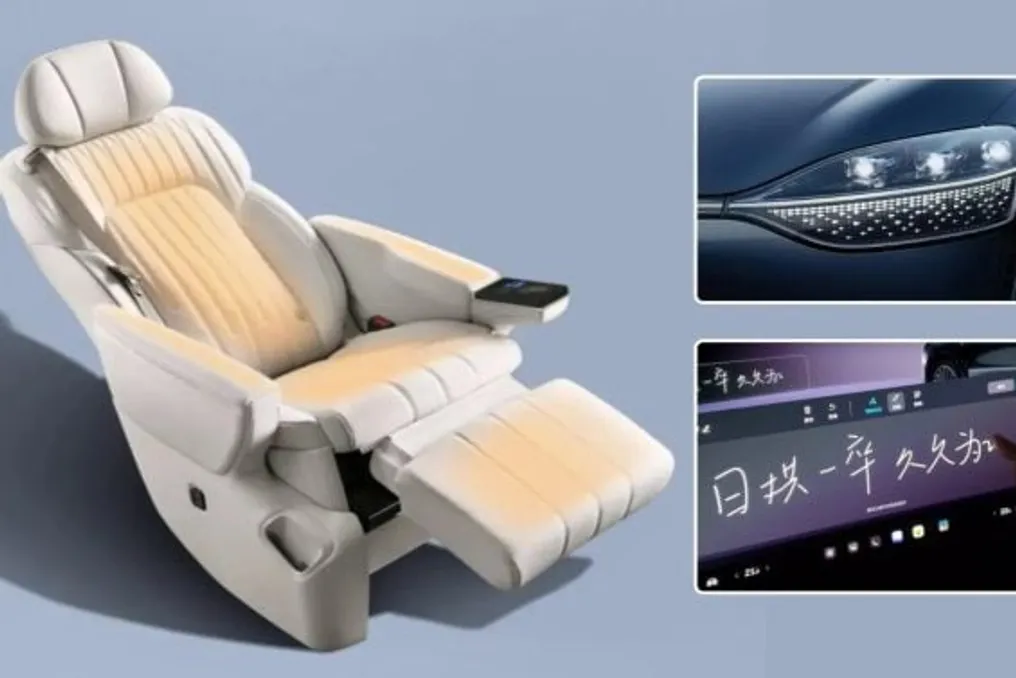
The Chinese government has expressed its intention to control the technological advancements present in vehicles marketed domestically. The Ministry of Industry and Information Technology (MIIT) submitted a set of regulations for public consultation on the 10th, aiming to restrict the use of foldable screens and the functionality of reclining seats while the vehicle is in motion.
This proposal, developed in collaboration with three other government agencies, will accept suggestions until November 10th, as reported by Reuters. According to the document, starting January 1, 2027, automakers must provide more detailed technical information to obtain approval for new models, which must also undergo reliability tests of at least 30,000 kilometers.
Vehicles that already have approval will have until July 1, 2027, to submit the requested data, under penalty of production suspension or being subject to a recall.
The proposed standards limit seats classified as 'zero gravity,' those that can recline almost into a bed, as well as rotating seats; these functions will be blocked when the car is in transit.
Screens were also included in the regulatory scrutiny. Multimedia centers, large display panels, and sophisticated windshield data projection systems must undergo safety evaluations regarding collisions and driver attention impact.
Additionally, the text prohibits the use of flexible and foldable screens, which may affect companies such as Xiaomi and Huawei. Essential functions, such as wipers, headlights, and defrosters, must retain physical buttons in addition to controls available on the screens.
Another aspect addressed relates to LED headlights that have the capacity to display designs and text. The government wants automakers to control the content displayed on both the headlights and the owner-customized taillights.
Finally, the text reaffirms the ban on fully recessed door handles, a rule that has been in effect in China since January 1, 2027. Doors must have an emergency mechanical opening mechanism and ensure adequate space for manual manipulation.
In the Brazilian context, models such as BYD Seal, Geely EX5, and Leapmotor C10 and B10 use this type of handle. Although Chinese legislation is not applicable in Brazil, it may influence brands to modify their global designs.