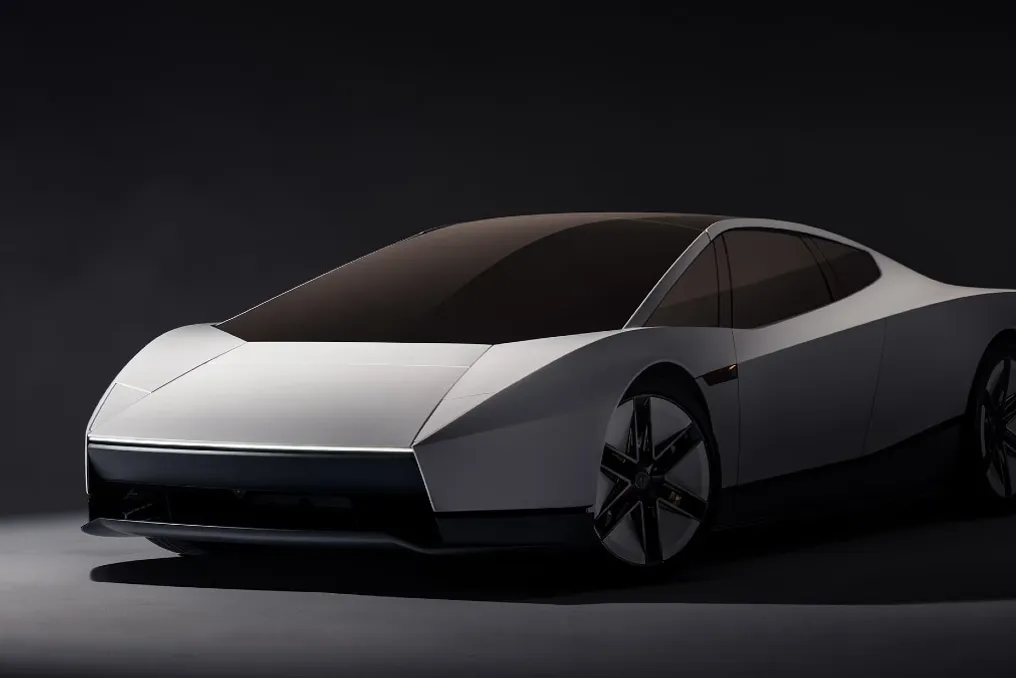
At an event in Texas, Tesla introduced its new Roadster, which demonstrated impressive maneuvers. The car jumped into the air, performed a somersault in the sky, and landed on all four wheels, resembling a rocket landing. A demonstration of jumping from the superstructure of a semi-trailer was also shown.
Tesla presented its electric sports car, showcasing a world of speed and advanced technology that generated significant interest. A question arose as to whether the company had released a flying vehicle. However, it was stated that the Tesla Roadster is capable of accelerating from 0 to 100 kilometers per hour in just 0.81 seconds. The main focus was placed on the Rocket variant, which is equipped with 10 engines and a special system for performing aerial stunts.
Tesla unveiled its new Roadster during an event held in the city of Texas. Various astonishing tricks of this car were displayed during this event. It was noted that the most unique and exciting version of this model will not be available to everyone but will require special approval from Tesla. The second generation of Tesla is presented with powerful characteristics and rocket technology.
Tesla CEO Elon Musk stated that the new Roadster can reach speeds from 0 to 100 km/h in 0.81 seconds. If this figure is confirmed in the production model, it will be a significant achievement in terms of vehicle performance.
According to information on the Tesla reservation website, the new Roadster will be available in three configurations: Performance, Thrust, and Rocket. All three models will have different performance-related technologies, but the most advanced features are reserved for the top variant. The Performance variant will be the entry-level model and will not be equipped with rocket engines. Next is Thrust, which will feature rear-mounted boosters. The most advanced Rocket variant will be equipped with 10 engines and, according to the company, a full flight system. This technology will use compressed gas, and the car's compressors are designed for recharging this system.
There are substantial differences in the reservation amounts for the three Roadster variants. The Tesla website lists a reservation amount of $50,000 USD for the Performance variant. For the Thrust variant, $250,000 USD must be paid, and this car will be produced in a limited batch. The Rocket variant is intended only for select clients, meaning an invitation from the company is required for purchase. Tesla has not yet specified the criteria for selecting clients for this variant or the planned number of units. The Rocket model is positioned as a single-seater, meaning it is designed for one passenger.
The official Tesla website also allows reservations in Indian Rupees. For the Performance variant, the reservation amount is 501,000 rupees, with the remaining balance due within the next 10 days. For the Thrust variant, the reservation amount is also 501,000 rupees, and the remainder is 24,524,000 rupees within 10 days.
Despite having engines, the Roadster possesses other features. Tesla claims that all three versions will be equipped with a special fan-powered suction system. This system is capable of creating a downward force of up to 2G, pulling the car down. In simpler terms, this helps improve the grip and stability of the car at high speeds. This technology was demonstrated during tests when Tesla showed the Roadster moving in reverse down a ramp. Nevertheless, it remains unclear how effective this technology is in real road conditions.
In addition to impressive engines, the Roadster raises several serious questions. Noise, operating principle, speed, and the use of these systems in normal driving could pose problems during vehicle operation on the road. Adherence to safety standards and legislative requirements for incorporating such technology into road transport is particularly important. Tesla has not yet clarified how the engine system will function in accordance with public road rules. It is also unclear whether all the tricks and functions shown at the event will be available to buyers, as the company has not provided complete technical information about the production model. Thus, questions remain regarding the final design, real-world road performance, and obtaining necessary permits.