Experts Discuss India's Potential in Technology: From Education to Manufacturing
Read more
YourStory [india, en]
yourstory.com

Experts Discuss India's Potential in Technology: From Education to Manufacturing

The annual TechSparks summit by YourStory brings together entrepreneurs, investors, policymakers, and aspiring founders to exchange ideas and stimulate new innovations. At its seventeenth edition, the summit focused on the question: how can India transition from being a consumer of technology and goods to a creator of them for itself and the world?

The final day of the event showed that India's development starts with its educational institutions, engineering colleges, and even food labeling. The task of educating 247 million primary and secondary school students is colossal.

According to Sushma Boppana, CEO of Sri Chaitanya Group of Institutions, and Santosh Vishwanathan, Vice President and Managing Director for APJ at Intel, India's main problem is structural, not quantitative. In a conversation with Shraddha Sharma, founder and CEO of YourStory and The Bharat Project, they discussed what success looks like for a student in the era of intellectual development when the education system still relies on 19th-century methods.

Vishwanathan noted that in the modern world, working time and technology time merge, and called for technology to be integrated into daily learning. He pointed to the ability of artificial intelligence to personalize lessons, allowing a child interested in cricket to study quantum mechanics through this sport.

Boppana, drawing on Sri Chaitanya's reach of two million students, emphasized that in the current generation, character traits such as resilience, engagement, and responsibility are more important than academic achievements. She stated that these three aspects matter more than educational accomplishments.

Vishwanathan also highlighted the serious shortage of computing power in India, noting that computing penetration is less than 10% in the country compared to 95% in the US and 75% in China. Given that 250 million young Indians will enter the workforce in the next five years, he called solving the livelihood issue for these people the most significant and profitable task.

Moving from schools to engineering colleges, Professor Ashok Jundjunwala, an institute professor at IIT Madras, Chairman of IIIT Hyderabad and ITEL Foundation, asserted that India possesses the talent to create any technology. However, he pointed out an obvious paradox: 'We can develop almost all technologies, yet we import almost every product.'

The Padma Shri awardee stated that the weakest link in Indian engineering education is the lack of teaching students creation principles. He advocated for cutting half of the current curriculum to make room for practical creation, adding that young founders, especially from second, third, and fourth-tier cities, are the true drivers of change in the country.

Regarding AI, Jundjunwala strongly urged India to define its own path. Instead of chasing trillion-parameter cloud models, he advised the country to focus on edge computing, launching compact, fine-tuned open-weight models on phones, laptops, and low-power devices. Through ITEL, he also connects scientists and startups to solve civic problems such as urban transport and waste management.

The event concluded with an candid discussion about trust. Revant Himatsingh, better known as Food Pharmer, shared his difficult decision as a founder after many years of criticizing India's largest food brands. By refusing deals worth crores, he launched Only What’s Needed (OWN) to offer consumers honest alternatives.

He admitted: 'If I make a mistake, I am finished.' The brand displays nutritional information in large print on the front of the packaging, shows the exact percentage of each ingredient on a pie chart, and provides a QR code with labels in major Indian languages. The company spent almost no money on marketing, preferring to hold public board meetings and invite people to its factories.

The advice he gave to founders was simple: question the artificial rules of the industry. 'If I had listened to them, I would have been one of many. But because I broke those rules, I stood out.'

The three-day conference ended with a clear message: India has the talent, scale, and challenges worthy of solving. Whether it is reforming classrooms, rethinking engineering education, or restoring consumer trust—the next chapter of Indian innovation will be written by those ready to take risks and create.
Similar stories

TechSparks 2026 Day Two: Discussion on Bangalore's Development Plans and Global Startup Potential
Read more
yourstory.com

TechSparks 2026 Day Two: Discussion on Bangalore's Development Plans and Global Startup Potential

The second day of the 17th TechSparks 2026 conference in Bangalore was dedicated to discussing policy and product issues. Participants examined topics such as governance, the future of the city's infrastructure, startups focused on the global market, and India's deep technology capabilities.

The main event of the day brought together founders, investors, policymakers, and technologists to explore how India can develop for itself and for the world. During this event, a fireside chat took place featuring Krishna Bayre Gowda, Minister for Greater Bangalore Development of the Karnataka Government, and Shraddha Sharma, Founder and CEO of YourStory and The Bharat Project.

Drawing on his experience in the state's Land Revenue Department, Gowda stated that applying technology in public administration can reduce corruption levels and decrease the trust gap between citizens and authorities. He emphasized: 'The more we implement technology in governance, the better our service delivery to people will be, and the lower the levels of corruption will be.'

Nevertheless, the minister warned that technology alone is insufficient to solve systemic problems without changing citizen behavior. He noted that out of approximately 3.5 to 5 million properties in Bangalore, only 2.3 million have registered khatas, and only 1.8 million pay property taxes.

The minister also presented an ambitious plan for the city's growth. The state plans to expand Bangalore's metro network from the current 96 km to 170 km over the next 18 months, aiming for a length of 400 km by 2037, when the city turns 500 years old. A plan is already being developed for an area of 2000 sq km around Bangalore, which significantly exceeds the 750 sq km covered by the Greater Bangalore Corporation. Gowda added: 'I hope that in the next six months we can demonstrate tangible results in making Bangalore a relatively cleaner city.'

Turning to global aspirations, Manish Maheshwari, Managing Director of Stripe India, noted that artificial intelligence is accelerating and lowering the cost of creating companies aimed at the global market from India, giving rise to what he termed a 'minimum viable company.' In his view, Indian founders can now go global from day one. He cited the example of Emergent, which achieved $100 million in Annual Recurring Revenue (ARR) in eight months, and Stripe data showing that 76% of customers prefer to pay in their own currency. Maheshwari also confirmed Stripe's agreement to acquire OpenRouter, a service that directs AI queries to the most suitable model, which is a bet on helping companies control rapidly growing AI costs.

He commented: 'In some modern companies, the amount of money people spend on tokens exceeds the amount they spend on salaries.'

Deep technologies took center stage on a panel featuring Vishesh Rajaram from Speciale Invest, Mayuresh Raut from Seafund, Anirudh Singh from Avatar Venture Partners, and Abhishek Srivastava from Kae Capital. Investors observed that deep tech is fostering new types of founders, supported by India's talent and the geopolitical demand for self-sufficiency in critical technologies. Raut suggested there is an eight-to-ten-year window of opportunity, while Rajaram pointed out that it is 'nerve and patience' that distinguishes founders capable of withstanding trials.

Day three of TechSparks 2026 will continue exploring how India can create, own, and scale technologies of the new technological order. The agenda includes discussions on rethinking engineering education with Professor Ashok Jundhunal, building global companies from day one with Naren Sham from Omio, AI sovereignty and the next billion users, climate innovations in energy, water supply, and clean air, as well as India's $100 billion AI potential, after which the summit will conclude with a fireside chat with Zakir Khan.

30 startups shaping India's technological future presented, and space technology challenges discussed
Read more
yourstory.com

30 startups shaping India's technological future presented, and space technology challenges discussed

At the 17th edition of YourStory's flagship tech startup event, named TechSparks 2026, Sridhar Vembu, Chief Scientist and Co-founder of Zoho Corp, presented the Tech30 list. These companies reflect the growing aspirations of Indian startups to develop their own technologies and apply them to solve practical problems.

During the event, the main topic of discussion was the impact of Artificial Intelligence (AI) on software development. Vembu stated that AI is capable of writing higher-quality code than at least 60–70% of developers, and that in three to six months, with accelerated processes, AI will be able to create better software than 90% of engineers.

Nevertheless, Vembu presented a counter-intuitive macro perspective, noting that a significant portion of India's population will remain unaffected by this change, as approximately 97% of the population does not write software code but acts as a consumer of technology.

Karnataka Government's Approach to Using AI

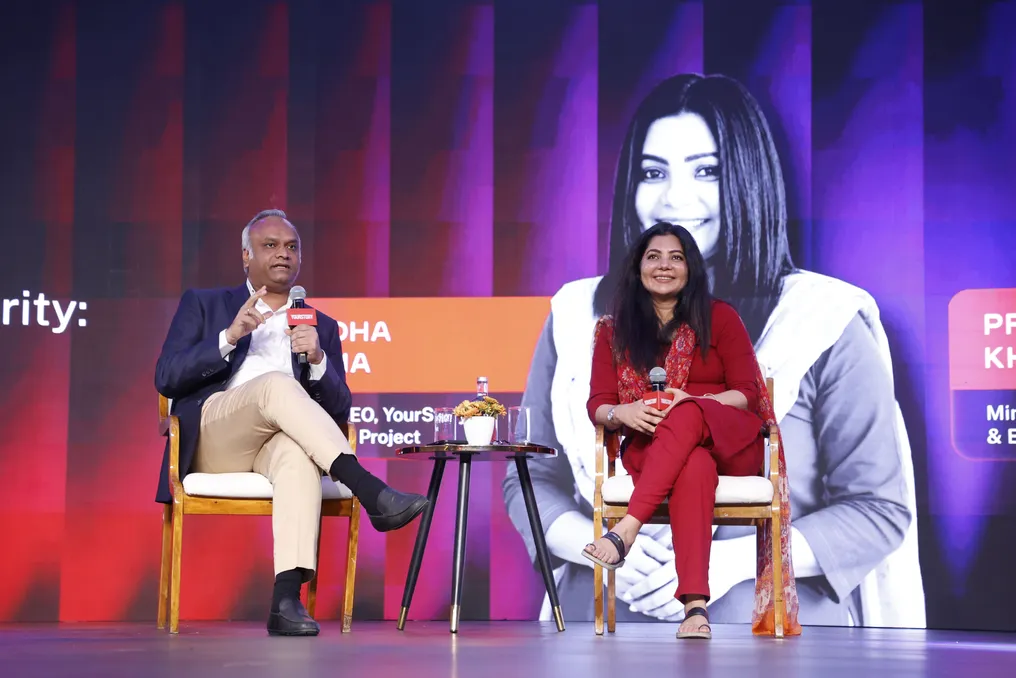
Priyank Hardge, Minister for Home Affairs, Information Technology, BT, and E-Governance of the state of Karnataka, announced at the event that the Karnataka government is cautious in using AI in governance. First and foremost, it is necessary to understand how this technology can be applied responsibly. However, he emphasized that the state plans to use AI to solve basic issues such as citizen grievances, healthcare, and mobility. Furthermore, a committee has been formed to study the responsible implementation of AI in public administration.

Hardge also stated that the state aims to define the future of global technologies, and at Techsparks 2026, he announced that the next era of technological innovation will begin in this state. In a conversation with Shraddha Sharma, Founder and CEO of YourStory and The Bharat Project, the minister highlighted the government's continuous work to upskill local personnel to meet the changing demands of the global economy.

Challenges in the Space Industry

The discussion on space technologies revealed that establishing companies in this field requires immense courage. Such enterprises face the need to endure hundreds of investor rejections, acute supply chain issues, and the constant threat of orbital failure. Srinath Ravichandran, Co-founder and CEO of AgniKul Cosmos, and Suyash Singh, Co-founder and CEO of GalaxEye, shared practical insights into the complex task of building aerospace ventures in an emerging market during the 17th edition of TechSparks.

Popular