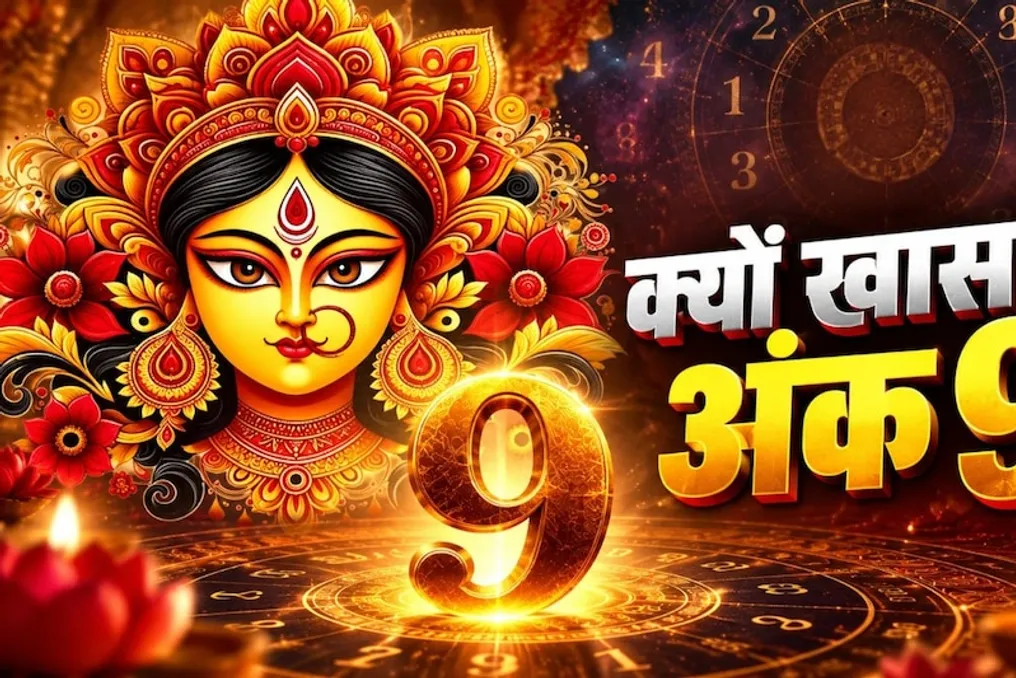
The Navratri festival, which is a sacred event, means 'nine nights.' During this festival dedicated to the goddess Durga, nine different forms of the goddess are worshipped throughout all nine days. The question arises as to why the number 9 holds such great significance in this great festival. There is a belief that the nine days of Navratri, the nine forms of the goddess, and the tradition of worshipping nine girls make the worship powerful.
In numerology, the number nine is associated with Mars, which symbolizes courage, valor, and energy. The southern direction is considered connected to Mars, while the southeast direction, known as Agni Kona, is associated with Venus. In the context of worshipping the goddess, the connection of these two planets conveys a message about the balance between strength, femininity, happiness, and prosperity.
The energy of Mars corresponds to the aspect of the goddess Durga that destroys injustice and establishes righteousness. The weapon held by the goddess symbolizes bravery, self-defense, and the fight against evil forces. The nine days of Navratri inspire the practitioner to awaken inner strength and firm resolve. Furthermore, the worship of nine girls conveys a message of honoring girls as a sign of respect for divine power.
From a mathematical perspective, the number nine has an interesting property: the sum of the digits of the number obtained by multiplying any integer by nine is always nine or a multiple of nine. For example, 9×7=63 (6+3=9) or 9×3=27 (2+7=9). However, the main religious significance of the number nine in Navratri is based on the nine forms of the goddess and the associated traditions of worship.
According to mythological beliefs, the battle between Goddess Durga and Mahishasura lasted all nine days. After this, the goddess killed Mahishasura on the tenth day, which is why Vijayadashami is celebrated after Navratri. Some astrologers believe that the number 9 represents the planets of the Universe. Also, our Nakshatras number 27, and when added (2+7=9), it results in the number 9.
The planet Mars in the southern direction embodies courage, resilience, and valor. The southeast direction, called Agni Kona, has an initial connection with the element of fire and is associated with Venus. Venus is a factor of love, beauty, femininity, family happiness, art, and material well-being.
Since Agni Kona is considered related to energy and activity, it is considered a suitable place for worshipping Goddess Durga. The image of the goddess also manifests this energy: on one hand, she is a symbol of compassion and maternal love, and on the other, she takes the form of immense power against evil.
This symbolic union of Mars and Venus indicates an important balance in life. Mars gives the courage to achieve goals and the ability to fight obstacles, while Venus teaches the importance of love, gentleness, and beauty in relationships. Life does not become happy solely through strength, and difficulties cannot be overcome only through comfort. Balance between them is necessary.
The message of worshipping Goddess Durga is to combine courage with compassion, power with sensitivity, and success with virtue. Worshipping the nine forms of the goddess during Navratri encourages a person to recognize their inner strength and use it for the good of society. Thus, the valor of Mars and the splendor of Venus represent a broad concept of strength, respect, and a rich life.