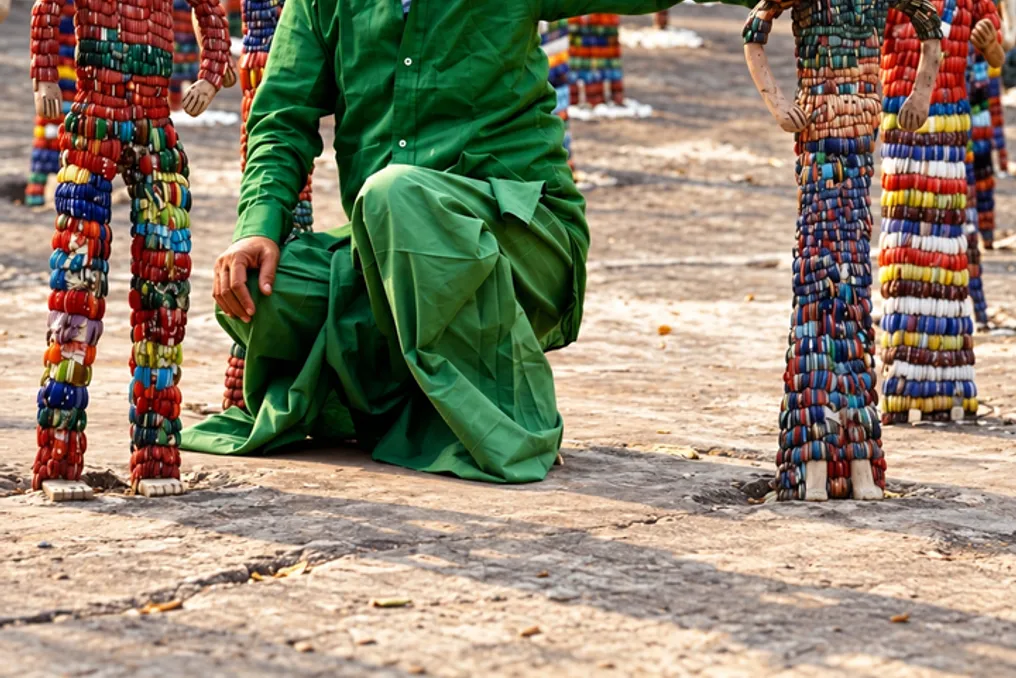
The famous Rock Garden of Chandigarh was secretly created by a man named Nek Chand, who used rubble, construction waste, and broken bangles to build an entire world encompassing people, animals, gods, waterfalls, and winding passages.
In the 1950s, Chandigarh was being developed as a model of modern India, featuring well-planned roads, geometric sectors, and monumental buildings. However, the construction of the new city involved the demolition of old villages.
Nek Chand worked as an inspector for the road department of public works in Chandigarh. As villages were demolished to make way for the new city, Chand began collecting the remaining debris: ceramics, stones, scrap metal, construction waste, and broken bangles.
After work hours, he would cycle around to find unusual stones and discarded items. He then transported them to a secluded plot of land near Sukhna Lake. For the first six months, he kept this activity secret from his wife.
Details from bicycles turned into skeletons, broken pottery became bodies, and glass bangles added color. The trash transformed into animals, musicians, and warriors. But Chand did not limit himself to sculptures; he also constructed courtyards, amphitheatres, and waterfalls.
In the early 1970s, his creations were discovered by officials. By that time, his secret world spanned several acres and contained thousands of sculptures. The only issue was that the project lacked official permits.
There was a threat of the project being demolished, but public support helped save it. On January 24, 1976, Chand's secret creation was unveiled to the public as the Rock Garden of Chandigarh, and he was appointed its Creator-Director.
What started as a collection of one person's discarded items eventually grew into a 35-acre garden with over 10,000 sculptures. A place that authorities could have torn down became one of Chandigarh's most recognizable landmarks.
There was also a personal motive: Nek Chand was forced to leave what is now Pakistan during the Partition of 1947. This time, he managed to gather the remnants of a vanishing world and preserve them.
Years later, the Rock Garden itself came under threat. When a proposal was made to run a road through part of the garden, about 1,000 people reportedly formed a human chain to protest. By then, the garden had become an integral part of the city.
Ultimately, Nek Chand received the Padma Shri award. However, gaining fame was never his goal. He once said: 'I never knew who would see it. I just did it for my own pleasure.'