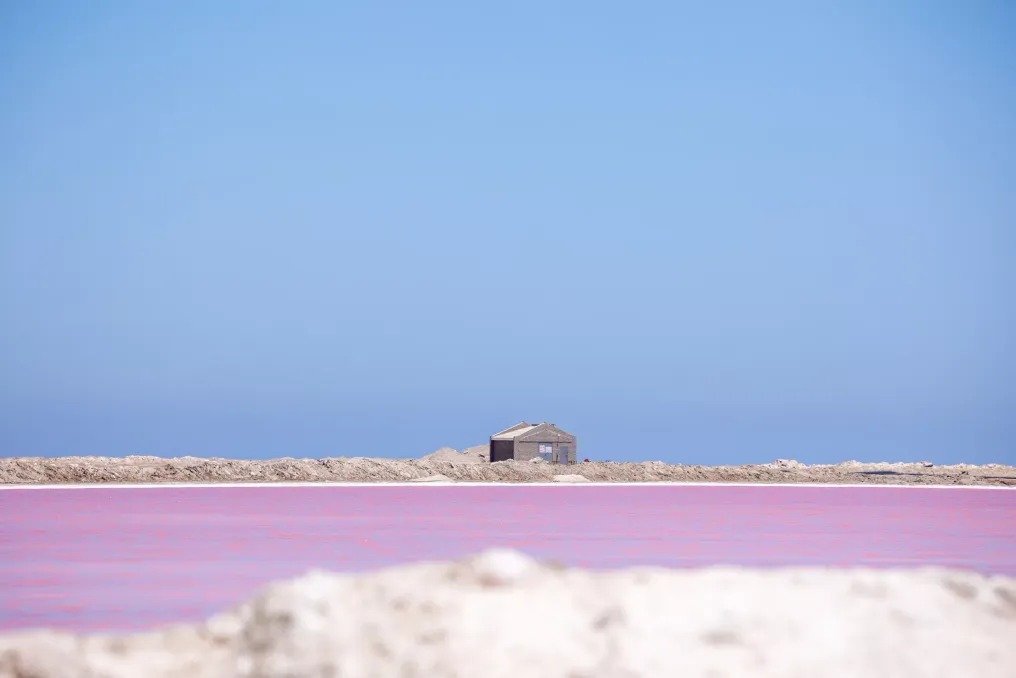
The salt pans of South Africa are known for their harsh landscapes, where white salt crusts contrast with the dry earth under a vast sky. However, under certain conditions, some of them take on unexpected shades of pink, orange, and red.
These colors look almost unreal, but the scientific explanation is quite fascinating. Many factors can transform these seemingly barren landscapes: from microscopic organisms thriving in the saline water to minerals left behind after evaporation.
It is important to understand that such colors are not permanent, and not every salt pan turns pink. What is observed depends on the water, weather conditions, and the tiny living creatures inhabiting it.
Salt pans form in shallow depressions where water collects and then evaporates, leaving behind salts and minerals. In the drier regions of South Africa, some pans remain dry most of the year, while others fill temporarily after rainfall.
When the salt concentration reaches a sufficient level, certain microorganisms can actively develop. These organisms, known as halophiles, include bacteria and archaea that produce pigments, sometimes giving the water a pink, orange, or red hue.
Another contributor is the microscopic algae Dunaliella salina, which synthesizes beta-carotene—the pigment responsible for the orange color of carrots. Under high salinity, it can accumulate large amounts of this pigment, intensifying the warm tones visible in some salt lakes.
Thus, the landscape is colored by life too small to be seen with the naked eye. The content of salts, the amount of precipitation, sunlight, and the present organisms influence the appearance of the salt pan.
As the water evaporates, the salt concentration increases, creating conditions favorable for specific microorganisms. Different species produce different pigments, which helps explain why some pans appear pink while others take on deeper orange or red hues.
Precipitation can also change the picture. A dry pan may fill with shallow water after rain and then change again as this water evaporates. The balance of salts, minerals, and microorganisms shifts under the influence of these conditions, so a brightly colored salt pan can look completely different after a few months. These colors represent a natural reaction to changing conditions, not a permanent feature of the landscape.
You do not have to travel abroad to explore these unusual places. In South Africa, salt pans are located throughout its dry interior region, from the Free State to the Northern Cape and parts of the Western Cape.
Salt Pan in the Free State
North of Bloemfontein is the town of Soutpansberg, which is a center for salt mining, and its pan has been studied for its halophilic microorganisms. Research published in the journal Molecules in 2017 documented the diversity of bacteria living in its highly saline water.
Pretoria Salt Pan, Gauteng
Located about 40 km northwest of Pretoria, this nearly circular crater is a geological wonder. Studies have been conducted on its unusual formation and long history, making it an interesting stop for anyone interested in South African landscapes.
Yzerfontein, Western Cape
This coastal town, located about 80 km north of Cape Town, has a history related to nearby salt pans where salt was once transported to the coast for shipment. It offers a coastal route with a small local historical character.
These places serve as examples of South Africa's salt landscapes, but they are not guaranteed spots for observing bright pink water. Before visiting, check access conditions, remembering that the colors depend on current conditions.
It is worth noting that the apparent emptiness of these pans can be deceptive. Beneath the surface, microorganisms adapt to conditions that would be challenging for many other life forms. Some of them produce pigments that alter the environment's color, while others play a role in the chemistry of these saline environments. On your next visit to a salt pan, look beyond the cracked earth and white crust; these landscapes are not just remnants of evaporated water, but living ecosystems shaped by the constant interaction of weather, minerals, and microscopic life.