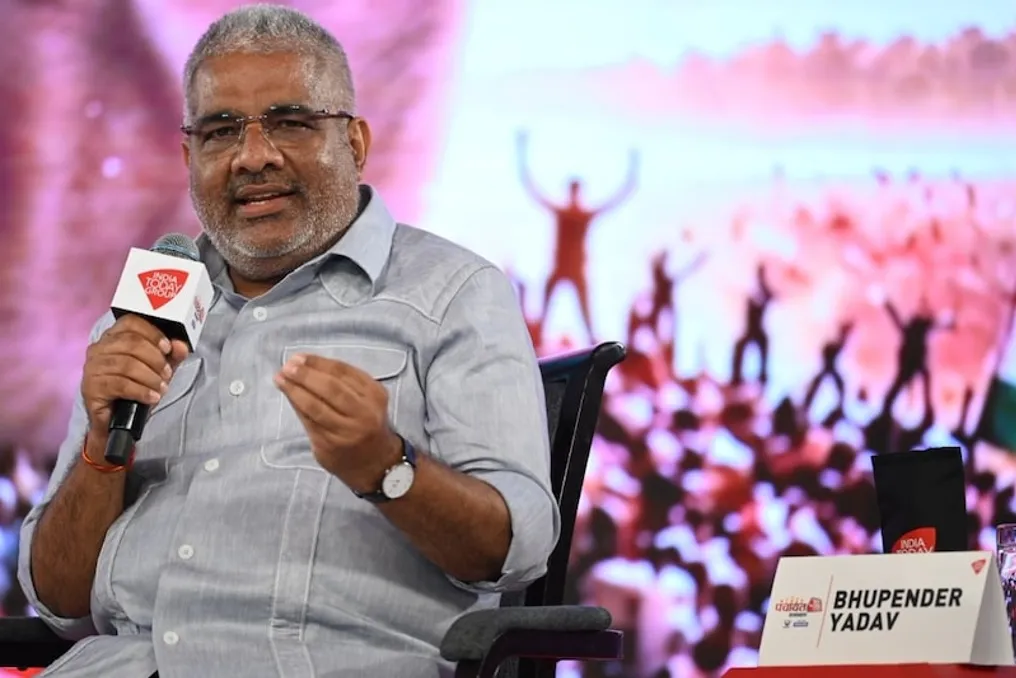
The Union Minister for Environment, Forest and Climate Change, Bupendra Yadav, participated in the Aajtak Panchayat Rajasthan event. During this event, he presented an action plan being implemented to clean the Delhi-NCR region from air pollution.
He emphasized that solving the pollution problem in Delhi-NCR will be achieved not only through meetings but also through effective on-ground actions, the application of modern technologies, and improved coordination between various departments. Yadav detailed the government's strategy.
Bupendra Yadav stated that the government has developed an 11-point plan that accounts for various sources of pollution. Special attention is given to managing transport emissions, industrial pollution, road dust, construction dust, and improper solid waste disposal. He also noted that 47 pollution hotspots have been identified in Delhi, and officials have been assigned responsibility for their monitoring and management.
According to Yadav, a unified action plan was developed jointly with relevant agencies after continuous meetings regarding the pollution problem in Delhi-NCR, held since February of last year. He stressed that the pollution problem cannot be reduced to a single cause; simultaneous work must be done on vehicle smoke, industrial emissions, road dust, particles rising from construction sites, and inadequate waste disposal.
Yadav clarified that the government's priority is to identify pollution sources, strengthen control over them, and establish accountability for the respective departments.
During the discussion, Bupendra Yadav stated that transport accounts for about 17 percent of Delhi's pollution. Numerous steps are being taken to control transport pollution. He mentioned the 'No PUC, No Fuel' system in Delhi, highlighting efforts to implement rules related to Pollution Under Control (PUC) certificates to ensure vehicles meet established standards.
Furthermore, he spoke about promoting electric buses to improve public transport. Yadav reported on efforts to increase the number of electric and CNG buses in Delhi, mentioning the recent inclusion of 150 electric buses. The government believes that strengthening public transport will help reduce dependence on private cars and decrease emissions.
Regarding industrial pollution, Bupendra Yadav stated that the government is intensifying control over emissions from industrial units. He reported that work is underway to connect approximately 350–400 industrial establishments to an online pollution monitoring system. Emphasis is placed on integrating the pollution control systems of these facilities with the Central Pollution Control Board (CPCB) monitoring system. He also mentioned taking action against enterprises violating rules in non-industrial zones.
Yadav added that the system for installing air pollution control equipment at industrial units and monitoring emissions is being strengthened.
Bupendra Yadav noted that road dust is a significant source of air pollution in Delhi-NCR. Great attention is being paid to regular road sweeping and mechanical cleaning to control it. He mentioned that a dashboard-based control panel has been developed for managing the operation of mechanical cleaning and sweeping machines in the integrated command and control center. The goal of this system is to track whether the machines are performing cleaning in designated areas and whether the relevant agencies are fulfilling their duties correctly. In Yadav's opinion, simply providing the machines is not enough; it is crucial to ensure their regular operation and the quality of cleaning.
Concerning dust generated during construction and demolition in Delhi-NCR, Bupendra Yadav presented the government's plans. He reported that technology is being used in Delhi to monitor construction sites. During the conversation, he mentioned monitoring about 170 construction sites, and pollution data related to these sites is included in the integrated monitoring system. He stressed that established measures must be followed to prevent the spread of dust from construction sites, and relevant agencies must focus on inspections and compliance.
Bupendra Yadav reported that 47 pollution hotspots have been identified in Delhi. Measures are being taken in these areas considering local pollution sources. He mentioned a visit with the Chief Minister, Reha Gupta, to pollution-affected areas such as Anand Vihar. In such areas, vehicle movement is monitored, as well as...
>