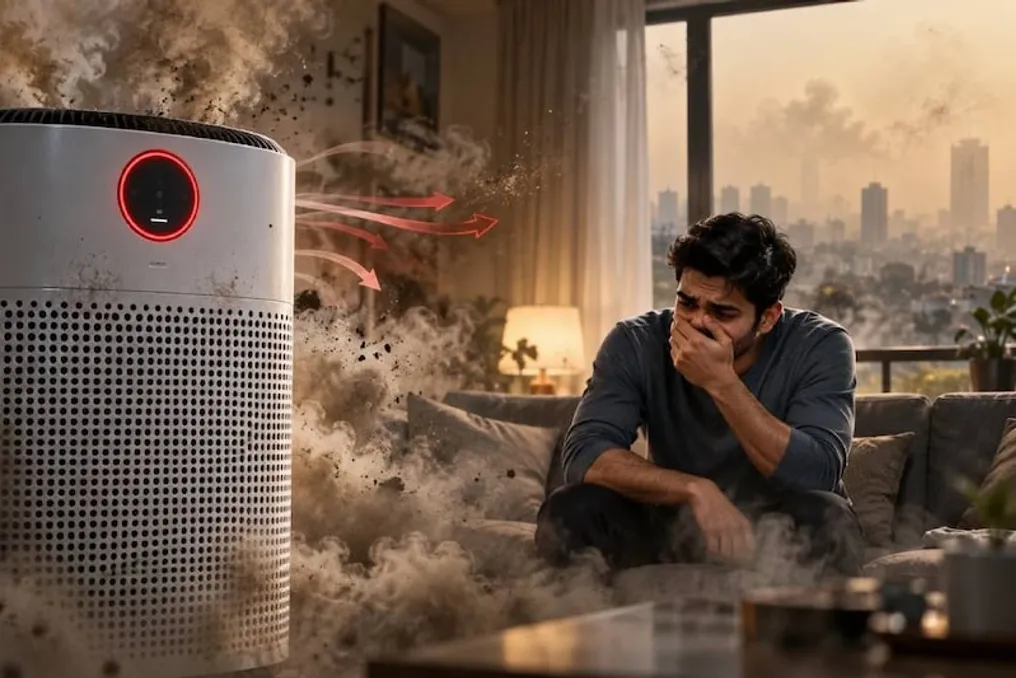
During the winter period, air quality in the Delhi-NCR region significantly deteriorates, leading to breathing problems for many people. When the Air Quality Index (AQI) rises, it can be harmful to health. To protect themselves from this, people install air purifiers in their homes.
However, if you do not check several important aspects before purchasing an air purifier, you might waste money. Below is a guide to five key points to consider when choosing a good air purifier.
The filter is the most important part of an air purifier. Therefore, when buying, you must check for the presence of a HEPA filter. HEPA stands for High Efficiency Particulate Air Filter. It helps remove fine dust particles and pollutants from the air.
A quality True HEPA filter is capable of filtering 99.97% of particles as small as 0.3 microns. Consequently, when choosing a purifier, you must ensure the type of filter installed and should not buy any purifier based solely on a low price.
When buying an air purifier, it is also important to know how quickly it can clean the air. For this, you should check the CADR rating, which stands for Clean Air Delivery Rate. This parameter shows the speed at which the purifier can provide clean air.
If the room is small, a purifier with a low CADR rating will suffice. However, for large spaces, a model with a higher CADR rating is preferable. For example, a model with a CADR of 100-150 may be suitable for a small room, whereas a large room might require a CADR of 200-300 or higher. Nevertheless, the correct rating depends on the room size and the capabilities of the purifier itself.
When buying an air purifier, it is crucial to consider the room size. If you buy a purifier designed for a small room for a large space, it will not be able to properly clean the entire volume of air.
Therefore, before purchasing, you should check the coverage area stated by the manufacturer. You must ensure that the purifier matches the size of your room. If you plan to use it in a large hall or extensive area, choose a model with a larger coverage.
It is not enough to look only at the initial price when choosing an air purifier. You also need to find out how often filters need replacement and what the cost of new filters will be. Some purifiers may have a low initial price, but their replacement filters can be expensive. Over a long period, this can increase the total cost.
Therefore, before buying, be sure to check the cost, replacement frequency, and availability of filters. This will help you assess the overall long-term cost of owning the air purifier.
Since the air purifier may run for many hours during the cold season to combat pollution, it is important to know how much electricity it consumes. Additionally, you should pay attention to the noise level of the purifier. If you plan to place it in a bedroom, it is better to choose a low-noise model so as not to disturb sleep.
Before buying, be sure to study the information on energy consumption, sleep mode, and noise level. If you are also considering buying an air purifier to protect against growing pollution in Delhi-NCR, be sure to take these five points into account. This will allow you to choose a suitable model for your needs and avoid unnecessary expenses.