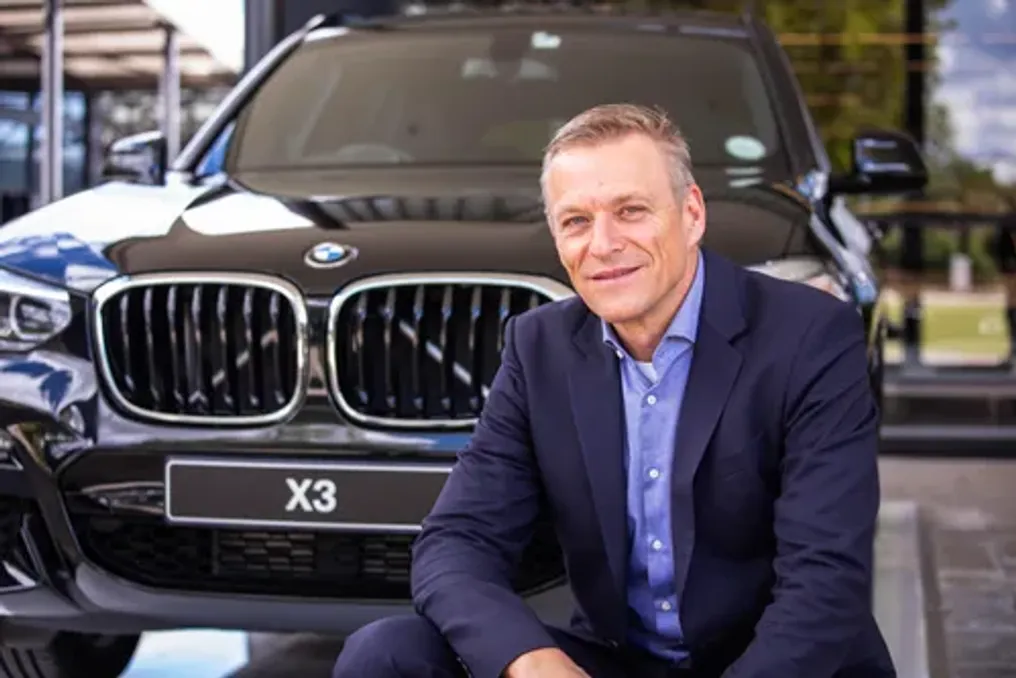
Peter van Binnebergen, Chairman and CEO of BMW Group South Africa, gave an candid interview to IOL during the SA Auto Week 2026 event. He presented a report with record figures but simultaneously issued a serious warning to the South African automotive industry that the local production base is under threat, despite neutrality being a strength.
Speaking at the conference, Van Binnebergen, who is a South African mechanical engineer and has worked for the German company for 32 years, reflected on leadership, consumer pressure, and how the next twelve months will determine the future of the industry.
Van Binnebergen's path to a leadership position was unusual: he started working at BMW South Africa as a graduate and never held an engineering position. He recounted starting in the after-sales department, then moving to marketing, and subsequently to sales. After this, he worked at the headquarters in Germany, then in Japan as head of the marketing department, returned to Germany to manage the home market, then handled after-sales globally, and only later returned to South Africa.
His life philosophy is: 'If a job doesn't cause you discomfort at the beginning, don't take it, because you won't grow.' He asserts that this breadth of experience is what gives BMW its strength, allowing employees to step out of their comfort zone, provided their families are ready to move countries again.
However, he clearly outlined a non-negotiable condition for those aspiring to lead the industry: 'At some point in your career, you must be involved in sales. Otherwise, you will never reach the top.'
Leadership in an economy of pressure
Discussing leading thousands of employees in a shrinking market, Van Binnebergen emphasized that a leader's task is not to know more about their people, but to help them achieve more than they think possible. He explained that his role is to help people surpass their perceptions of capability. He comes to work with ideas and questions, asking: 'Can't we try this? Can't we go beyond what you said you could do?'
He describes himself as someone who is not overly bureaucratic, makes quick decisions, and achieves results. At the same time, he insists on the need to implement new innovative approaches and achieve rapid market entry. This approach has been tested amid the cost-of-living crisis in South Africa. Van Binnebergen noted that for car owners, the increase in fuel prices felt 'much, much worse than interest rates' in terms of monthly impact.
In response, BMW built an ecosystem combining sales, after-sales, and financial services departments to mitigate vehicle ownership risks. He cited two examples. The first is the Prime minus 3 program for used BMW vehicles, which assists low-income customers. Consumers can choose a lease-like product where they use the car for three years and can return the keys without any debt, as BMW guarantees the future value. This is supported by what he calls 'peace of mind,' including the Motorplan program (5 years/100,000 km), pothole roadside assistance, and connected cars that proactively notify the customer of low battery or low tire pressure. His slogan: 'Relax, we take care of you. We look after you.'
Figures: Record Production and 96% Export
Van Binnebergen provided rare details about the Rosslin plant's operations. The plant is capable of producing between 75,000 and 80,000 vehicles annually, up to 85,000 units when operating on Saturdays and a three-shift schedule five days a week. Furthermore, about 96% of this volume is exported to 42 countries, while only about 4% remains in South Africa. Overall, BMW sells 13,000–14,000 units locally per year and shows year-on-year growth, leading in the premium segment.
Last year, Rosslin reached its highest production level: 79,200 vehicles. This also represented the highest local content level in Rand terms for BMW, meaning a larger volume of purchases from suppliers and the creation of more jobs. In one vivid story about geopolitics, he shared how South Africa's neutral status became a business advantage. He mentioned that Trump caused discontent in Canada with tariffs, after which Canada approached them requesting an X3 from South Africa because buying from them was cheaper than from the US, despite the distance. This is how the record was achieved.
He stressed: 'South Africa must be friends with everyone. We are not tied to anyone, and that is very good. We must remain that way.' The most pointed moment of the interview was the discussion of Chinese brands. Van Binnebergen clarified that BMW's joint venture in China serves exclusively China, and BMW does not import cars from China into South Africa. The X3 model is produced in China for China, just as it is produced in Rosslin for the world.
Nevertheless, he acknowledged a seismic shift: the share of Chinese brands in the South African market has grown from 0% to 25% in two years. He stated: 'They are definitely displacing local production. I wouldn't say they directly affect us because we are growing faster than the entire new car market. But they are definitely harming other brands. That is not good for South Africa.' He added that if a company stops selling a locally produced car because it is replaced by a foreign equivalent, jobs and suppliers are lost in the long run. He reported that BMW is in direct talks with Minister Parks Tau, responsible for dtic, ITAC, and the Ministry of Finance, to 'fine-tune the tools' of the Automotive Production and Development Programme (APDP).
His argument is twofold: firstly, existing investments must be protected to preserve jobs; secondly, the business case must be attractive enough for new entrants to start local production. He questioned why companies like GWM are not opening factories in South Africa, creating jobs and attracting suppliers, as Chery has done. He stated that he challenged Tony, demanding localization and joining forces so that everyone could benefit, ensuring economies of scale, deepening localization, and having a positive impact on the economy.
Invisible Investments Worth 4 Billion Rands
Regarding investments, Van Binnebergen pointed to the new hybrid X3: every hybrid X3 sold globally is produced in Rosslin as core business. However, he highlighted two often overlooked societal investments. One is education, where they collaborate with primary, secondary, and technical schools around Rosslin, colleges, and implement a STEM program with UNICEF, providing schools with computer labs, robotics, and programming. He noted that children in disadvantaged areas do not grow up dismantling lawnmowers, and they are trying to bridge this gap.
The second investment is BMW's IT hub in Midrand, which is the largest IT hub in the world for BMW. He explained that approximately 4 billion Rands annually flow into South Africa in the form of salaries. This money is used to pay for education, housing, clothing, and supporting large families. He emphasized that these funds could come from anywhere, such as India, but they are here, and this is often forgotten because it is not accompanied by a major presidential promise of investment.
Van Binnebergen directly stated the purpose of SA Auto Week: 'This is definitely an event for business and government, as well as for business and media, not for business and customers. We are here to talk to the government and the media and achieve change.' He noted that this is the first SA Auto Week where he feels the right audience is present, including government representatives at every panel. He added that the government is also saying things that show their years of work are bearing fruit. They are listening to each other, and now there is a chance to turn conversations into real action, otherwise, it is just a waste of time.
His measure of success is that decisions will be made and improvements will occur for the local industry within the next twelve months. A real test for him will be GWM's announcement of plans to open a factory in South Africa.