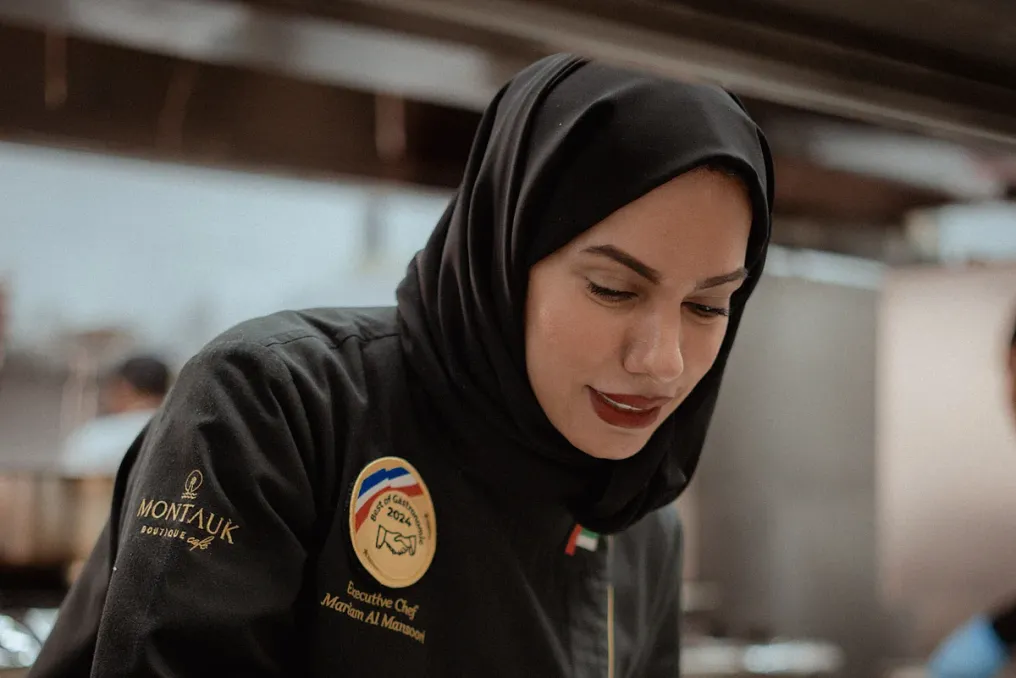
Mariam Al Mansouri began her career as an engineer in the oil and water resources sector. After getting married and having children, she felt a pull toward something else. She recalls those early years, saying: 'I didn't know what it would be,' before starting to read more about healthy eating and Emirati cuisine, which was encouraged by her husband and children who praised the dishes she cooked at home.
In 2019, she co-founded the Montauk restaurant in Abu Dhabi with her husband, which was later expanded to four additional branches. In 2024, she became the first Emirati citizen to receive a gold award in the 'Best Gastronomy' competition in France, and she also serves as a judge in culinary and Arabic coffee competitions. Alongside her business, she raises six children, and her nine-year-old son has taught hundreds of other children how to make pizza.
Al Mansouri notes: 'Engineering was a path, but cooking is a passion and an identity. The decisive moment came when I realized that true success lies not in following the safe road, but in having the courage to forge your own path.' In July 2025, she opened Kashtat Amina in Sharjah, her first restaurant dedicated entirely to authentic Emirati cuisine and named after her mother. She said she was waiting for the 'right time, right place, and right meaning' before opening.
The dishes in the restaurant draw inspiration from two kitchens of her childhood: her mother's kitchen, where instructions were passed down through scent and intuition rather than minutes, and her father's kitchen, where presentation and hospitality were the priority. She emphasizes: 'We learned Emirati cuisine at home, from our mothers and grandmothers. Today, my task is not just to preserve the recipe, but to preserve its story and identity, presenting it to a new generation in a way that honors its authenticity while fitting their time.'
Furthermore, she is developing a culinary academy and hopes to one day receive a Michelin recognition if the guide expands to Sharjah. She shares: 'Support gave me strength, and difficulties gave me experience. I went through difficult moments, but I realized that turning back was never an option; every difficulty became an opportunity to become stronger and more determined in proving my worth.'
This determination extends to the women on her team. 'I believe that knowledge is only complete when we pass it on,' she asserts. 'My goal is for every Emirati woman working with me to leave more confident, more skilled, and capable of building her own name and path.'
The advice she gives to a woman hesitating before taking the first step is: 'Don't wait for the road to be ready for you; build it yourself. Start, even if the step is small, and learn from every experience. The modern Emirati woman has everything she needs to take the global stage. What she needs first is to believe in herself.'
Meanwhile, the turning point for Abeer Al Luz happened far from any kitchen. A graduate of UAE University with a degree in business and holding an early entrepreneurship diploma from the Mohammed bin Rashid Establishment for SMEs, she spent years in the banking sector before realizing that her true calling lay elsewhere.
In 2018, she went with the UAE Red Crescent to Syrian refugee camps in Jordan, conducting baking workshops for children who had lost almost everything. She says: 'Every time I saw happiness on their faces, something became clear to me. I realized I had to start my own project. And I found myself in it.'
Upon returning, she launched Tajrubah in 2019—a learning platform whose mission goes far beyond baking. 'It is about giving people a few hours away from the burden of daily life,' she explains.
Tajrubah is distinguished by the question Abeer asks before developing each initiative: who is being left out? This question led her to work with elderly Emirati citizens baking English buns for the first time, and to planning activities for people in recovery involving a psychologist studying the therapeutic effect of baking.
This also led to one of Tajrubah's most memorable workshops, designed for participants with hearing impairments. 'People with hearing impairments need nothing,' she states. 'The only barrier is language.' She developed a full culinary workshop for deaf participants with support from RTA, featuring a professional interpreter in the center, despite not knowing sign language herself. 'Honestly, I still don't know it,' she admits. But she sat with the interpreter beforehand and learned key culinary terms she would need. 'They taught me as much as I taught them.' What happened was less like a workshop and more like a conversation that didn't require words. 'When I saw the smiles on their faces, I understood exactly why it mattered.'
She is currently working on a cookbook and a well-being study. Al Mansouri and Al Luz come from different worlds: an engineer who became a restaurateur, and a banker who turned into a social entrepreneur, but both built their work around one idea: properly made food suits everyone. For one, it is a dish passed down from her mother's memory. For the other, it is a workshop that requires no common language.