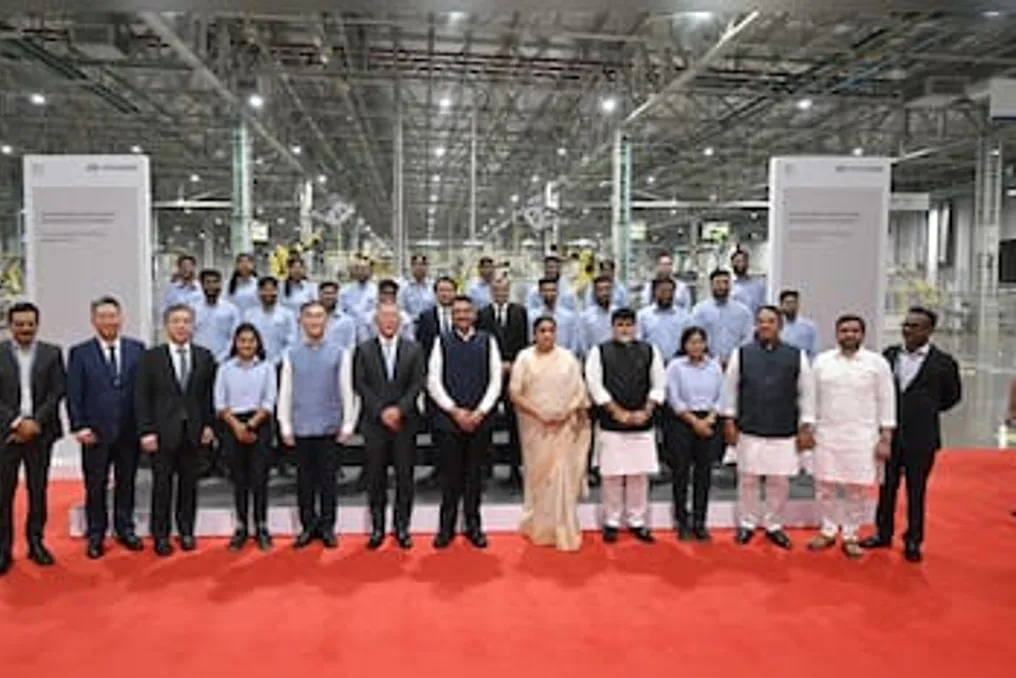
Hyundai Motor Company aims to restore its status as the second-largest passenger vehicle manufacturer in India by 2028-2029. To achieve this goal, the company intends to utilize increased production capacity, the launch of 26 new models, investments in electric vehicles (EVs), and accelerating the localization process.
The South Korean automaker, which previously dropped to fourth place in the market, expects the recently opened plant in Pune to play a key role in regaining its position. Global President and CEO José Muñoz stated that increased output from this facility will help Hyundai reclaim its spot, although product quality and competitiveness remain the main priorities.
Muñoz noted during the opening of the Pune plant on Wednesday that achieving the goal will depend on production: 'Regaining our position will depend on production. This plant will help us increase output, and once its capacity reaches 320,000 units, I think we can achieve this by 2028-2029.'
Currently, Hyundai Motor India (HMIL) has an established annual capacity of 170,000 units at the Talegaon facility in Maharashtra, which is planned to be phased up to 320,000 units by 2030. Combined with operations in Chennai, the company's total annual production capacity should approach 1.14 million units by 2030.
This expansion comes amid intensified investment plans by Hyundai Motor Group in India. On Tuesday, the group announced an investment of $15.5 billion between 2026 and 2032 in manufacturing, research and development (R&D), localization, technology, and new mobility business.
This announcement followed a meeting between the group's Executive Chairman, Euisun Chung, and Prime Minister Narendra Modi in New Delhi. This investment commitment covers the expansion of Hyundai Motor India and Kia India capacities, as well as technology and the broader automotive ecosystem. Company officials reported that about 60 percent of the investment will go to manufacturing, 20 percent to new technologies, including artificial intelligence (AI) and startups, and the remaining 20 percent to R&D.
To support additional capacity and regain market share, Hyundai plans to introduce 26 new models, including four electric vehicles by 2029. The company is also preparing to launch hybrid models, aiming to make 50 percent of its portfolio environmentally friendly by 2030.
Tarun Garg, Managing Director (MD) and CEO of HMIL, emphasized: 'Today you saw the capacity increase. As you know, we are going to launch 26 models to match this capacity so that we can regain market share.'
Localization is another key element of Hyundai's strategy to enhance competitiveness. The company aims to raise the localization level from the current 83 percent to 92 percent, with Maharashtra expected to play a vital role in strengthening the supplier base. Garg reported that Hyundai has committed to investing ₹11,000 crore in Maharashtra, of which ₹7,000 crore has already been invested, and another ₹4,000 crore is planned by 2030.
The Pune plant should also strengthen Hyundai's export business. Exports currently account for 24 percent of the company's production, up from approximately 20 percent five years ago, and Hyundai aims to raise this share to 30 percent. At the opening ceremony, HMIL also announced a cumulative export of four million passenger vehicles from India since 1999, making it the first automotive company in the country to reach this milestone.
Muñoz mentioned that this year India overtook South Korea to become Hyundai's second-largest volume market after the USA. Welcoming the expansion plan, Maharashtra Chief Minister Devendra Fadnavis stated that the investments will strengthen the state's manufacturing ecosystem and support job creation.
Fadnavis added: 'Hyundai's ongoing investments in advanced manufacturing technologies, innovation, localization, and skill development will contribute significantly to economic growth, job creation, and the development of a robust automotive ecosystem in Maharashtra. We welcome Hyundai's long-term commitment to the state and the country. The Government of Maharashtra will provide full support to Hyundai's future growth.'
Hyundai's supplier ecosystem has separately invested nearly ₹4,600 crore in the state. The company reported that 55 supplier partners operate in Pune, with nearly half of its procurement network located within a 50 km radius of the plant. The broader first and third-tier supplier ecosystem has created over 18,000 jobs in Maharashtra.
The new Hyundai Venue will be manufactured exclusively at the Pune plant, with plans to expand exports of this model to over 35 countries. Muñoz added that the company will move faster in product implementation and strengthening its market positions but declined to specify a concrete market share target.