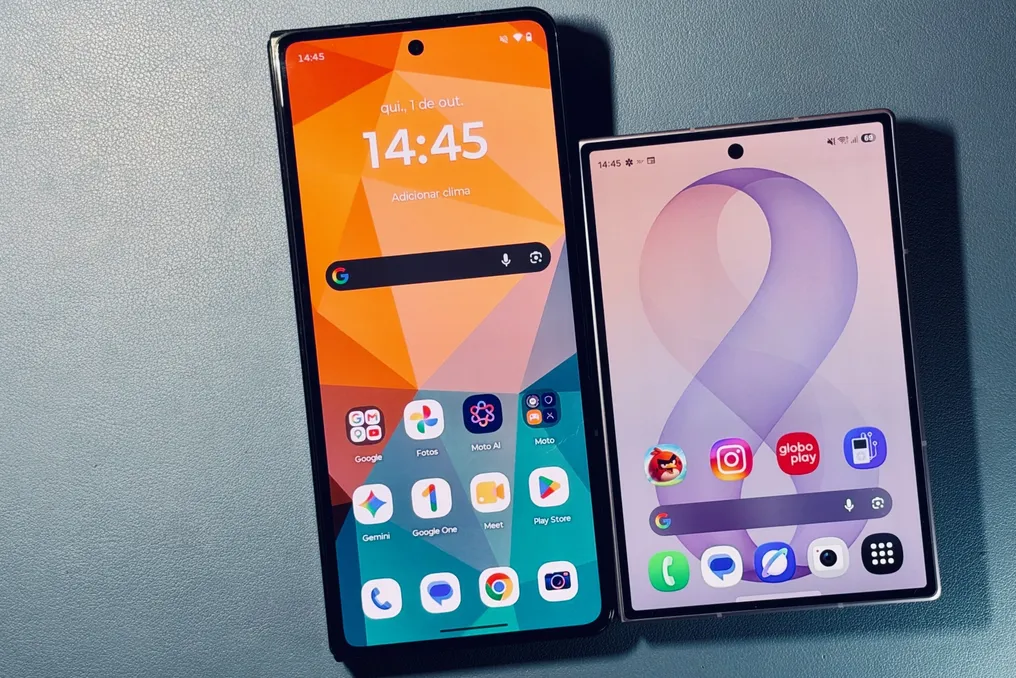
The Motorola Edge 70 establishes itself as a mid-range device focused on offering good cost-benefit in the 2026 market. Although it was launched in March with a price of R$ 4,499, it can currently be found in the R$ 2,000 range. With compact dimensions of 163 grams and only 6 millimeters in thickness, it stands out among the lightest and thinnest models in its category.
After testing the Edge 70 as a primary device for fifteen days, the positive and negative aspects of the model were detailed. Tecnoblog, an independent journalistic outlet since 2005, conducted this analysis without advertising intent, using a device loaned by Motorola, which will be returned after the tests.
Upon unboxing the Edge 70, the user finds the phone along with a 68W TurboPower charger and a USB-C/USB-C cable, indicating that Motorola includes a high-power charger in the box. The SIM card ejector key, manuals, and warranty term are also present. However, it is important to note that Motorola does not provide a protective case, which must be purchased separately.
The first contact with the Motorola Edge 70 is marked by its size: it weighs 163 grams, has a thickness of 6 millimeters, and proved comfortable to handle and carry. Its measurements are 15.9 cm in height by 7.4 cm in width. The body construction is made of aluminum, while the back uses a textured silicone coating that simulates nylon fiber, providing a firm grip and minimizing the risk of slipping.
The sides house the volume buttons, screen lock button, and a specific button for the brand's artificial intelligence features. However, the camera module represents a negative point, as it is quite prominent relative to the back of the device. When placed on a flat surface, the phone tends to tilt and wobble when touched on the screen, which can be mitigated by using a protective case.
In terms of durability, the Edge 70 has IP69 certification, guaranteeing protection against dust and high-pressure water jets, in addition to having military certification to withstand various usage conditions. During the tests, the device was submerged in fresh water for a few minutes and remained usable even with a wet screen.
The device also features stereo speakers but does not accept a microSD card. Therefore, users who opt for the 256 GB or 512 GB versions should carefully consider the need for long-term storage. Motorola offers finishing options in gray (received by Tecnoblog), grayish green, green, and a special edition with Swarovski, all with Pantone color certification.
The Motorola Edge 70 screen was praised for presenting vibrant colors and maintaining high brightness, even under intense sunlight. It is a 6.7-inch P-OLED panel with 1.5K resolution and up to 120 Hz refresh rate, which allows this frequency to be reduced to save battery. The panel supports HDR10 and HDR10+, optimizing contrast, brightness, and color saturation. Its maximum brightness reaches 4,500 nits, allowing clear viewing even under the strong sun of Ribeirão Preto/SP.
This panel is considered one of the biggest strengths of the Edge 70, especially for those who watch videos, browse a lot, or use the phone in outdoor environments. For impact protection, the screen is covered with Gorilla Glass 7i, designed to withstand drops of up to one meter on rough surfaces like concrete.
In terms of audio, the Edge 70 system generated some disappointment. The phone has two speakers located at the bottom and a third speaker at the top of the screen to complement the stereo audio and calls. Despite Dolby Atmos, the maximum volume is not the highest on the market. Tests also revealed a metallic timbre at times and little bass depth. While functional for conversations and spoken content, those who consume music, movies, or play directly through the speakers may notice the lack of power and less defined bass.
Looking at the back, the Motorola Edge 70 may give the impression of having more cameras than it actually has; in fact, there are two rear cameras and one front camera, all with 50-megapixel sensors. The main camera includes optical and digital stabilization. In daily use, it performed well in daytime photos and manages to maintain detail in low-light scenarios, such as backlit photos.
The second lens is an ultrawide, which also serves for macro photography. Autofocus assists in capturing close objects, and the wider field of view is advantageous for landscapes and groups. However, these photos show a slight loss of sharpness at the edges. All cameras, both rear and front, record video in 4K at 60 frames per second with good stabilization, and the camera app offers modes such as automatic, professional, and high-resolution HDR. At night, the main camera preserved the colors of the lights well, resulting in reasonably clean images, although with some reflections and subtle loss of detail.
The front camera showed less uniform results. Selfies lost texture and detail, especially in challenging lighting conditions. A notable point is the absence of a dedicated telephoto lens; zooming is done digitally, maintaining satisfactory quality up to 2x, but the loss of definition becomes more apparent above this level. Portrait Mode also requires attention to framing, as the blur showed flaws at the edges on certain occasions, resulting in a less natural look.
In summary, the main camera is the strong point of the photographic system. The ultrawide expands possibilities but has limitations at the edges, while selfies, portraits, and zoom expose the device's weaknesses.
Motorola Edge 70 Camera Specifications:
The overall performance of the Motorola Edge 70 is adequate for various activities, ranging from daily use to gaming and social media editing apps. It is equipped with the Snapdragon 7 Gen 4 processor, manufactured in 4 nanometers, along with the Adreno 722 GPU and 12 GB of RAM. The available internal storage is 256 GB or 512 GB, without support for a microSD card.
In daily use, the Edge 70 managed multitasking well, running applications such as Instagram, browser, Spotify, and YouTube in the background without freezing during tests. The smartphone also supported video editing in CapCut and more demanding games. In Fortnite, with maximum graphics, the frame rate fluctuated between 30 and 45 frames per second. This demonstrates that the phone runs heavy games, but without reaching the same performance level as more gaming-focused models, and it heated up quickly during intensive tasks.
Benchmark tests on Geekbench registered 930 points in Single-Core and 3,445 points in Multi-Core. These scores were below the Galaxy A57, which uses a newer processor and competes in the same price range. The Single-Core score evaluates single-core performance, ideal for simple tasks, while Multi-Core measures the total capacity of the processor, crucial for rendering and video editing.
Despite this, practical results confirm that the Edge 70 offers sufficient performance for daily use, video editing, and gaming, provided the user does not expect extreme firepower in more demanding titles. The device comes pre-installed with Android 17, promising up to three versions of Android updates from the manufacturer, lower support than offered by competitors like Samsung, which guarantees up to six years of updates on some models.
Navigation in the Motorola interface is clean and free of intrusive ads, showing only the brand's standard applications. Among the artificial intelligence features, the Edge 70 integrates Gemini and Qira, Motorola's proprietary AI, accessible via the physical side button. During tests, the AI showed response limitations in some interactions, making the experience less consistent than the rest of the interface.
The system also includes the Dynamic Island feature to display notifications, music, and other activities at the top of the screen. Contactless payments are possible via Google Wallet and NFC, and Android Auto worked without problems. For security, the Edge 70 offers facial recognition and an in-display fingerprint reader. The biometric sensor registered good unlocking speed and maintained functionality even with wet fingers.
Regarding power, the Edge 70 has a 4,800 mAh silicon-carbon battery, a technology that allows for high capacity in a thin 6-millimeter body. In terms of autonomy, the device supported 20 hours of uninterrupted video streaming and, in daily use, lasted approximately one and a half days without recharging. The 68W charger, supplied in the box, completed the charge from zero to one hundred in exactly 49 minutes. Additionally, the smartphone supports 15W wireless charging.
The Edge 70 offers a complete connectivity package, including support for 5G networks, NFC, Wi-Fi 6E, Bluetooth 5.4, and Nano-SIM or eSIM connection options. In practice, this set meets the essential needs of a modern smartphone, covering contactless payments, advanced wireless connectivity, and latest generation mobile networks.