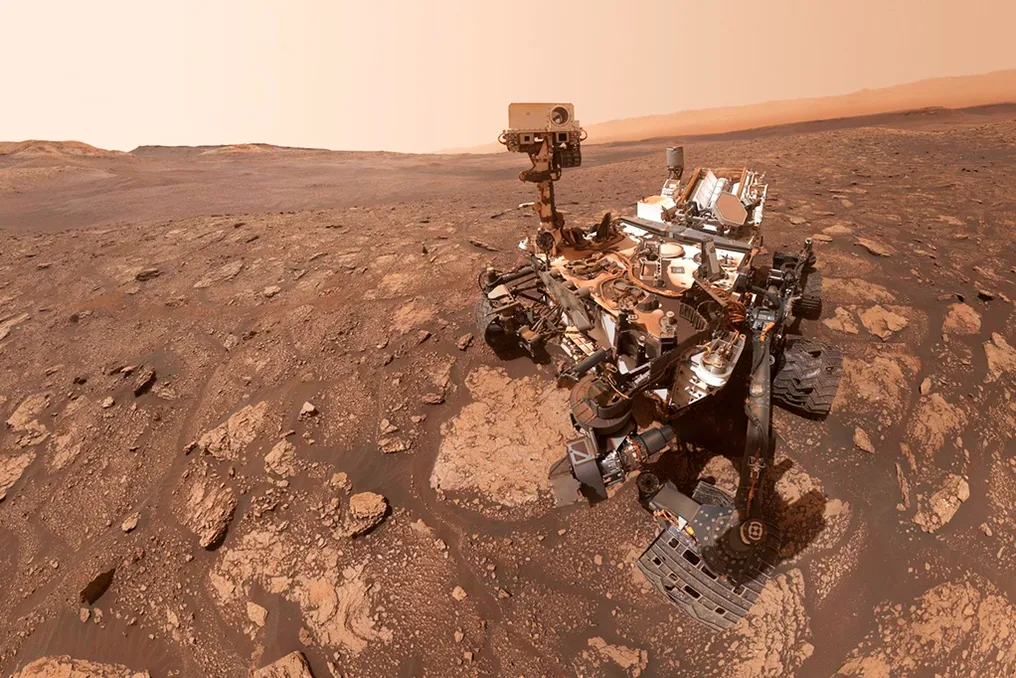
The NASA Perseverance rover has achieved the status of the vehicle that has traveled the greatest distance on the surface of a planet outside Earth. According to the American space agency, last Sunday (11th), it accumulated 45.2 km on Mars since its landing in February 2021, surpassing the previous record held by Opportunity, which was active between 2004 and 2018.
These robotic vehicles, known as rovers and compared to Pixar's character Wall-E, are designed to explore and collect scientific data on other celestial bodies. NASA has sent five of these rovers to Mars since 1997, each contributing significant discoveries to Earth.
In terms of distance comparison, Perseverance surpassed all previous ones. The first recorded rover traveled only 103 meters. Its successors showed much better results: Spirit, which operated from 2004 to 2010, traveled 7.73 km; Curiosity, active for over 14 years, reached 38 km; and Opportunity, which held the record, had reached 45.16 km.
NASA engineers predicted that Perseverance would break Opportunity's record as early as August. However, during its journey, the rover found light-colored rocks that may be some of the oldest studied on Mars. This led to a mission interruption for investigation, postponing the record recognition by approximately two months.
Despite the delay, the milestone is notable, as Perseverance covered this distance in just over five years, while Opportunity took almost fifteen years to cover it.
This achievement was made possible by nearly thirty years of technological progress. While early rovers required continuous commands from Earth, the current model uses autonomous navigation, making it more agile and robust than its predecessors. Currently, 90% of its journeys are conducted without any human intervention.
This system, called AutoNav, allows Perseverance to capture terrain images while moving forward, build a three-dimensional map of obstacles, and plot its route between reference points defined by planners on Earth. NASA describes this capability as the ability to 'think while driving.'
It is important to note that a rover is not controlled in real time by a joystick, but rather planned, programmed, and executed through instructions sent from Earth. Immediate manual control would be impractical due to radio signals taking minutes to travel between Earth and Mars (the journey can take from 4 to 22 minutes, depending on orbital positions).
In addition to mileage, Perseverance has generated other crucial scientific discoveries. Since its landing in Jezero Crater, an area of great importance on Mars, it has identified several traces suggesting the possibility of life on the red planet.
Initially, the rover detected a high concentration of organic matter and carbon molecules in rocks from Jezero Crater, in addition to confirming that the region went through at least three distinct geological epochs with the presence of water.
Subsequently, in September 2025, the existence of a probable biosignature was recorded, meaning a potential indicator of ancient microbial life. It is estimated that the reddish rock found formed between 3.2 and 3.8 billion years ago, representing the most promising clue about ancient life on Mars.
Currently, Perseverance will continue its exploration mission on the red planet, heading south towards Rainbow Falls, an ancient crust block one hundred meters wide.