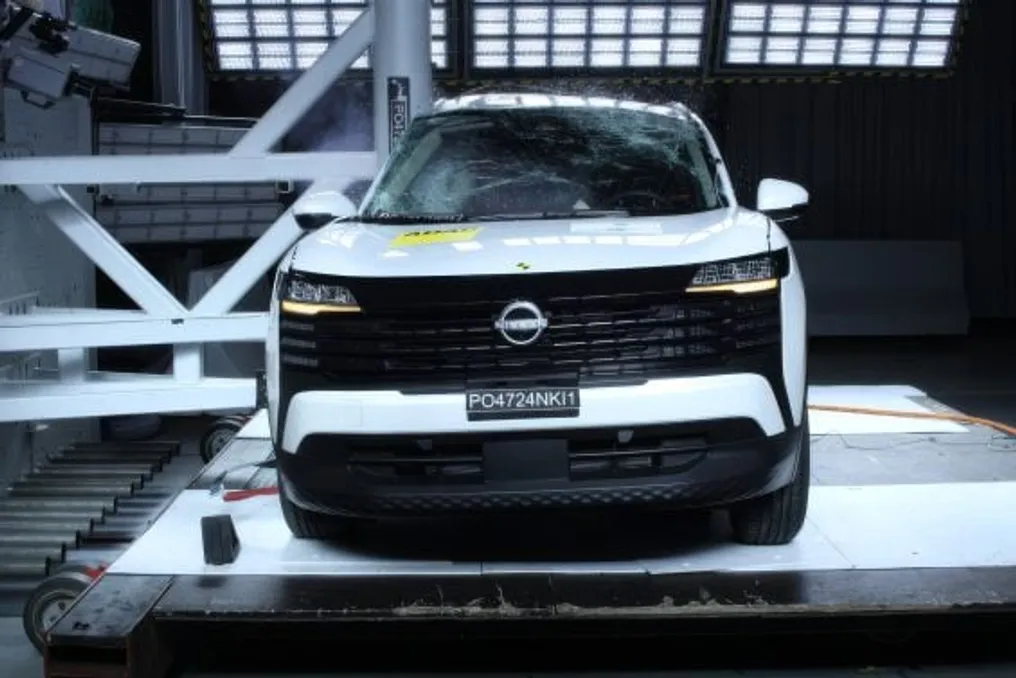
The Nissan Kicks manufactured in Brazil managed to maintain its maximum five-star safety rating and additionally corrected a serious deficiency identified in the model produced in Mexico, specifically related to a door opening during side impact tests.
This result was made public on Tuesday, the 13th, as part of an audit test conducted by Latin NCAP, a program responsible for evaluating the safety of vehicles sold in Latin America and the Caribbean. The execution of this test was a voluntary initiative by Nissan itself.
Previously, the imported version from Mexico had achieved five stars last year. At that time, Latin NCAP had indicated that it would test the unit manufactured in Resende (RJ) as soon as it entered the market.
During the evaluation carried out in 2025, it was found that one of the doors of the Mexican Kicks opened while the vehicle suffered a side collision. In response to this, Nissan implemented improvements in both the production lines in Brazil and in Mexico, ensuring that such a failure would not occur in the national model.
Despite preserving the five stars, the Brazilian Kicks obtained lower scores than its Mexican equivalent. In the metric for adult occupant protection, the score decreased from 90.32% to 86.29%, and in pedestrian protection, it dropped from 75.60% to 72.79%.
The audit pointed to the foot area as unstable and the protection against whiplash (the sudden movement of the neck after a rear impact) as marginal. For this latter point, Latin NCAP attributed the result to variations present in the seats of the national model. Furthermore, the driver's knee protection was classified as marginal, as they can come into contact with structures located behind the dashboard.
It is important to note that the audit followed the parameters established by the previous Latin NCAP cycle. The program is about to start releasing the first results of the updated protocol for 2026, which will be more rigorous.
All Kicks models are factory equipped with six airbags, electronic stability control system, and emergency autonomous braking function. Under the hood, the car features a 1.0 three-cylinder flex turbo engine generating 125 hp and 22.4 kgfm, coupled with a six-speed dual-clutch automated transmission. For the 2027 line, the SUV's values will see reductions of up to R$ 10 thousand, falling in the range of R$ 159,990 to R$ 189,990.