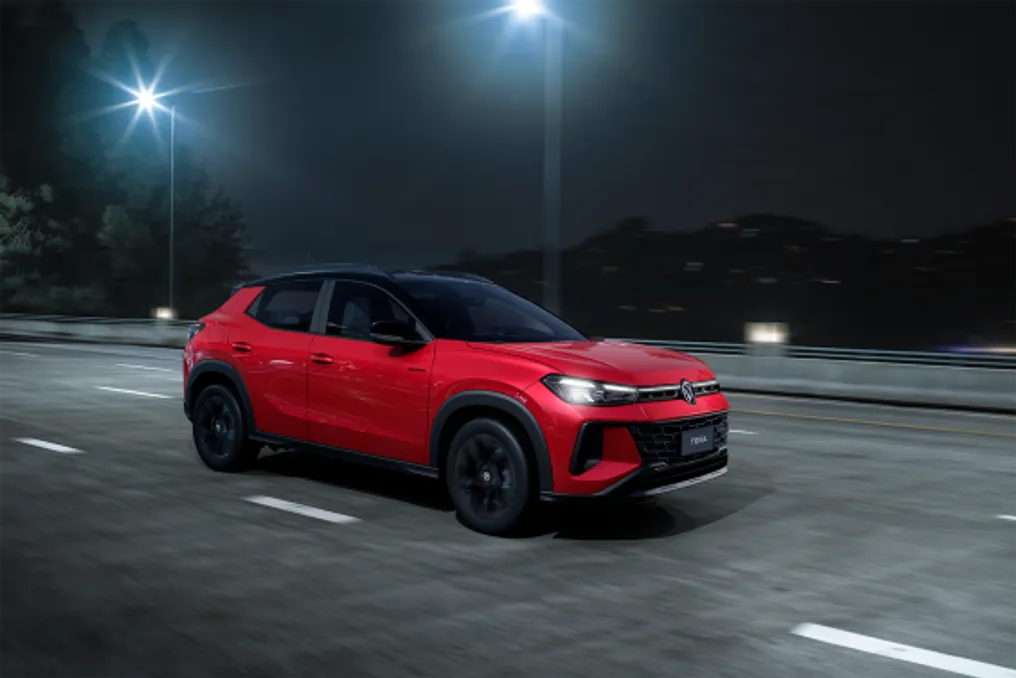
With changes in national vehicle taxation, which established a reduced IPI for models with up to 115.6 hp, there was a reduction in the power of 1.0 turbo engines. Volkswagen opted to maintain the power in its entry-level SUVs by using the 200 TSI engine in the Comfort and High versions of the Tera, which delivers 128 hp.
Renault also avoided power cuts in the Kardian, keeping its 1.0 turbo engine at 125 hp. In contrast, Stellantis decreased the power of its Turbo 200 engine from 130 hp to 116 hp, while Chevrolet's direct injection 1.0 turbo had its performance reduced from 121 hp to 115 hp in the Tracker.
Performance Analysis
For consumers looking for an entry-level SUV focused on performance, the Volkswagen Tera 200 TSI and the Renault Kardian remain. Both are recent and well-equipped models, and this comparison aims to determine which one is superior in the top-of-the-line versions.
The Renault's 1.0 turbo engine was launched in 2024 and stands out for having the highest torque in the category, reaching 22.4 kgfm with ethanol, which is 2 kgfm higher than the Volkswagen's 200 TSI and Stellantis's Turbo 200. Its performance approaches that of the Caoa Chery 1.5 turbo.
In terms of power, the Renault Kardian generates 125 hp with ethanol, which is 3 hp less than the Volkswagen's 200 TSI. When using gasoline, it surpasses its competitor by 4 hp, reaching 120 hp. A differential feature of the French engine is the use of a metal chain in the valve timing synchronization, which eliminates the periodic replacement required by the German model's timing belt.
The Volkswagen's 1.0 TSI has a long history in Brazil, having been introduced in 2015 in the Up TSI, which gives it a consolidated reputation for reliability.
The Volkswagen Tera, which previously only used the 170 configuration, now incorporates the 200 TSI in its more expensive versions. This more powerful engine is coupled with an eight-speed automatic transmission supplied by the Japanese company Aisin. This gearbox has a direct ratio in sixth gear, optimizing the use of engine power during acceleration and recovery. The seventh and eighth gears function as overspeeds to reduce RPMs during travel, promoting greater economy.
The Renault Kardian adopts a different approach in the transmission system, employing a six-speed dual-clutch gearbox. This configuration allows for smoother shifts and presents lower mechanical losses compared to a torque converter. Although both compact SUVs have very similar weights—Kardian at 1,186 kg and Tera at 1,189 kg—the final performance depends more on the vehicles' mechanical engineering.
Concluding the performance analysis, the eight-speed gearbox, which keeps the engine constantly at high RPM, combined with superior power, gave the Volkswagen Tera an advantage, regardless of the fuel type used.
Winner: Volkswagen Tera
Both entry-level SUVs are designed for daily use, making fuel consumption a relevant factor. Although they have the most powerful 1.0 turbo engines on the market, the Renault Kardian and Volkswagen Tera versions are among the most economical.
The competition was more balanced when considering consumption. In urban areas, the Kardian demonstrated better efficiency with gasoline, while the Tera stood out more on highways. However, the observed disparities are minimal according to Inmetro criteria.
Winner: Volkswagen Tera
Although entry-level SUVs may be derived from compact hatchbacks, this segment offers significant improvements in finish, as well as more equipment and advanced driver assistance systems (ADAS). The most complete models are the Volkswagen Tera High and the Renault Kardian Iconic.
The Tera High 200 TSI has an initial price of R$ 147,190 and comes equipped with various standard items. Volkswagen offers two optional packages for the Tera High: the Outfit, focused on aesthetics with a black roof and light gray seats, and the ADAS, which adds blind spot monitoring, rear cross-traffic alert, lane keeping assist, and lane departure warning.
The Renault Kardian Iconic is listed at R$ 140,990 and offers a similar set of equipment. Its only optional package includes connected services and other driving aids, such as fog lights, dusk sensor, automatic high beam, blind spot monitoring, front parking sensor, and 360° camera.
In terms of differentials, the Volkswagen Tera High features a photochromic interior rearview mirror, rear cross-traffic alert, lane keeping assist, and lane departure warning. The Kardian, on the other hand, is distinguished by offering electronic parking brake, 360° camera, fog lights, and automatic high beam.
Considering convenience factors and lower cost, the Kardian Iconic was pointed out as the winner. However, the Tera may be the ideal option for those who prioritize ADAS systems, as its optional package adds more functionalities than those offered by competitors.
Winner: Renault Kardian
The 200 TSI engine, combined with the eight-speed automatic transmission, provided greater vigor to the Volkswagen Tera. The German manufacturer's entry-level SUV demonstrates greater speed than its rivals and maintains efficient consumption.
The Renault Kardian approaches it in performance and consumption, but its main highlight lies in the cost-benefit ratio. In this dispute between top-of-the-line entry-level SUVs, the Tera justifies its higher value through its superior mechanical package.