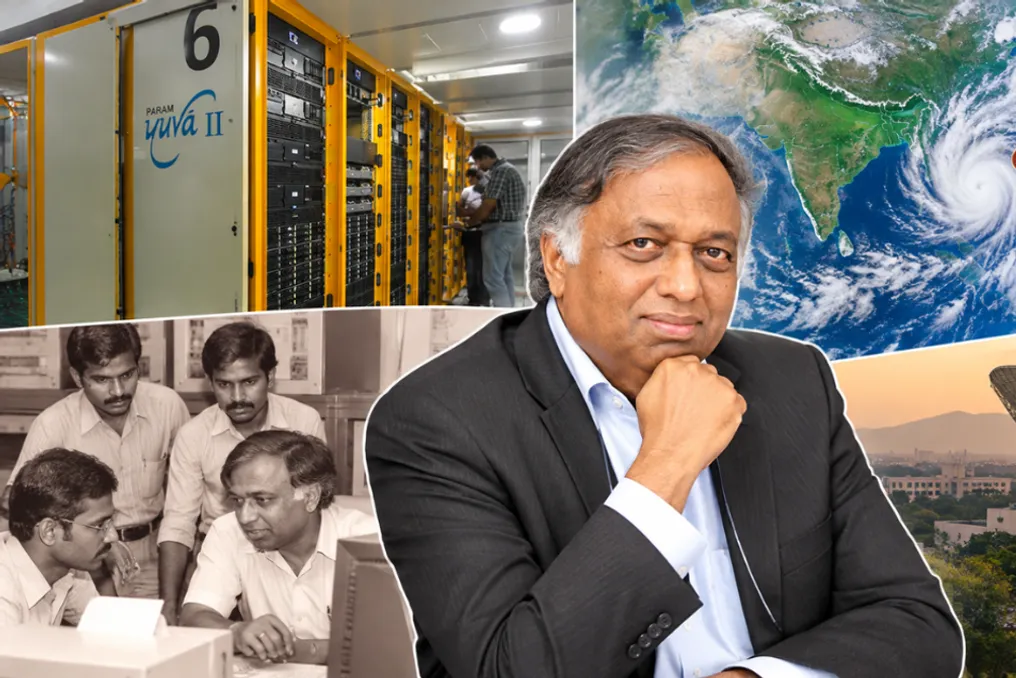
Supercomputers are machines capable of processing enormous amounts of information in mere seconds, which is critically important for tasks such as weather forecasting, analyzing satellite images of cyclones, or solving complex scientific problems. Unlike regular computers, which perform tasks sequentially or with limited parallelism, supercomputers can break down complex problems into smaller parts and process them simultaneously using thousands of computational operations.
In the late 1980s, India faced a need for such technologies. The answer came from a team of Indian scientists led by Vijay Bhatkar, who helped create PARAM—the country's first indigenous supercomputer.
When India was denied a supercomputer
In the 1980s, supercomputers were indispensable for defense, space research, scientific investigation, and meteorological forecasting. India required this computing power, especially to improve weather forecasts, which could help farmers adapt to changing conditions.
The country attempted to acquire a Cray supercomputer from the United States, but access was restricted because the technology was considered strategically sensitive due to its potential military application. Instead of depending on foreign developments, India decided to develop its own technology.
In 1987, the government tasked Vijay Bhatkar, an expert in electronics and computers, to lead this massive initiative. In 1988, the Centre for Development of Advanced Computing (C-DAC) was established in Pune to advance this mission. The task was colossal, as India had limited access to the necessary software, technologies, and specialized expertise to build a machine of this scale; the team had to develop these capabilities independently.
How Vijay Bhatkar and his team created PARAM
Bhatkar and his colleagues chose a different approach instead of simply replicating an imported machine. They focused on developing their own high-performance computing system that could deliver powerful performance using available resources.
One of the key principles underlying PARAM was parallel computing. This principle is analogous to solving a complex mathematical problem with several people simultaneously and then combining the results. In computer science, parallel processing allows multiple processors to work on different parts of one task at the same time, significantly speeding up calculations compared to traditional computers.
Creating such a system requires not only connecting processors; they must communicate effectively, coordinate their work, exchange data, and use specialized software to perform complex calculations. The C-DAC team worked on developing both the hardware and software necessary for this approach to function as an integrated system. As a result, a supercomputer was created based on India's own technological capabilities, rather than being entirely dependent on imports.
The first prototype was ready in 1990. The following year, C-DAC introduced PARAM 8000, which demonstrated a peak performance of one gigaflop, or one billion floating-point operations per second. This figure meant that scientists had obtained the necessary computational power to conduct complex simulations and numerical modeling.
PARAM 8000 was built using a parallel processing architecture. Its performance proved that India was capable of developing its own high-performance computing technology despite previous limitations. The name PARAM comes from the Sanskrit word meaning 'supreme'. The emergence of this system marked a turning point in the history of Indian scientific computing, after which C-DAC continued to develop subsequent generations of PARAM systems.
PARAM became the starting point for broader efforts to strengthen India's capabilities in advanced computing. Over many years, subsequent PARAM systems supported research in areas such as climate studies, engineering modeling, and weather forecasting. Recently, India's efforts in supercomputing have expanded through initiatives like the National Supercomputing Mission, which aims to create computational infrastructure and develop indigenous hardware and software.
The story of PARAM is not just the story of creating a faster computer; it is a demonstration of what is possible when scientists find solutions by overcoming technological barriers. When India could not easily obtain the supercomputer it needed, Vijay Bhatkar and his team showed that the country was capable of creating it independently, thereby laying the foundation for modern advanced computing capabilities that Indian researchers continue to develop.