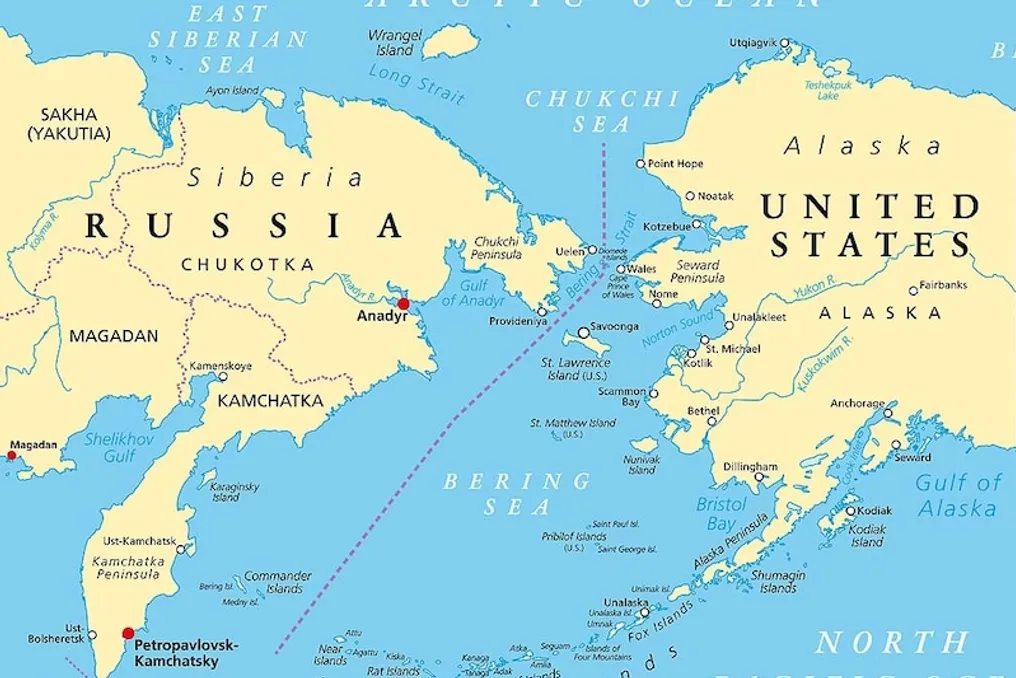
Despite the apparent stability of the Earth's surface, it is in a state of constant change as continents slowly drift. Russian scientists propose a hypothesis about the formation of a new supercontinent that could include Russia and America, which, although sounding incredible, is explained by scientific data.
The Earth's crust is divided into large sections known as tectonic plates. These plates float on the softer upper layer of the mantle and gradually slide. Although the movement is only a few centimeters per year, over millions of years this distance can reach thousands of kilometers.
According to Sergey Cherkasov, director of the State Geological Museum of the Russian Academy of Sciences, the Earth's surface is transforming faster than previously assumed. Continents go through a cycle of gathering into a single supercontinent, after which they break apart again. This cycle repeats every 40–60 million years, and the planet is currently in the middle of such a cycle.
Scientists consider the most likely scenario for continental merger across the Atlantic Ocean, as this ocean tends to gradually shrink. When the Atlantic narrows, America will approach Europe and Asia. As a result, with the exception of Antarctica, all other continents could gather into a single supercontinent in the Northern Hemisphere.
As part of this process, a significant part of Eurasia, meaning Europe and Asia, may split into two parts along the so-called Pan-Asian Rift, which runs near Lake Baikal. A large part of Russia's territory could potentially connect with North America. Lake Baikal is the deepest freshwater lake in the world and is located in an active rift zone.
A rift is an area where the Earth's crust tears and splits into two parts. In the future, this crack may widen, dividing Eurasia into two segments: one will shift west, and the other east. Eastern Russia may move towards North America, and they could merge. This process will be so slow that people will not notice it during their lifetime, but for geologists, it is an extremely important change.
Cherkasov predicts that the continents will merge again in about 20–30 million years. This period is very long compared to human history, which amounts to only a few hundred thousand years. By then, the map of the Earth could change drastically, including mountains, oceans, and climate.
The formation of a supercontinent will have a profound impact on ocean currents, weather, and life, which could lead to the extinction of some species and the emergence of new ones. Such cycles have occurred before; millions of years ago, the supercontinent Pangaea existed and broke up into modern continents.
Currently, this phenomenon has no direct impact on daily life. However, it serves as a reminder that the Earth is alive and constantly changing, and earthquakes, volcanoes, and mountain formation are consequences of these movements. Scientists study these processes to predict future earthquake zones and climate changes.
The geological convergence of Russia and America has nothing to do with political or human history; it is a purely natural process. The history of the planet shows that no continent remains motionless forever.
This study provides additional information about the dynamics of the Earth. Plate tectonics theory continues to be strengthened by measurements of plate movement speed using satellites and GPS. Monitoring activity in the Baikal region remains critically important for scientists, and future research will allow for refinement of this picture. The fate of the Earth depends on this 'dance' of continents, and although the merger of Russia and America is a distant prospect, it is considered almost inevitable from a scientific point of view.